

Unlock a practical path to feeling more vibrant each day. The term energy comes from the Ancient Greek energeia, which means activity or operation. That idea helps us see how inner strength becomes visible in our aura and actions.
In 1783 the modern word began to describe the capacity for work and the creation of light. Knowing that history lets you trace how different forms energy takes shape in daily life.
Every body has a unique frequency you can tune. For example, the heat from metabolism shows the power you expend when you move. With mindful habits and better time use, you can shape the force you project to stay balanced.
These words and ancient concepts give a clear foundation. Use them to explore how the varied forms of energy interact within your mind and body, and to grow the strength of your personal aura.
Key Takeaways
- Origins of the term explain how action links to aura and behavior.
- Modern use of the word ties to work and the production of light.
- Your body’s heat and movement reflect the power you use each day.
- Managing time and habits helps balance the force you project.
- Simple, ancient ideas offer a practical path to boost personal strength.
Understanding the Fundamental Nature of Energy
At its core, the physical concept measures how much work a system can do. This definition helps us link observable change to a clear, quantitative idea.

Defining the Concept
Scientists describe this property as a measurable quantity transferred to a body or system. It shows up whenever an action causes movement, heat, or a shift in state.
The Capacity for Work
The ability to perform work is the primary meaning here. When you apply force to an object, you demonstrate a direct transfer of that property.
- Aristotle’s idea of energeia laid early groundwork for modern thought.
- Every system needs specific power to function and maintain motion.
- Studying the capacity for work reveals how this property is conserved and transferred across systems.
For a practical guide on how these principles relate to personal and spiritual practice, see this energy healing guide.
The Scientific Definition of Energy
Physicists treat this property as the measurable agent behind all physical change.
The conservation law states that this quantity can change form but is never created or destroyed. Over time, systems convert it from one type to another while the total remains constant.
In 1845, James Prescott Joule showed the link between mechanical work and heat. His experiments proved that performing work produced measurable thermal change.
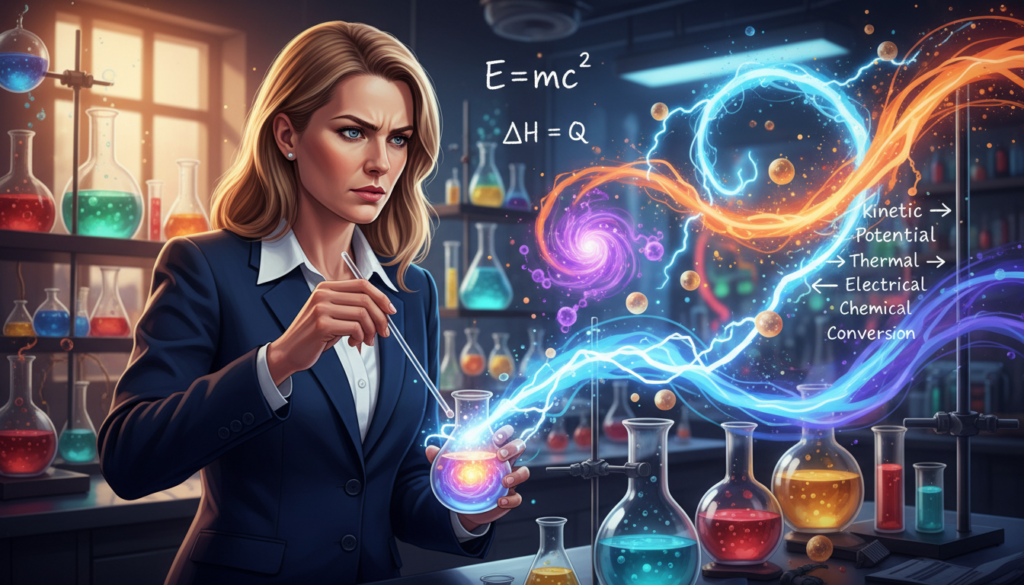
Scientists measure this quantity to calculate the force needed for specific interactions. That ability to measure makes engineering and controlled experiments possible.
- The concept centers on production of physical change within systems.
- It is a conserved quantity in isolated systems.
- Understanding energy work guides how we harness power in technology.
| Concept | Implication | Example |
|---|---|---|
| Conservation | Total remains constant | Closed system heat transfer |
| Work–Heat Link | Work can become heat | Joule’s paddle-wheel experiments |
| Measurement | Calculates force and output | Laboratory calorimetry and motors |
For practical applications that tie science to personal practice, explore this guide to scalar modalities. It connects measurable principles with techniques used in modern healing contexts.
Exploring Different Forms of Energy
Different physical forms show how activity moves and stores potential across systems. Understanding these categories helps you see which sources best serve daily life and larger systems.

Kinetic and Potential
Kinetic refers to motion. Anything that moves has kinetic capacity to do work.
Potential is stored capacity, ready to release as motion or work. Together, kinetic and potential make the base for most other forms and common sources in nature.
Thermal and Radiant
Thermal describes the microscopic motion of particles; higher particle motion means higher heat. This is why friction raises temperature.
Radiant is carried by electromagnetic waves, like visible light and infrared. Sunlight is a major example that supplies both radiant and thermal effects.
Chemical and Nuclear
Chemical storage sits in bonds between atoms. Breaking bonds releases power for engines, metabolism, or batteries.
Nuclear binds nucleons inside the atom. When altered, it releases massive output, as seen in reactors or stellar cores.
- Lightning can convert roughly 500 megajoules of electric potential into light, sound, and thermal heat.
- Electricity, often from solar or wind sources, powers modern life and links many forms.
- Elastic storage in solids is an example of force that returns an object to shape.
How Energy Functions in the Physical World
The physical world operates by moving stored capacity into motion and back again.
Total system capacity can be split into potential and kinetic parts. Scientists call the full sum the Hamiltonian. It helps predict how objects behave over time.
Motion often produces heat when friction or resistance is present. That heat is a disordered form of mechanical output released when work is done.

Mechanical energy combines translational and rotational motion. For example, a spinning wheel holds rotational kinetic capacity plus any stored potential from its height.
- Forces like gravity and electromagnetism show how capacity interacts with matter.
- Classifying different forms helps track how power moves through systems.
- The constant swap between potential and kinetic defines motion and change.
| Concept | Role | Example |
|---|---|---|
| Potential | Stored capacity ready to become motion | Raised mass on a shelf |
| Kinetic | Active motion doing work | Rolling ball |
| Mechanical | Sum of motion forms | Spinning turbine |
| Thermal | Disordered mechanical output | Friction warming a brake |
The Role of Energy in Biological Systems
Life on Earth depends on a steady flow from the Sun that plants turn into usable fuel. This conversion makes the base of food webs and supports complex life.

Photosynthesis and Cellular Respiration
Photosynthesis captures radiant light and transforms carbon dioxide and water into carbohydrates. These molecules act as stored chemical potential that other organisms use as food.
Mitochondria in eukaryotic cells then release that stored power. They use oxygen to process nutrients and produce ATP, the molecule cells rely on for work.
“Plants turn sunlight into the fuel life uses, and cells unlock that fuel to do the work of life.”
- Sunlight captured by plants creates the primary sources of food.
- When organisms consume food, catabolism frees the stored chemical energy as usable power.
- Heat is produced as a byproduct of metabolic pathways and helps keep body systems ordered.
Over time, these processes evolved to improve capture and conversion across habitats. To explore related concepts of color and healing, see color of healing.
Human Metabolism and Daily Energy Expenditure
Basal metabolic rate for an average adult runs near 80 watts. That is the steady power the organs need to keep you alive and functioning at rest.
Metabolism converts food into usable output measured in kilojoules or calories per day. Most adults need about 1,600 to 3,000 calories daily to maintain the body and do normal work.

The MET scale compares activity against a baseline of 3.5 mL oxygen. It helps show how much extra the body uses when you move or exercise.
For example, a fit person can briefly produce about 1,000 watts, far above the 80-watt basal rate. Much of that output appears as heat, since the body sheds excess to keep systems ordered.
- Every action, from sitting to sprinting, draws precise fuel from nutrients.
- Knowing these forms of expenditure helps plan meals and rest across the day.
- Track activity and calories to optimize performance and recovery.
“Understanding how your body spends power makes it easier to support health with smart choices.”
To learn practical ways to balance internal resources, try techniques that help you channel your healing energy in daily routines.
Harnessing Energy to Boost Your Aura
Small shifts in daily practice can raise the frequency you carry into a room. Start with clear intent and steady breath to make subtle but visible changes in how you feel and how others respond.

Vibrational Frequency and Aura
Vibrational frequency is a way to describe your inner tone. When you calm thoughts and steady emotion, your field feels brighter to people nearby.
Focus on posture, breath, and short pauses. These habits change the forms of attention you send out and help your body relax.
Positive Spiritual Force
Projecting a positive spiritual force means choosing kindness and steady focus. Over the day, small acts of care raise your strength and invite better moments.
Practice short rituals — a mindful pause, a kind word, or a grounding breath. They shape the power you radiate and help you stay aligned.
- Align intention with actions to influence people gently.
- Use emotional stability and mental focus as practical tools.
- Repeat short practices each day to build lasting resilience.
| Practice | Purpose | Result |
|---|---|---|
| Mindful breathing | Steady attention | Calmer presence |
| Posture reset | Grounding the body | Clearer projection |
| Kind action | Signal positive intent | Stronger social bonds |
For techniques on sending calm and support, learn how to send healing to others and refine your practice.
Historical Perspectives on Energy Concepts
Scholars across centuries reshaped the idea of active force, turning Aristotle’s ancient energeia into a scientific term used by modern thinkers.

Key milestones mark how the word and the idea moved from philosophy to lab work. In the 4th century BC, Aristotle used the Greek word to mean activity and operation. Later, Leibniz proposed vis viva to capture moving bodies.
Émilie du Châtelet then argued for conservation in her 18th-century work. Thomas Young is credited with early modern usage around 1807. James Prescott Joule sealed a major shift in 1845 by linking mechanical work to heat.
“The shift from caloric theory to a measurable concept changed how scientists treated motion and change.”
- Aristotle: energeia describes action and function.
- Leibniz: vis viva frames motion as living force.
- du Châtelet: conservation ideas in translation and theory.
- Joule: experimental proof connecting work and heat.
| Milestone | Implication | Example |
|---|---|---|
| Aristotle (energeia) | Words tied action to purpose | Philosophical framing of motion |
| Leibniz (vis viva) | Quantified motion as force | Early mechanics of moving bodies |
| du Châtelet | Conservation concept refined | Translation and theoretical argument |
| Joule (1845) | Linked work to measurable heat | Experiments showing heat from work |
Studying these historical forms helps us see how shifting words and models led to modern science. For a related look at how ideas and intent shape practice, see how words guide attraction.
Measuring Energy in Modern Science
A single common unit lets researchers translate mechanical effort into precise numbers. Standard measures make experiments repeatable and allow clear comparison across labs and industries.
The Joule and SI Units
The joule (J) is the SI unit defined as the work done by a force of one newton through one meter. This definition ties force and distance to a concrete value.
One kilowatt-hour equals 3,600,000 joules, showing how power over time converts to total output. Scientists also use units like the erg or foot-pound when context or tradition calls for alternative measures.
For example, Joule measured the mechanical equivalent of heat with a paddle in water. That classic test linked mechanical work and thermal change and helped standardize how we count heat and work.
- Standard units ensure the same word means the same thing in every field.
- Accurate measures let engineers calculate the force needed for complex systems.
- Consistent units optimize the production and use of resources across science and industry.
Practical Tips for Managing Your Personal Energy
Being mindful about food, rest, and surroundings makes a real difference in how you feel through the day. Start by tracking what you eat and drink so you can see which sources fuel your focus.

Keep regular meals and prioritize whole food. Hydrate with plain water and avoid long gaps between snacks; your body signals will be clearer. Sleep on a steady schedule to rebuild strength each night.
- Note simple sources of fuel: meals, rest, and gentle movement.
- Cut needless waste of electricity and excess heat at home to feel more connected to what you consume.
- Spend time with positive people; their mood lifts yours and saves mental power.
Listen to your body. When you feel low, rest; when you feel alert, use that moment for focused work. These practical habits take little time but add steady gains in daily resilience for any person.
Conclusion
Conclusion
Understanding how motion, heat, and light connect helps you use small choices to gain real results. We explored the basic ability to do work, how different forms energy takes, and how those forms shape body and mind.
Remember practical notes: food fuels metabolism, the heat your body gives off matters, and steady habits save wasted work over time. The words and the single word we use to name these forces carry a long history and useful meaning.
Use this guide to grow daily strength. Apply simple practices and watch how your internal force shifts and supports a brighter, more balanced life.
FAQ
What does the term "power" mean in everyday life?
Power refers to the ability to do work or cause change. In daily use, it can mean physical strength, the output of an appliance measured in watts, or personal vitality that helps you act and make decisions. Think of it as the capacity that turns effort into results.
How does the concept of work differ from heat?
Work involves force applied over a distance to move an object, while heat describes transfer of thermal motion between things at different temperatures. For example, lifting a box is work; warming your hands by a mug is heat transfer.
What are common sources that provide usable power?
Everyday sources include sunlight, fossil fuels, wind, flowing water, and food. Sunlight fuels photosynthesis, coal or natural gas run many plants, wind turbines capture motion, hydroelectric dams use falling water, and food fuels the human body.
How do kinetic and potential forms differ?
Kinetic form is tied to motion — anything moving has it. Potential form depends on position or configuration, like a stretched spring or an object held high above the ground. Motion converts potential into kinetic and vice versa.
Why do thermal and radiant forms matter for comfort and technology?
Thermal form controls temperature and comfort; radiant form carries light and electromagnetic waves. Radiant sources like sunlight provide light and warmth, while thermal systems keep buildings comfortable and drive engines.
How do chemical and nuclear processes release power?
Chemical processes break and form molecular bonds, releasing or absorbing heat — think burning wood or metabolizing food. Nuclear processes change atomic nuclei, releasing far greater amounts of power per unit mass, used in nuclear reactors.
How does this concept operate in the physical world?
It follows conservation: total amount remains constant but shifts between forms. Forces cause transfer and transformation, such as mechanical work becoming heat through friction, or stored potential turning into motion.
What role does this play in plants and animals?
Plants capture light and convert it into chemical stores via photosynthesis. Animals break those chemical stores through cellular respiration to power movement, growth, and repair. This cycle fuels ecosystems.
How does human metabolism relate to daily expenditure?
Metabolism converts food into usable fuel for basal bodily functions and activity. Daily expenditure includes resting metabolic rate, physical activity, and digestion. Balanced intake and activity influence how much you have available for tasks.
Can practices boost a person’s vibrational frequency or aura?
Practices like mindful breathing, regular exercise, adequate rest, and a healthy diet can improve mood, clarity, and resilience. Those changes often feel like an uplift in personal presence or vibrational quality.
What is meant by "positive spiritual force" in this context?
That refers to attitudes and behaviors that foster well-being: compassion, gratitude, and focused intention. Such practices tend to improve relationships and mental state, which people describe as a stronger, more positive presence.
How have views about this concept changed over time?
Ancient thinkers often tied it to life force or vitalism. Over centuries, scientists developed measurable models — work, heat, and motion — leading to the formal laws of thermodynamics and modern physics.
How is measure defined in modern science?
The joule is the standard SI unit for work and thermal transfer. Instruments like calorimeters, dynamometers, and power meters quantify transfers, allowing consistent comparisons across experiments and devices.
What practical tips help manage personal levels throughout the day?
Prioritize sleep, stay hydrated, eat balanced meals, and take short movement breaks. Set realistic task blocks and use deep-breathing or brief stretches to reset focus. Small, consistent habits preserve capacity and prevent burnout.