

Ingo Swann coined this phrase during a 1971 experiment that helped shaped later work, including the Stargate Project.
Think of the target as the focal object that guides a viewer’s impressions. It can be an image, a room, a person, or a natural scene. An envelope often holds images so attention stays fixed on one item.
During practice, a remote viewer quiets mind and records colors, patterns, textures, and simple details on paper. These impressions form raw data to review later. With time and training, access to clearer information improves.
This guide will cover history, examples from experiments, and ways to strengthen abilities through steady practice. By letting go of stray thoughts, viewers often gain richer perception and better results.
Key Takeaways
- The target acts as a focus point for impressions and sensory notes.
- Ingo Swann helped popularize the term during early experiments.
- Envelopes and simple tools help viewers hold attention on one image.
- Practice, calm mind, and review of paper notes improve accuracy.
- Programs like Stargate showed structured study over many years.
Understanding What Is the Target in a Remote Viewing Session
A clear focal point helps a practitioner gather impressions and stay anchored during practice.
Defining the Concept
In structured practice, the target acts as a single subject that the viewer attempts to perceive. Think of it as a mental marker that guides attention toward details. Over time, that marker becomes more than an image; it becomes a set of data points a person can learn to read.
The Importance of Focus
To access useful information, the viewer must keep attention steady. A quiet, distraction-free space helps, and short practice periods often yield better results than long stretches.
During each session, the target serves as an anchor that filters out stray thoughts. This allows subtle sensory impressions to surface and be recorded without heavy interpretation.
Beginner tips:
- Start with simple subjects and short runs.
- Record colors, textures, and spatial hints first.
- Review notes later to spot patterns in perception.

For practice drills and guided exercises, try these remote viewing exercises to build access and confidence over time.
Defining the Role of the Target
Using one clear cue gives a remote viewer an anchor for perception. That anchor helps separate true impressions from imagination. It also creates a simple point of comparison when checking results.
The target functions as a bridge between conscious thought and deeper access to information. With that bridge, the mind stays focused and the flow of details becomes easier to note. Good targets reduce confusion and speed learning during practice.
When you remote view, a well-defined target lets the viewer focus senses on shape, size, and context. This focused work helps produce testable impressions rather than vague guesses.
Choose targets that are clear and verifiable. A strong target grounds the experience, creates useful structure in the space, and allows fair evaluation of how closely a remote view matches reality.

Historical Origins of Remote Viewing
Long before modern tests, occult writers called the practice telesthesia or traveling clairvoyance. They spoke of an inner eye that could perceive distant scenes and hidden objects.
In the 1970s, physicists Russell Targ and Harold Puthoff began formal study at the Stanford Research Institute. Their work brought experimental methods to a field once confined to esoteric texts.
Government interest led to a formal program that aimed to test ability under controlled conditions. Early efforts sought to access information not reachable by normal means.
Early Occult Roots
Roots in occult literature show practices that framed perception as trainable skill rather than miracle. Over time, methods shifted from anecdote to repeatable protocol.
That shift changed the viewer role. Training emphasized documentation, blind controls, and later, structured feedback. This evolution shaped how studies measured results and credibility.

- Occult accounts described inner sight and telesthesia.
- SRI research formalized tests and protocols.
- Government program converted experiments into training routines.
| Period | Key Figures | Focus | Outcome |
|---|---|---|---|
| Early occult era | Unknown mystics | Inner sight practices | Myth and anecdote |
| 1970s | Russell Targ, Harold Puthoff | Experimental study | Structured protocols |
| Program era | Government researchers | Training and testing | Operational trials |
The Stargate Project and Intelligence Applications
From 1975 through 1995, a $20 million program tested whether psychic skills could help military intelligence.
Stargate represents the largest government effort to use remote viewing for tactical work. Leaders hoped trained remote viewers could supply useful information about distant sites and events.
Training was rigorous. Recruits practiced describing a clear target with detail and accuracy. Programs emphasized repeat drills to improve ability and structure reports for analysts.
Despite sustained effort and funding, evaluators found the material often lacked specificity needed for action. Over time, reviews concluded that most reports failed to provide reliable, verifiable leads.
That outcome highlights two lessons: selection of a precise target matters, and translating impressions into usable intelligence remains difficult. Stargate shows how high stakes demand tight protocols and measurable results.

- Largest funded test of remote viewers for intelligence use.
- Focus: access to hidden locations and event details.
- Result: many impressions useful for research, few actionable reports.
| Years | Budget | Goal | Outcome |
|---|---|---|---|
| 1975–1995 | $20 million | Assess use of remote viewing for intelligence | Program closed; limited actionable information |
| Training focus | Intensive drills | Improve accuracy describing target | Better research data, not operational leads |
Selecting Appropriate Targets for Practice
Choose clear, neutral material to build steady skill. Start with five to ten real-world images that are easy to describe. Pick scenes of people, architecture, nature, or water. These help the viewer record simple impressions without distraction.
Keep content safe and non-offensive. Avoid images that might upset or bias anyone. Disturbing photos reduce focus and skew results over time. Use familiar scenes so progress is measurable.

Choosing Real World Images
- Select 5–10 photos: people, buildings, parks, beaches.
- Place each image inside a sealed envelope to prevent prior knowledge.
- Use simple images first, then add varied scenes as training improves.
Avoiding Disturbing Content
Protect mental space for better access to subtle cues. Offensive or violent images harm focus and reduce useful information. Keep your set neutral.
| Category | Example | Why it works |
|---|---|---|
| People | Portraits, street scenes | Familiar shapes and clothing aid descriptive practice |
| Architecture | Houses, bridges | Clear geometry and materials provide testable details |
| Nature | Forests, rivers, beaches | Textures and colors help hone sensory impressions |
Track results on paper after each run. Over time, this process shows growth and helps refine selection for future sessions.
Preparing Your Environment for Success
Create a quiet room where interruptions stay out. A stable chair, soft lighting, and minimal clutter help a viewer arrive calm and ready.

Gather plain paper and a pen before you begin. Place an envelope with the chosen image nearby to preserve experiment integrity.
Set a short block of time for practice so attention stays fresh. Short, regular runs beat long, distracted attempts.
- Choose a consistent spot for every training run to build mental cues.
- Silence phones and notify people nearby to avoid interruptions.
- Keep a simple checklist: paper, pen, envelope, timer.
Follow a steady process each session. That routine helps viewers access impressions and record information with less noise and more clarity.
Quieting the Mind Before Viewing
Begin each run by settling into a calm posture and letting breath lead attention. Small rituals help clear noisy thoughts and prepare viewers to access subtle impressions.

Meditation Techniques
Use breath focus. Spend two to five minutes following inhales and exhales. This clears ideas and keeps the mind steady before you try to perceive an image or target.
Practice short routines daily. Regular training makes it faster to enter a receptive state during any session.
- Body scan: note tension, then release it piece by piece.
- Counting breaths: count to ten, then return to one when the mind wanders.
- Anchor word: pick one neutral word to bring back attention without judging thoughts.
| Technique | Time | Benefit | How to use |
|---|---|---|---|
| Breath focus | 2–5 min | Calms mind, sharpens attention | Follow inhale/exhale; note distractions, return to breath |
| Body scan | 3–6 min | Releases tension, improves access | Move awareness head to toe; soften each area |
| Counting breaths | 2–4 min | Reduces stray thoughts, steadies rhythm | Count 1–10 then repeat; restart if distracted |
Quiet practice protects objectivity so personal ideas do not color incoming information. With steady training, viewers report clearer impressions and better accuracy describing targets during viewing.
Make short meditation part of every process. Small time investments yield steadier access and more reliable results.
Initial Impressions and Sensory Data
At the start, the viewer notes raw impressions—person, place, or object—without judging them. Record this first label on paper so later review stays honest.
Sensory clues matter. Write colors, smells, temperature, and tactile hints as they come. Small details often link to larger patterns.
Focus on shape, size, and repeating motifs. Those dimensionals help form structure and give useful information for later checks.

“Write every impression, even tiny ones. Often the smallest note proves vital during review.”
- Note simple category first: people, room, nature, or object.
- List sensory data: colors, temperature, smells, textures.
- Sketch or jot shapes and patterns quickly to lock them in.
| Step | What to record | Why it helps |
|---|---|---|
| Label | Person / place / thing | Keeps focus and limits guessing |
| Sensory notes | Colors, smells, temperature | Builds verifiable details |
| Dimensionals | Shape, size, patterns | Creates a spatial map for later comparison |
Tip: Treat the envelope and paper as partners in the process. Writing everything as it arrives protects the mind from second-guessing and speeds access during future sessions.
Sketching Your Mental Imagery
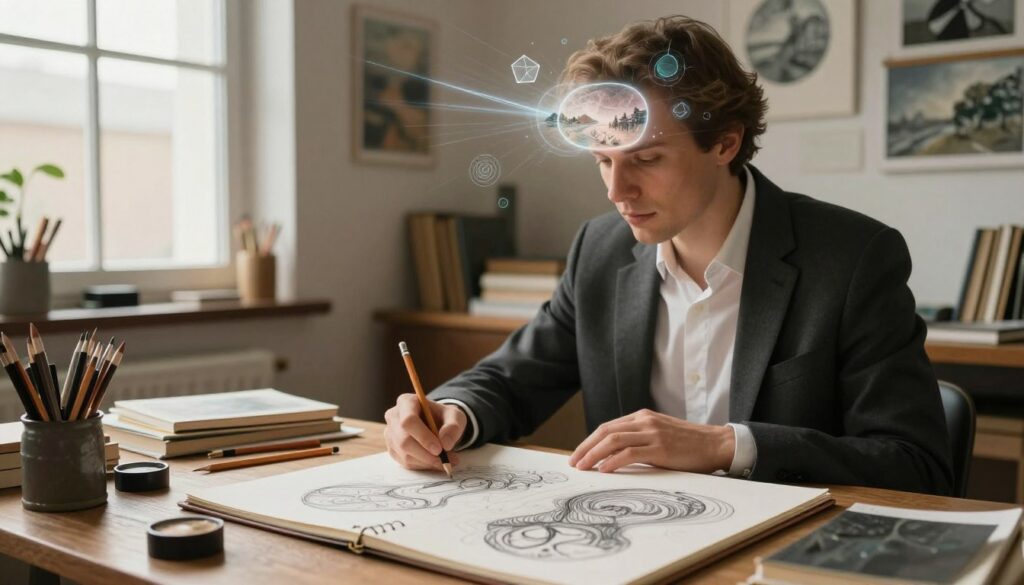
A quick pencil sketch often reveals structure that words alone cannot capture. This simple act helps a remote viewer hold fleeting impressions long enough to study them.
Don’t worry about art skill. Focus on shapes, lines, and basic patterns you sense. Sketch from the angle that feels most natural; that view will keep your mind tied to core details.
Use plain paper and a timer for short blocks of practice. Drawing during a session helps you access deeper layers of information that may not arrive as words.
- Record simple outlines first, then add texture and colors.
- Label parts of the sketch if words come later.
- Keep each run with an envelope and paper to track progress.
Over time, sketches become a visual log you can compare with actual images and assess accuracy. That record speeds training and sharpens access to useful data.
“Sketching turns fleeting sense impressions into testable marks on paper.”
For calming routines that support this process, see how to send someone healing energy.
Adopting a Bird’s Eye Perspective
Lift your viewpoint above the scene to spot layout and relations that ground impressions. This aerial stance helps a viewer see how parts fit together.
Imagine floating over the image. Let shapes, paths, and color blocks arrange themselves on an internal map. That wider angle often reveals useful information missed earlier.
Use this move during training and practice. Spend short blocks of time shifting from close detail to a broad overview. Doing so improves access to both context and fine notes.
Record any new thoughts that arise when you change view. Even small impressions can link into larger, verifiable clues about targets and space.
“Changing perspective turns fragments into structure and gives fresh leads for later review.”
- Float above to see layout and relations.
- Alternate close and wide focus for richer perception.
- Write new impressions immediately for later comparison.

| Technique | Benefit | When to use |
|---|---|---|
| High-angle view | Reveals layout | After initial impressions |
| Zoom-in pass | Clarifies detail | After mapping |
| Rotate perspective | Finds hidden relations | Mid-process review |
Evaluating Your Session Results
Post-run review turns impressions into training data you can learn from. After you finish, open the envelope and place the image beside your paper notes and sketches.
Compare colors, shapes, and patterns. Note where impressions matched and where guesses crept in. This side-by-side check gives clear feedback for future practice.
Record the time you began and ended, then add a short summary of results. A dated log helps track progress across sessions and reveals steady gains.
Use feedback to refine your process. Review which cues offered reliable access and which did not. Adjust your quieting routine, sketching habit, or focus methods based on what you learn.
“Honest evaluation converts raw impressions into usable skill.”
- Open envelope, compare image with notes.
- Mark accurate matches and clear misses.
- Log time and a brief result summary.
| Step | Action | Benefit |
|---|---|---|
| Immediate check | Compare sketch and image | Fast feedback on accuracy |
| Record | Log time and summary | Track progress over sessions |
| Adjust | Change training or routine | Improve future impressions |
Identifying Patterns in Your Performance
Keeping simple logs reveals trends about images you handle well and those that need more work.
After each run, compare notes and mark clear matches and recurring misses. This process shows whether your impressions favor people, nature, architecture, or other images.
Over time, patterns emerge: you might notice faster access to color and texture but weaker reads for faces or small details. That insight lets you shape training to correct weak spots.
Use a short table or checklist to track type, accuracy, and time spent. Repeatable records let a viewer see how practice shifts skill across targets and sessions.
- Note which targets give reliable impressions.
- Record types that need extra practice.
- Adjust training to focus on weak categories.
Recognizing trends gives a clear path for improvement. With steady review, viewers become more consistent and confident across diverse targets.

“Track results honestly; patterns guide smarter practice and better access to information.”
Scientific Skepticism and Research Findings
Skeptical reviews often demand strict controls before accepting claims about perception beyond normal senses. That caution shaped major reports and influenced how programs were run.
Lack of repeatability remains the central critique. Independent reviewers noted that promising results rarely held up across repeated runs or different teams. In 1995, the American Institutes for Research reviewed Stargate and concluded no usable intelligence emerged from the program. Such outcomes raise concern about consistency over time and across sessions.
Lack of Repeatability
Some experiments showed initial success yet failed replication. Critics point out that repeatable methods matter more than single dramatic cases.
Sensory Cueing Issues
Studies warn that uncontrolled cues can steer a viewer toward the correct answer. If a list of targets is ordered, or labels leak, impressions may reflect hints rather than true access.

“Careful controls separate genuine perception from clever guessing and hidden clues.”
| Study | Finding | Implication |
|---|---|---|
| Stargate (AIR review) | No usable intelligence | Limited operational value |
| PEAR (336 trials) | Composite z-score 6.355 | Contested statistical interpretation |
| Independent labs | Mixed replication | Need stronger controls |
Balanced practice benefits from this critical view. For further context on claims about psychic skills, see psychic powers overview.
Common Challenges for New Viewers
New practitioners often find separating imagination from true impressions harder than expected.
One big hurdle is confusion between inner stories and actual cues from the cue image. This leads viewers to record vivid but unrelated notes.
It takes time and steady practice to quiet inner chatter and gain reliable access to information. Early runs may feel frustrating; that reaction is normal.
Keep attention steady on the cue, trust the process, and log every attempt. Over many sessions, patterns appear that show growth in perception and accuracy.

“Patience and honest review turn mistakes into useful training.”
- Environmental distractions can skew impressions and reduce clarity.
- Sensory cueing from labels or hints distorts outcomes during experiments.
- Short, regular runs help build ability more than occasional long efforts.
Quick fixes:
| Challenge | Effect | Practical fix |
|---|---|---|
| Imagination overlap | False details | Use timers, record raw notes, then compare |
| Room distractions | Lost focus | Quiet space, remove cues |
| Sensory cueing | Biased results | Seal materials, blind protocols |
| Impatience | Inconsistent runs | Short practice blocks, steady training |
For calming routines that support training, try a healing energy routine to steady breath and attention before each run.
Resources for Continued Learning
Build a steady plan for ongoing study so your skills grow with each practice run.
Continued learning helps any viewer refine perception and turn impressions into useful information. Books, online courses, and expert interviews give structure and fresh techniques for each practice block.
Jennifer McVey, a Spiritual Director, offers guidance on mindset and practical routines that support steady progress. Her insights focus on process, not miracles, so learners improve ability over time.
Join groups or forums to get feedback after runs. Peer review speeds growth and keeps sessions honest. Also consider guided lessons that include timed drills and review methods.
- Read foundational texts and follow step-by-step courses.
- Practice with peers and exchange notes after each run.
- Use expert advice to shape daily routines and short practice blocks.
“Consistent learning and practice are the best ways to develop skills and achieve better results over time.”
| Resource type | Benefit | How to use |
|---|---|---|
| Books and guides | Build theory and method | Read, summarize, then apply drills |
| Courses and workshops | Structured practice and feedback | Follow modules, join live reviews |
| Peer groups | Honest critique and support | Swap runs, compare impressions |
| Expert coaching | Personalized correction | Book sessions, adopt suggested routines |
For guidance tailored to new and rising viewers, see remote viewer coaching. Small, steady investments of time and practice will deepen experience and strengthen abilities.
Conclusion
Consistent practice and careful logs help a viewer grow measurable ability. This guide aimed to show how structure, calm focus, and clear notes shape each run.
Keep practicing, and give yourself honest review after every attempt. Skepticism remains, yet personal experience often keeps curiosity alive for many learners.
Spend time on short drills, track progress, and adjust techniques that work for you. Both beginners and seasoned viewers find value in steady work and patient study.
To explore guided options and readings, visit the psychic readings page for practical support and next steps.
FAQ
What role does the target play during a session?
The target serves as the focal point for impressions and mental images. It guides attention, shapes sensory impressions, and gives structure to the process of gathering information. Clear targets help trainees stay on task and reduce distracting thoughts.
How do you define a target for practice?
A practice target can be a photograph, object, room, or geographic spot sealed inside an envelope or held by a monitor. Use simple, concrete items at first — an image of water, a tree, or a building — to build accuracy and confidence.
Why is focus important when approaching a target?
Strong focus filters out noise and supports reliable impressions. When attention stays narrow, subtle sensations and patterns become easier to notice. Training improves this skill through short, regular sessions and attention exercises.
Where did this method originate?
Roots trace to early occult traditions and parapsychology experiments from the late 19th and 20th centuries. Military and intelligence programs later formalized protocols and terminology used by modern practitioners and researchers.
How did government research influence development?
Programs such as the Stargate Project explored operational uses for remote perception. Researchers tested protocols, target controls, and tasking methods to assess any practical value for intelligence work.
What makes a good practice target?
Choose clear, varied images and objects with distinct colors, textures, and shapes. Photographs of landscapes, rooms, or everyday items work well. Avoid overly abstract or emotionally intense targets while learning.
Are there targets to avoid?
Yes. Do not pick disturbing scenes, graphic content, or anything that might cause stress. Emotional material skews impressions and can hinder accurate reporting and review.
How should I set up my space before trying a task?
Create a quiet, comfortable area with minimal distractions. Dim lights, remove electronics, and have paper and drawing tools handy. A consistent environment supports routine and better outcomes.
What steps help quiet the mind prior to viewing?
Short breathing exercises and five to ten minutes of simple meditation calm mental chatter. Focus on breath or body sensations, then shift gently to the target cue without forcing images.
Which meditation techniques work best for beginners?
Guided breathwork, progressive muscle relaxation, and mindfulness basics suit most learners. Use apps like Headspace or Calm for structured, brief practices tailored to concentration training.
What are initial impressions during a session?
Early data often arrive as textures, colors, tastes, smells, or emotional tones rather than clear pictures. Note these raw sensations first; they form the backbone for later, more structured descriptions and sketches.
How should mental imagery be sketched?
Capture quick, simple outlines and dominant shapes. Don’t aim for artistic detail; focus on proportions, key features, and labels for colors or sensations. Sketches act as memory aids during review.
What does adopting a bird’s eye perspective entail?
Shift from close-up sensory impressions to an overhead sense of layout, scale, and spatial relationships. This viewpoint helps identify context, routes, and connections between elements in the target.
How do I evaluate session results afterward?
Compare impressions and sketches to the actual target using objective criteria: colors, major objects, relative positions, and functional details. Keep logs to measure progress over multiple sessions.
How can I spot performance patterns?
Track accuracy for categories such as color, texture, structural layout, and emotional tone. Identify consistent strengths and recurring errors, then tailor practice to reinforce reliable skills.
What does scientific research say about repeatability?
Peer-reviewed studies emphasize inconsistent replication and challenges with controls. Many researchers cite problems with repeatability and recommend rigorous protocols and blind testing for valid results.
How do sensory cues affect outcomes?
Uncontrolled cues — verbal hints, environmental signals, or subtle feedback from monitors — can bias responses. Proper shielding and double-blind setups help minimize cueing and improve data integrity.
What hurdles do new viewers typically face?
Beginners often struggle with mental noise, premature analysis, and trying to force images. Common fixes include shorter trials, stricter target controls, and regular feedback from clear source images.
Where can newcomers find resources to learn more?
Books on perception training, courses by reputable parapsychology labs, and community practice groups offer structured guidance. Use scientific papers and controlled-experiment guides to stay critical and methodical.