

Remote viewing began as an experimental method during the Cold War. The U.S. Army’s Stargate Project sent remote viewers on sensitive assignments. They sought distant crash sites and other secret targets.
The technique asks participants to trust their mind as a kind of psychic antenna. Viewing relies on quiet focus and brief impressions. Michael Ferrier created the Remote Viewing Tournament app to let people test this skill in a modern way.
By spending time practicing, one can tap hidden aspects of consciousness. In the past, remote viewers produced results that surprised researchers and shaped certain government work. Today, this method draws interest across the world as a novel path toward insight.
Key Takeaways
- Remote viewing started with military research like Stargate.
- The practice treats the mind as an antenna for distant targets.
- Apps such as the Remote Viewing Tournament invite broader testing.
- Regular practice can reveal subtle impressions and new viewpoints.
- Explore further with trusted resources like online psychic guides.
Understanding the Origins of Remote Viewing
The roots of modern viewing research lie in long-running projects that tested human perception under controlled conditions.
The Stargate Project
For more than two decades, a classified program examined psychic spying methods. The Stargate Project ran until 1995 and was based at the Stanford Research Institute. Declassified records later showed that the intelligence community found limited operational value in those efforts.

Academic Research
Academic labs played a key role. Teams at the Princeton Engineering Anomalies Research Lab and the Stanford Research Institute backed formal experiments and systematic research.
Those studies produced useful information and raised fresh questions among people and researchers. Even though the project’s findings did not convince all agencies, the experiments influenced later science and the practice of remote viewers.
- Long-running project: more than two decades of testing until 1995.
- Academic partners: Princeton and Stanford labs advanced experimental methods.
- Ongoing questions: declassified files sparked public interest and new research.
How to Use Remote Viewing for Financial Markets
Participants use a clear routine that ties brief sketches to real stock outcomes.
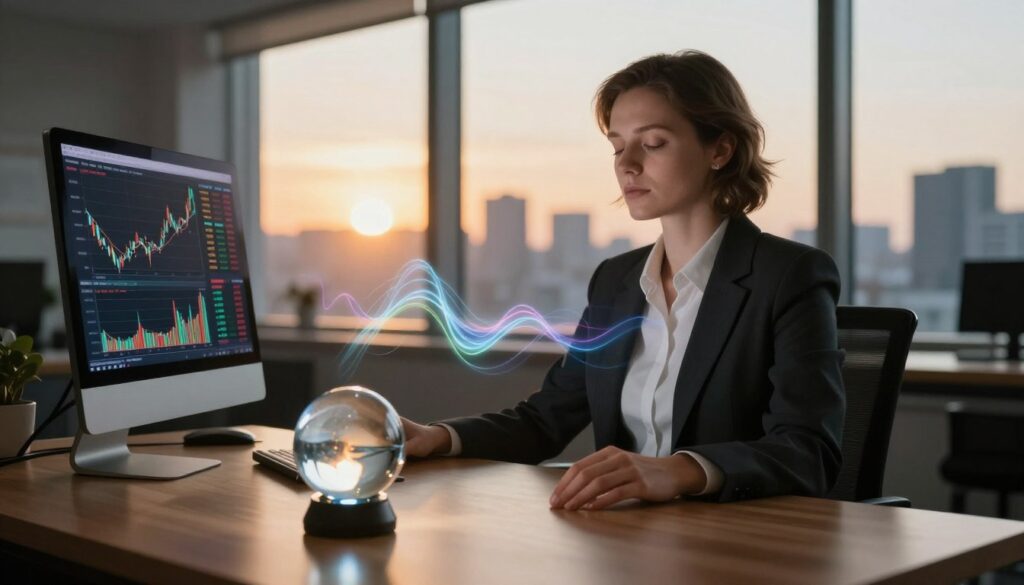
Michael Ferrier’s app asks users to meditate on a short number string, then sketch impressions. Each trial shows image A for a rise and image B for a fall. Viewers submit impressions and a consensus prediction forms.
The project began with a test investment of about $12,500. Ferrier places trades based on the crowd signal: buy if the consensus favors a rise, sell short if it favors a drop. Positions close at day end and users receive feedback on actual outcomes.
| Step | Target Image | Action |
|---|---|---|
| Meditate and sketch | Image A (rise) | Record impressions |
| Collect votes | Image B (fall) | Form consensus |
| Execute trade | Selected target | Buy or short, close at day end |
The experiment converts many small impressions into actionable information. Over time, larger user samples help refine prediction accuracy and clarify which signals most reliably map to market outcomes.
The Role of Associative Remote Viewing in Trading
A key ARV principle turns visual matching into a clear binary choice that guides decisions. Associative remote viewing pairs two images with alternate outcomes, letting a sketch point toward one result or the other.

The Mechanism of Image Association
Russell Targ and Harold Puthoff developed this protocol in 1984 to link impressions with future events. A tasker hides the true target until after the outcome, then reveals which image matched the sketch.
Why it matters: traders can translate a simple match into a trade signal. A famous experiment at the University of Colorado Boulder reported seven successful arv trials in a row with untrained viewers.
| Element | Role | Example |
|---|---|---|
| Tasker | Assigns image links | Image A = rise, Image B = fall |
| Viewer | Sketches impressions | Produces comparison data |
| Analyst | Matches sketch to images | Forms prediction for trading |
The statistical effect comes from many arv trials and consistent matches. Over time, repeated success refines which cues best map to stock and market events.
Setting Up Your First Remote Viewing Session
A simple, repeatable ritual helps new viewers settle into a consistent way of working. Start by choosing a quiet space and a 15–20 minute block for a single session. The Remote Viewing Tournament app has seen about 10,000 downloads, and it guides users through each step.
Begin with a short meditation on a set of numbers. This number focus calms the mind and prepares you to sketch impressions of the target.
After sketching, the app asks you to compare your drawing with two images and pick the closest match. The system collects that information from many viewers to test whether predictions hold across trials.
- Daily sessions: short, regular practice refines your skills.
- Clear steps: meditate, sketch, compare, submit.
- Data-driven: the project aggregates results to answer key questions about accuracy.
| Step | Action | Purpose |
|---|---|---|
| Meditate on number set | Quiet focus for 1–2 minutes | Prime attention for impressions |
| Sketch impressions | Freehand drawing | Capture visual cues linked to target |
| Compare with images | Select closest match | Turn sketch into a prediction |
| Submit result | Upload through app | Gather information for analysis |
Tip: If you want guided exercises, try the remote viewing exercises page for simple routines and practice prompts.
Analyzing Your Sketches and Impressions
A methodical look at your drawings helps separate gut impressions from mental guesses. Regular review gives clear information about where your strengths lie and where analytic overlay is shaping your output.

Identifying Analytic Overlay
Analytic overlay (AOL) is the mind filling gaps with logic. It can add labels and stories that did not come from the original impression.
Tip: Mark words or guesses on your page and treat them differently from pure sensory sketches. Over time you can spot recurring overlays and learn to set them aside.
Interpreting Target Feedback
Feedback arrives the day after a session, when you compare sketches with the actual images. Michael Ferrier notes that even sketches that seem wrong may contain valid fragments once AOL is filtered out.
- Compare many sessions and collect data on matches and near-misses.
- Look for repeating shapes, textures, or numbers across a set of trials.
- Track results over time to refine your prediction skill and reduce the effect of projection.
For deeper practice and structured exercises, see this guide on psychic vision training.
The Importance of Consistent Practice
Small, repeated sessions helped competitors sharpen attention and handle distractions during trials. Grin Spickett, a repeat winner, found that following strict protocols made his ADHD easier to manage and turned creative work into a puzzle-like rhythm.

Consistency matters. Over the years, steady practice allowed some people to earn prizes in the Remote Viewing Tournament. The amount awarded has reached $3,360, which nudged many participants to keep improving.
Success rarely followed a straight line. Spickett’s wins waxed and waned with his technique, intent, and mood. That shows the human side of any experiment: emotional state affects output.
Practice with others can speed learning. Community feedback helps remote viewers spot patterns and refine predictions. Sharing routines also builds confidence and a stronger sense of connection to the world.
- Daily short sessions sharpen focus and reduce analytic overlay.
- Track mood and intent to spot links with success.
- Engage the community for feedback and steady improvement.
Scientific Perspectives on Psychic Phenomena
Proving a subtle psychic effect hinges on tiny probabilities and strict experimental rules.
Michael Ferrier notes that the measured effect is small and not yet highly statistically significant. That means more data and careful controls are needed before strong claims follow.
Researchers face a common catch-22: scanning large sets of data can produce odd patterns that arise by chance. This can mislead teams into thinking an effect exists when it does not.
Statistical Significance and Chance
The current experiment seeks interesting patterns among apparently talented viewers. The plan is to pre-register a method and collect fresh data if pilot results grow stronger.
| Goal | Challenge | Plan |
|---|---|---|
| Demonstrate real effect | Small effect size | Pre-registered experiment |
| Avoid false patterns | Data mining risks | Strict analysis rules |
| Refine findings | Limited sample noise | Focus on top-performing viewers |
- Scientific work often struggles to rule out chance in reported results.
- Ferrier analyzes experiment data to judge whether evidence grows over time.
- As an academic course showed, consistent outcomes are hard to achieve in this field.
For a practical path into related skills and study, consider this short guide: becoming a paid psychic.
Ethical Considerations in Market Prediction
Mixing intuition with trading strategy forces traders and regulators into tough debates.
Fairness is central when unconventional methods aim at profit in the stock market. Past interest runs deep: in 1987 about 120 traders signed up for a “psychic business cruise” exploring intuition and trading. That event shows curiosity has shaped trader culture for years.
Legal and reputational risk matters. The SEC has declined to comment on the legality of such approaches, and commentators warn that any claim of extra-sensory insider trading would draw swift scrutiny.

Michael Ferrier stresses he will block tasks that harm others on any future platform. That stance hands ethical choices back to the community and platform designers.
“Regulators would come down hard on any evidence of ‘extra-sensory insider trading.'”
- Ethical concerns are paramount when prediction affects trading outcomes.
- Historical examples show traders have long explored unconventional signals.
- Regulation and transparency should guide any experiment that links impressions with market events.
Balancing profit motive with responsibility is the core challenge. Open discussion, clear rules, and public reporting can help viewers and traders navigate this sensitive area.
Potential Risks and Regulatory Challenges
New regulatory questions arise when an experimental crowd model connects impressions with stock decisions.
Gig-economy concerns shadow this project. Regulators and worker advocates have criticized gig systems for shifting costs and weakening protections. Michael Ferrier recognizes this and is open to more traditional employment options for viewers.
The pilot stage is intentionally cautious. Ferrier is collecting careful data to judge whether the effect holds before any wider rollout.
Practical limits remain clear. Small groups struggle to reach high prediction accuracy, and scaling brings systems and management challenges that may erase any early gains.
“Balancing a novel approach with fair treatment and strong oversight is essential.”
| Risk | Concern | Mitigation |
|---|---|---|
| Labor model | Undermines worker protections | Offer employment alternatives and clear contracts |
| Regulation | SEC and labor scrutiny | Transparent reporting and legal review |
| Scientific validity | Small effect, noisy data | Collect more data and pre-register experiments |
| Operational scale | Managing many users and data | Build robust systems and ethical rules |
Researchers and project leaders must answer many questions about reliability, oversight, and public trust. Clear information, careful research, and open debate will shape whether this approach can move beyond pilot events.
For additional context on related intuitive skills and professional pathways, see numerology readings.
Integrating Intuition with Conventional Analysis
Blending instinct with analysis can reveal fresh signals that data alone might miss.
Michael Ferrier’s project has produced measurable results: 273 investments since September 2019, with 152 correct decisions (55.7%). That rate sits slightly above chance and suggests a modest effect worth testing further.
Keep the approach complementary. Use intuition as an extra input alongside charts, models, and research rather than a replacement for standard business intelligence.

Best practices include clear protocols, skilled remote viewers, and full transparency with stakeholders about the experiment stage. Start small and track outcomes closely.
- Apply the method where outcomes are easy to measure.
- Keep stakeholders informed about experimental status.
- Combine qualitative impressions with quantitative data for robust decisions.
| Element | Purpose | Expected benefit |
|---|---|---|
| Structured protocol | Standardize trials | Consistent data for analysis |
| Skilled viewers | Raise signal quality | Better prediction outcomes |
| Transparent reporting | Build trust | Credibility with stakeholders |
Conclusion
, A disciplined approach lets small signals surface into meaningful conclusions. Remote viewing offers a unique way to explore human consciousness and its practical reach in everyday decisions.
Early results feel promising, yet lasting success needs steady practice and stronger research. Combine these impressions with standard analysis to gain clearer insight and better outcomes.
This journey may take years, but one clear benefit is a deeper view of the world and new ideas about images, patterns, and effect. With care and ethics, the work can help others and expand what we accept as possible.
FAQ
What is the background of remote viewing and where did it start?
Remote viewing emerged from Cold War-era research into anomalous cognition. The most cited program was the U.S. government’s Stargate Project, which ran from the 1970s through the 1990s and explored whether trained individuals could gain information about distant targets. Parallel academic studies and commissioned experiments at institutions like Princeton Engineering Anomalies Research added different methods and data. These efforts produced mixed results and sparked ongoing debate about replicability and controls.
Does associative remote viewing work for predicting stock moves?
Associative remote viewing (ARV) pairs two images with future market outcomes, then has viewers describe which image matches a later event. Some practitioners report successes, but controlled trials show inconsistent performance. ARV can offer an additional data point, yet it should not replace rigorous financial analysis, risk management, or evidence-based trading systems.
How do ARV trials typically assign targets and measure results?
In ARV, a blind selector assigns two images to represent alternative future states, such as up or down for a stock price. Viewers attempt to describe the target before the event. After the outcome is known, the image linked to that outcome validates the session. Scoring uses hit rate and statistical tests to judge whether results exceed chance expectations.
What steps are involved in running a reliable viewing experiment?
Good experiments use strict protocols: clear target randomization, double-blind procedures, pre-registered methods, and objective scoring criteria. Multiple independent viewers, a large number of trials, and careful documentation reduce bias. Including control tasks and analyzing base rates helps separate signal from noise.
How should sketches and impressions be analyzed without bias?
Start with blind scoring: reviewers who don’t know the intended outcome compare transcripts and drawings to candidate targets. Watch for analytic overlay—when a viewer drifts into reasoning instead of sensory impressions—and flag it. Use consensus coding and quantify matches, then apply statistical tests to assess significance.
What is analytic overlay and why does it matter?
Analytic overlay occurs when a viewer inserts guesses, expectations, or logic into a session, contaminating raw sensory data. It reduces reliability because it reflects the viewer’s interpretation rather than pure impressions. Training to recognize and discard overlay improves clarity and the chance of useful information.
Can small teams or solo practitioners generate useful signals?
Solo sessions can produce meaningful impressions, but small samples increase the risk of false positives. Working with multiple trained viewers and aggregating independent results strengthens confidence. Replication over many trials is essential before treating a signal as actionable.
What role does practice and routine play in developing skill?
Consistent practice builds discipline, reduces overlay, and sharpens sensory reporting. Daily short sessions, feedback loops, and structured training exercises improve accuracy. Like any skill, progress is gradual; documenting sessions and outcomes aids learning and long-term assessment.
How do researchers evaluate whether results exceed chance?
Analysts use statistical methods such as binomial tests, chi-square, and Bayesian analysis to compare hit rates against expected probabilities. Large sample sizes and pre-registered stopping rules avoid p-hacking. Transparent reporting of methods and negative results is crucial for scientific credibility.
What ethical issues arise when applying this approach to markets?
Ethical concerns include market manipulation, unfair advantage, and the potential for misleading clients or investors. Practitioners should disclose methods, avoid making absolute promises, and follow legal and industry standards. Transparency about limitations and uncertainty protects both users and audiences.
Are there legal or regulatory hurdles to using psychic-based information in trading?
Regulators focus on insider trading, fraud, and market abuse rather than the source of an edge. Still, claiming guaranteed returns or hiding methods in client communications can trigger scrutiny. Compliance with securities law and clear disclosure are essential when offering services based on unconventional methods.
How can intuition be combined with traditional analysis?
Treat impressions as one input among many. Use technical analysis, fundamental research, and risk controls as primary decision frameworks. When an impression aligns with conventional indicators, it can prompt deeper investigation or a higher-conviction hypothesis. Always size positions conservatively when relying on subjective signals.
What evidence supports practical success with these techniques?
Published experiments and anecdotal trading reports show occasional above-chance results, but findings vary widely. The strongest support comes from controlled, replicated studies with transparent protocols. Users should demand verifiable track records and independent audits before assigning weight to claimed successes.
How long does it typically take to see measurable improvement?
Improvement timelines vary. Beginners may notice clearer impressions within weeks of structured practice, while reliable performance that stands up to statistical testing often requires months or years and many trials. Consistent logging, feedback, and peer review accelerate learning.
What practical risks should traders consider when experimenting with these methods?
Key risks include overconfidence, misallocation of capital, and confirmation bias. Small sample wins can mislead. Maintain strict risk limits, document every trade tied to an impression, and evaluate outcomes objectively. Treat early experiments as learning exercises, not profit engines.
Where can someone find reputable training or peer-reviewed research?
Look for university studies in parapsychology, articles in journals that allow replication data, and workshops led by instructors with verifiable trial records. Organizations like the Rhine Research Center and publications that provide raw data and open protocols offer starting points for serious study.