

Ingo Swann introduced the term remote viewing during a 1971 experiment at the American Society for Psychical Research. That protocol set a clear structure for how a viewer approached targets beyond normal senses.
The concept of a signal line described a hypothesized train of transmissions from a vast non-material framework called the Matrix. This framework held data about space, time, objects, and events.
Practitioners trained the mind to sense and decode those transmissions. A remote viewer worked with a monitor during each session to objectify impressions and turn sketches or ideograms into usable information.
Research by Targ and Puthoff, and later program work such as Stargate Project, explored how a person controls noise and sustains focus. Understanding this process helps explain how a viewer reached consistent results.
Key Takeaways
- Ingo Swann coined a formal protocol that shaped modern practice.
- The signal line serves as a proposed carrier for Matrix information.
- Training taught viewers to convert impressions into sketches and data.
- Monitors helped maintain structure and reduce mental noise during sessions.
- Decades of research examined theory, examples, and program applications.
Defining the Signal Line
Overview: Practitioners describe a continuous train of transmissions that carries encoded material from the Matrix to a trained perceiver. That broadcast behaves like a carrier in radio theory, carrying layered information across many frequencies.

The Carrier Wave Concept
Like radio, a carrier must be tuned. A viewer uses structured protocols and aperture control to reduce noise and favor useful bands. Proper structure during a session raises the chance that impressions remain clear and usable.
Decoding Encoded Data
Encoded content arrives as raw impressions, ideograms, or fleeting images. The viewer decodes these into sketches, words, and workable data through disciplined training and monitor feedback.
- Many frequencies: radiation across bands requires selective attention.
- High awareness: guards against distortion from internal processes.
- Systemic form: session rules convert impressions into coherent information.
The Matrix and Information Origin
Imagine a geometric grid of discrete data points that maps every location, object, and event across space.
The Matrix is described as a vast, nonmaterial framework that holds organized information about all things. Each geographic location has a matching segment that reflects that place’s nature. A viewer, when prompted by coordinates or other targeting, taps this repository for useful data.
Access is available to conscious entities and includes both living and nonliving elements. When a person acquires impressions during a session, those bits trace back to this structured field.

- Acts like a three‑dimensional grid of discrete information nodes.
- Opens to trained perception and program protocols.
- Serves as the origin for encoded transmissions used by a viewer.
| Characteristic | Description | Example |
|---|---|---|
| Form | Structured, nonmaterial grid | Geographic segment mirrors terrain |
| Access | Available to consciousness and trained persons | Sessions prompted by coordinates |
| Origin | Source of encoded data used in practice | Data decoded into sketches and ideogram |
What is the Signal Line in Controlled Remote Viewing
Practitioners describe a steady thread of informational flow that connects trained perception to distant targets.
Remote viewing here refers to a disciplined method for obtaining data beyond normal senses. A successful session needs five parts: a subject, active ESP ability, a distant target, recorded responses, and confirmatory feedback.
The viewer stays blind to target identity. That protects results and keeps impressions pure. The monitor may suggest focus points but never directs the process.
- Record in real time: use pen on paper to capture raw impressions.
- Maintain structure: CRV training at SRI formalized this approach.
- Confirm results: feedback closes the loop and improves skill.
| Element | Role | Example |
|---|---|---|
| Subject | Provides conscious access | Trained viewer during session |
| Monitor | Guides focus, prevents guessing | Observer who suggests pauses |
| Recorded response | Externalizes perception | Sketches, words, ideogram |
“The viewer controls when to start and stop based on internal state.”
The Role of the Autonomic Nervous System
A body’s automatic wiring often converts distant impressions into quick, muscular responses. This system controls smooth and cardiac muscle plus glandular tissues without conscious effort.
Reflexive nervous responses occur when incoming information reaches deep layers of mind and body. The unconscious often detects initial impressions and hands them off to autonomic channels.
Those channels can produce a reflexive mark on paper. In practice, that mark becomes an ideogram — a brief, nonverbal trace that contains compressed data. If a viewer allows the motion, the ideogram serves as the first objectification of incoming information.

Training and protocol help separate true impressions from analytic overlay. By staying structured, a viewer reduces noise and keeps the process mostly reflexive. Research at SRI and later program work documented how these bodily responses aid reliable data capture.
| System Element | Function | Example |
|---|---|---|
| Autonomic Nervous System | Converts subtle reception into reflexive motor output | Ideogram drawn without conscious planning |
| Unconscious | First detector of incoming impressions | Initial sense or urge before awareness |
| Training / Protocol | Maintains structure and reduces analytic noise | CRV procedures used by military programs |
Practical note: For those practicing, simple exercises on paper help tune this response. Guided drills and monitored sessions improve clarity; see a set of practice exercises for structured training at remote viewing exercises.
Understanding Aperture and Signal Energy
A well‑managed aperture keeps early impressions tight and focused, then opens for broader detail later.
Borrowed from radar theory, aperture acts like an electronic gate that shapes dispersion of incoming energy. In practice, a viewer uses this concept to control how much perceptual data reaches consciousness during a session.
At Stage I, detection often arrives as a sharp, rapid influx of energy that gives large gestalts. A narrow aperture limits that rush, so the mind can record clear ideogram and first sketches on paper without overload.
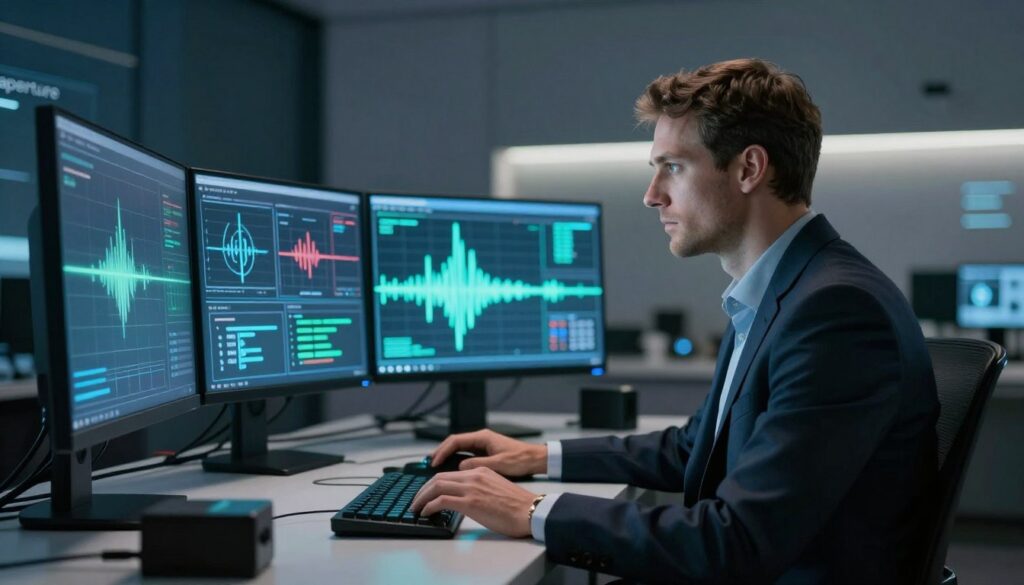
As a session advances, the aperture widens to admit longer, slower waves of information. This shift lets the viewer move from broad form to specific objects and finer detail.
Research by Russell Targ and Harold Puthoff at SRI used aperture ideas to refine CRV protocol. Learning to manage aperture helps keep structure, protect results, and focus on useful elements rather than distracting noise.
- Early stage: narrow gate for large gestalts.
- Later stage: wider gate for sustained detail.
- Skill: training teaches timing and control.
The Concept of Bilocation in Sessions
Maintaining awareness both here and there lets a trained mind record impressions as they form.
Bilocation means a viewer keeps attention split between the physical seat and the target location. This balanced state lets a person perceive information while still writing on paper.

Unlike an out‑of‑body trip, the remote viewer does not fully leave the body. Staying present preserves real‑time reporting and reduces memory loss that often follows travel after the fact.
Ingo Swann highlighted this skill during CRV training. He taught that split awareness helps capture clear ideogram, sketches, and other raw data during a session.
- Monitor role: helps keep balance and structure through cues and gentle pacing.
- Practice: repeated drills train the mind to toggle without losing focus.
- Research: SRI and program records show consistent results when bilocation is maintained.
| Element | Function | Example |
|---|---|---|
| Bilocation | Dual awareness for accurate report | Perceive target while marking paper |
| Monitor | Support focus and timing | Pauses, prompts, structure |
| Training | Builds reliable process | Drills, feedback, staged sessions |
“Balanced presence at both points preserves raw impressions for accurate recording.”
Managing Mental Noise and Analytic Overlay
Left‑brain habits can hijack raw impressions, turning fragments into confident but false stories. Analytic Overlay (AOL) happens when a viewer’s conscious mind forces meaning onto partial data. That rush creates mental noise that masks true perception.

Identify false interpretations by noting sudden labels, neat stories, or familiar objects that appear too fast. These often stem from habit, not the incoming information. Researchers like H. Shevrin and Scott Dickman studied how unconscious processes shape those reactions.
Reducing logical interference
Use strict structure during a session to externalize impressions. Describe sensory feel and shape rather than naming. A monitor watches for premature guesses and prompts pauses when necessary.
- Pause and record: stop when a clear cognition arrives so it can integrate into consciousness.
- Describe not name: avoid labels that invite analytic overlay.
- Practice drills: CRV training teaches the process and improves results over time.
“Externalizing thought keeps the process clean and reduces mental noise.”
The Importance of Real Time Objectification
Good notes captured at the moment keep impressions honest and verifiable.
Real-time objectification means writing or sketching every perception as it arises. A remote viewer uses pen and paper to externalize fleeting sense impressions and ideogram gestures so short-term memory does not have to hold complex information.
This practice cuts internal editing and lets an analyst trace where noise enters the record. By 1986, the Defense Intelligence Agency had confirmed that this method improved accuracy for military reporting.
Kinesthetic acts—sketching or simple 3D modeling—reinforce contact with a target and add dimension to verbal notes. That physical interaction anchors impressions and reduces guesswork later during review.
- Record now: capture impressions as they occur to avoid massive loss of raw data.
- Monitor role: an observing monitor keeps protocol and format consistent throughout a session.
- Training focus: repeated drills teach the process so results remain reliable.
“Capture at the moment preserves what memory would otherwise reshape.”
For practical resources on skill development and broader context see related training material.
Learning Theory and Skill Development
Training for this method rewards stopping while success is fresh, not grinding until fatigue sets in. Beginners often score high on first attempts. That surge—often called beginner’s luck—may reflect initial excitation of dormant neural channels.
Rote repetition can lock in bad patterns. Instead, short runs followed by breaks let new synaptic links, or cognitrons, consolidate. K. Fukushima and S. Miyake (1978) described self‑organizing neural networks that support this view.
Practical rule: when a viewer feels a clear hit, pause training and rest. Inform the monitor so a break can be scheduled. This reinforces correct performance and protects gains.
A typical learning curve shows early success, a sharp drop as analytic mind reasserts itself, then steady improvement with structured practice. Avoid overtraining; pushing past saturation risks collapse and loss of function.
- Quit on a high: lock in useful relays after a strong run.
- Avoid rote drills: favors breaks and spaced practice.
- Monitor role: note high points and protect the viewer’s time.
Avoiding Overtraining and System Burnout
Pushing practice past healthy limits causes mental systems to fray and performance to collapse.
Overtraining occurs when a viewer’s learning system becomes saturated. That burnout stops reliable perception and can lead to full system collapse, much like an overworked muscle.
The monitor plays a vital role. They must pause sessions, note high points, and stop a run when a viewer reports a strong cognition. Halting lets important information fully matriculate and reduces long-term damage.

Norman Dixon’s 1981 work on preconscious processing helps explain why rest matters. Brief layoffs allow neural consolidation, restoring access to clear data and steady ideogram gestures.
Remedy: a total training layoff, then a slow, stepwise return to practice. Limit session count per day, watch recovery time, and build a sustainable program that protects both skill and health.
For techniques that support recovery and paced practice, see a short guide on recovery and energy work.
The Role of the Monitor in the Process
Neutral, steady oversight keeps a session honest. A monitor watches the viewer and gauges readiness before any pen touches paper.
The monitor reads coordinates, the viewer copies them, and work proceeds by method. That simple handoff protects blind conditions and starts timing with care.
During a run, the monitor gently guides focus when needed. Prompts stop naming, guessing, and analytic overlay that distort raw ideogram and sensory notes.
Monitors follow strict non‑intrusion rules. In 1986, the Defense Intelligence Agency described protocols to prevent cueing and to preserve integrity of results.

- Observe readiness and confirm pen placement before a session begins.
- Protect blind conditions and avoid leading questions.
- Steer attention toward perspective shifts that yield useful information and data.
- Support training by flagging mental noise and analytic overlay when they appear.
“A good monitor preserves the viewer’s raw report by staying neutral and precise.”
Collaboration matters: this partnership, refined at SRI, helps a remote viewer keep structure, capture clearer material, and improve with training.
Historical Context of the Stargate Program
Cold War priorities drove secret programs that tested unconventional methods for intelligence collection. Between 1975 and 1995, U.S. agencies funded a formal study of psychic phenomena under several code names, later known as the Stargate Project.
Declassification and Public Disclosure
Researchers such as Russell Targ and Harold Puthoff helped launch early labs after Ingo Swann coined the term remote viewing in 1971. The project received about $20 million over two decades.
The program moved from the Defense Intelligence Agency to the CIA in 1995, then closed after a retrospective review. Evaluators found the effort failed to deliver consistent, actionable information or reliable data for field use.
After declassification, documents entered the public record. Former military staff began teaching structured training protocols to civilians, and archived reports spurred wider interest in session methods and ideogram practice.
“The records reveal an unusual mix of rigorous protocol and mixed operational payoff.”
| Year Range | Agency | Outcome |
|---|---|---|
| 1975–1995 | DIA / CIA | $20 million; closed after review |
| 1971 (origin) | ASPR / researchers | Ingo Swann coins term; early experiments |
| 1995 | CIA | Declassified; public teaching begins |
Scientific Reception and Skepticism
By the 1990s, formal reviews forced a hard look at methods, controls, and claimed hits for remote viewing.

In 1995 the CIA hired the American Institutes for Research to audit Stargate results. Reviewers Ray Hyman and Jessica Utts reached opposite conclusions. Hyman argued no proof existed, while Utts saw statistical hints worth study.
Academic labs added to the debate. PEAR at Princeton reported strong composite scores after 336 trials, but critics raised concerns about controls and replication.
Analysts like David Marks and Richard Kammann found sensory cues and transcript problems that could explain high hit rates. Mainstream organizations still regard many claims as pseudoscience.
Key issues include lack of a guiding theory, inconsistent replication, and weak experimental controls. These gaps matter because they block clear interpretation of any data or information from a session.
“Rigorous controls and independent replication remain essential to settle disputed findings.”
Distinguishing Remote Viewing from Other Practices
Remote viewing follows a deliberate protocol rather than relying on spontaneous trance or channeling. A trained viewer works with structure, a monitor, and real‑time notes to reduce guesswork.
Unlike clairvoyance or astral work, this method treats perception as a skill. It teaches handling mental noise and preventing analytic overlay during each session.

Intentional practice matters: the viewer aims at a defined target and records impressions as they arise. That approach turns fleeting sense into usable information and clear data.
- Trainable: people build skill through repeated, structured practice.
- Protocol-driven: monitors and real‑time objectification keep reports honest.
- No mystification: emphasis on description, not naming, limits false overlays.
| Aspect | Other Psychic Arts | Remote Viewing |
|---|---|---|
| Approach | Often spontaneous or trance-based | Structured, repeatable protocol |
| Noise management | Rarely formalized | Explicit methods to minimize interference |
| Output | Subjective impressions | Recorded notes, sketches, ideogram |
For practical recovery and supportive techniques that pair well with disciplined practice, see a short guide to send healing energy.
Future Directions for Research
Progress depends on replacing informal judgment with automated, bias‑resistant metrics. That shift can reduce human error and make results easier to replicate across labs.
Future work must prioritize stricter controls, independent replication, and clear protocols. Teams aim to duplicate SAIC and SRI experiments under blinded, interlaboratory conditions so findings hold up over time.
Analytical judgment methods that limit human bias already show promise. In 1996, PEAR published a report using new scoring approaches to avoid subjective judging. Such tools may become standard for scoring raw data from a session.

Researchers also pursue a positive theory to guide which variables matter and which can be ignored. Work on neural holographic models, inspired by P.R. Westlake, probes how brain processes could encode distant information.
Longer term, studies will test autonomic contributions and process‑oriented protocols rather than chasing single hits. If methodology improves and sensory cues are eliminated, results may finally fit modern scientific frameworks.
For practical training and further context about a trained practitioner, see remote viewer.
Conclusion
Structured practice and solid protocol link past research to usable skills for any serious viewer.
By studying training methods from pioneers such as Ingo Swann and Hal Puthoff, a practitioner can learn to decode faint data and improve session accuracy. Managing mental noise and analytic overlay remains essential for reliable results.
Historical programs remind us that rigorous controls matter. Ongoing research will refine methods and test neural models that explain how consciousness accesses distant information.
For further reading on inner perception and higher awareness, see third-eye awakening. Keep practice short, work with a steady monitor, and track gains over time.
FAQ
What does the signal line represent during a session?
The signal line marks the moment a viewer senses a shift from background impressions to actionable data. It helps separate vague ambient sensations from clearer, reportable information so the session can proceed with sketches, descriptors, and focused probing.
How does the carrier wave concept relate to perception?
Think of a carrier wave as an ongoing mental rhythm that carries subtle cues. When a viewer tunes their attention, they pick up on variations within that rhythm. Those variations become the raw material for later decoding and translation into words, drawings, and coordinates.
How are encoded impressions decoded into usable details?
The decoding process combines layered impressions, ideograms, and sensory hits. Training and structured protocols turn initial scribbles and sketches into refined elements like form, texture, and spatial relations. Monitors help by asking targeted questions to clarify ambiguous data.
Where does information appear to originate during sessions?
Many practitioners describe a sense of information arising from a nonlocal matrix or a shared informational field. Whether framed as consciousness, a probabilistic field, or collective awareness, the origin feels distinct from ordinary memory or imagination.
How can a viewer tell when data comes from the matrix rather than their own mind?
Reliable signals often arrive with neutral affect and sensory richness, lacking the emotional color of memory. Clear, novel impressions that resist logical construction usually indicate external sourcing. Training refines this discrimination over time.
How do autonomic responses affect session quality?
Heart rate shifts, breathing changes, and minor muscle tensions can align with stronger impressions. These reflexive cues often coincide with meaningful hits and serve as additional validation when recorded alongside verbal reports and sketches.
Can reflexive nervous responses be used as objective markers?
Yes. Recording physiological changes during viewing adds a layer of data that supports subjective reports. Many programs pair simple biofeedback with sessions to track correlations between body responses and informational accuracy.
What role does aperture play in picking up signal energy?
Aperture refers to the mental focus window the viewer creates. Wider aperture catches broad ambient patterns; narrower aperture isolates fine detail. Adjusting aperture helps balance context and specificity during data collection.
How does adjusting aperture change session outputs?
A narrow aperture yields precise shapes and textures but may miss overall context. A wide aperture provides scene-level information but can blur specifics. Skilled viewers shift aperture dynamically to capture both levels effectively.
What does bilocation mean in the context of viewing?
Bilocation describes the sense of simultaneous presence at the viewer’s physical location and at the target location. It’s an experiential report that often accompanies vivid sensory impressions and enhanced clarity during targeting.
Is bilocation necessary for accurate results?
No. While some sessions include a strong sense of dual presence, many accurate sessions occur without this feeling. Accuracy depends more on protocol adherence, training, and managing interference than on a particular subjective state.
What is mental noise and how does it affect reporting?
Mental noise comprises random thoughts, memories, and expectations that clutter perception. It competes with genuine impressions and can produce false leads or muddled sketches if not managed promptly.
How can viewers identify false interpretations quickly?
False interpretations often carry emotional weight or logical structure. If an impression feels like a story or judgment, it’s likely analytic overlay. Returning to raw sensory descriptors, ideograms, and repeating brief neutral checks helps expose errors.
What techniques reduce logical interference during sessions?
Simple methods work best: stick to sensory language, avoid speculative narratives, use brief ideograms, and let sketches remain rough. Monitors intervene with neutral prompts to prevent premature analysis and keep data clean.
Why is real-time objectification important for accuracy?
Objectification anchors fleeting impressions into tangible outputs like drawings, tactile descriptors, or short phrases. Capturing data in real time prevents retrospective rationalization and preserves the original quality of the information.
How does learning theory apply to skill development for viewers?
Repetition, immediate feedback, and graded difficulty drive improvement. Training programs use blind targets, monitored sessions, and validation to reinforce correct decoding patterns and reduce analytic overlay.
What signs indicate overtraining or system burnout?
Burnout shows as declining clarity, increased noise, and fatigue-related errors. Sessions may feel heavy, with fewer vivid impressions. Regular breaks, varied practice, and reduced session frequency help restore reliability.
What role does the monitor play during a session?
The monitor structures the session, records inputs, and provides impartial prompts. Good monitoring prevents leading questions, maintains protocol discipline, and helps translate raw impressions into testable descriptors.
How did the Stargate Program influence public awareness?
Declassified material from government-sponsored research brought controlled remote perception into public discussion. Released reports and press coverage sparked interest in training methods and encouraged civilian research and courses.
What happened during declassification and disclosure?
Key reports and program summaries entered the public domain through Freedom of Information Act releases. Those documents revealed methodology, case studies, and mixed evaluation results that fueled both support and critique.
How does mainstream science view this practice today?
The scientific reception remains skeptical due to challenges with replicability and theoretical grounding. Some experimental studies show intriguing correlations, but critics call for tighter controls and larger datasets.
How does this discipline differ from intuition or clairvoyance?
The discipline emphasizes protocol, blind targets, and verifiable outputs. Unlike casual intuition, it relies on structured reporting, monitoring, and feedback to produce reproducible results rather than anecdotal hits.
What are promising future directions for research?
Combining physiological monitoring, machine learning analysis, and rigorous double-blind testing promises clearer evaluation. Cross-disciplinary work with cognitive neuroscience may also clarify mechanisms behind information uptake and decoding.