

Ingo Swann spent his life exploring how the human mind could reach beyond ordinary limits.
Researchers debated whether spontaneous esp and formal protocols produce the best results. This article traces the history of remote viewing and looks at how people became viewers under test conditions.
We examine the Stargate program and other studies to see what evidence the data offered. By comparing how a viewer interacts with a target, readers learn how time and information shape outcomes.
Expect clear examples and measured claims that show the effect of method on accuracy and on the ability to gather usable data.
Key Takeaways
- Ingo Swann was a central figure in early research on psychic abilities.
- The article compares spontaneous ESP with controlled viewing methods.
- Decades of studies, including the Stargate program, provide insight into results.
- How a viewer approaches a target affects the information collected.
- Time and data handling play key roles in validating claims and evidence.
Understanding the Roots of Psychic Research
The story begins with personal reports and small experimental steps that pulled anomalous perception into laboratory settings.
One well-known subject claimed an out-of-body episode as a child during a tonsil removal. That early account colored later interest when he volunteered for formal research at age 37.
Early work focused on whether people could reliably perceive a distant target. Scientists set up tests to gather information over time and to separate chance from a true effect.

Evidence came slowly. Programs such as the Stargate program and other efforts collected data to test the claims. Researchers asked if a viewer could repeatedly access non-local information.
- Studies began with spontaneous reports and then moved to controlled tests.
- Volunteers turned personal experience into measurable research subjects.
- The core question remained: was perception consistent or random?
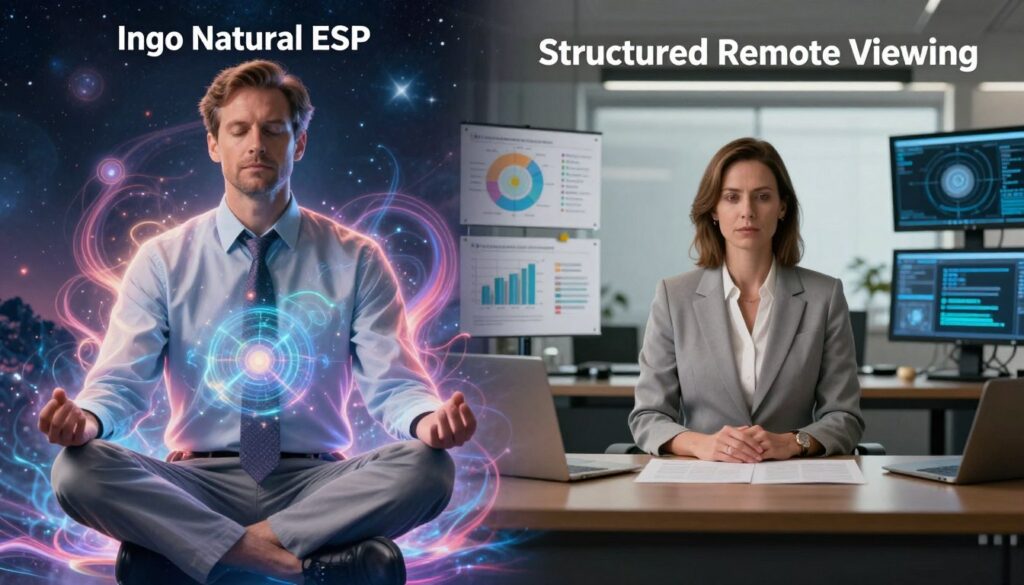
Defining Ingo Swann Natural ESP vs Structured Remote Viewing
Two paths emerged: one that trusted spontaneous insight and another that enforced a repeatable procedure. This section defines those approaches and shows why the split mattered for research and training.
The Nature of Intuition
Some people report sudden impressions about a distant target. These impressions can be vivid but vary by person and time.
The Discipline of Protocol
Controlled remote viewing was developed by Ingo Swann and Hal Puthoff in the early 1980s to create a teachable method. The protocol breaks the session into a set number of steps to limit bias and track data over time.
“By adding structure, teams aimed to turn sporadic hits into reproducible results.”
The work shows that while some individuals have strong ability, the method helps more people become reliable remote viewers. Below is a quick comparison.
| Aspect | Intuition | Protocol |
|---|---|---|
| Source | Personal insight | Standardized steps |
| Consistency | Variable | Higher over time |
| Training | Limited | Systematic |
The Early Days at Stanford Research Institute
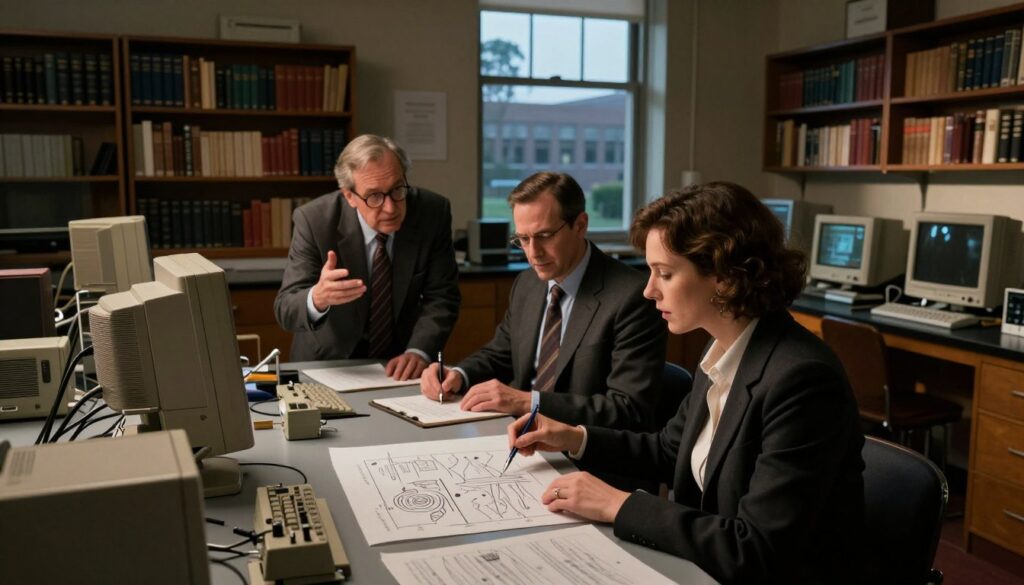
In the early 1970s, a handful of lab rooms at a California research institute became the testing ground for unusual claims about perception.
Harold Puthoff and Russell Targ led experiments at the Stanford Research Institute that aimed to treat intuition as testable data. One notable subject was Ingo Swann, who took part in controlled sessions that asked a viewer to describe a distant target.
Researchers logged transcripts, sketches, and ratings to measure accuracy. Over time, the collected evidence showed enough repeatable hits to attract wider interest.
The work at the research institute proved important for later programs. Those early results helped justify the creation of the Stargate program, which sought to turn these findings into practical tools for intelligence.
- Stanford research served as the epicenter for formal testing.
- Subjects described targets and supplied information under strict controls.
- Analysts compared reports to actual locations to evaluate the claims.
To explore how those sessions evolved, see a fuller account of protocols and results in this detailed write-up: early remote viewing research.
The Transition to Controlled Remote Viewing
The name change reflected a deliberate move toward repeatable technique. In the early evolution of the practice, the new term made clear that sessions would follow set steps rather than rely on chance impressions.
From coordinate to controlled meant the remote viewer treated a single location or target with protocols. This helped viewers sort impressions from imagination and capture clearer data.
Practitioners reported that the method improved focus. Over time, people learned to pause and note only the information they felt came from the target.
From Coordinate to Controlled
- The shift changed how a viewer approached a specific location and target.
- By using a defined method, a person could manage what entered the mind during sessions.
- Training turned anecdotal ability into a teachable process with measurable evidence.

For a practical overview of techniques and program history, see this remote viewing guide. The record shows the change yielded more consistent results across time and data sets.
The Role of the Stargate Project
The Stargate Project became a high-profile effort to test whether trained practitioners could deliver useful intelligence under pressure.
The Central Intelligence Agency funded the program to explore military uses of remote viewing and to see if the process could yield actionable information.
Researchers such as Hal Puthoff worked inside the program to refine methods and improve how data were collected from each session.
Much of the evidence was classified, yet records show that the viewer could influence outcomes. Over time, critics questioned the validity of some claims and the real-world usefulness of the results.
Still, the program represents a major part of the history of this research. It helped shape protocols and set standards for data handling and evaluation.

| Aspect | Purpose | Key People | Outcome |
|---|---|---|---|
| Funding | National security tests | CIA, contractors | Classified reports, mixed results |
| Research | Refine process | Hal Puthoff, program staff | Improved protocols, debated evidence |
| Application | Field intelligence attempts | Trained viewers | Some useful hits; contested validity |
For background on key personalities and later commentary, see a profile of famous psychics.
Examining the Six Stages of the Original Protocol
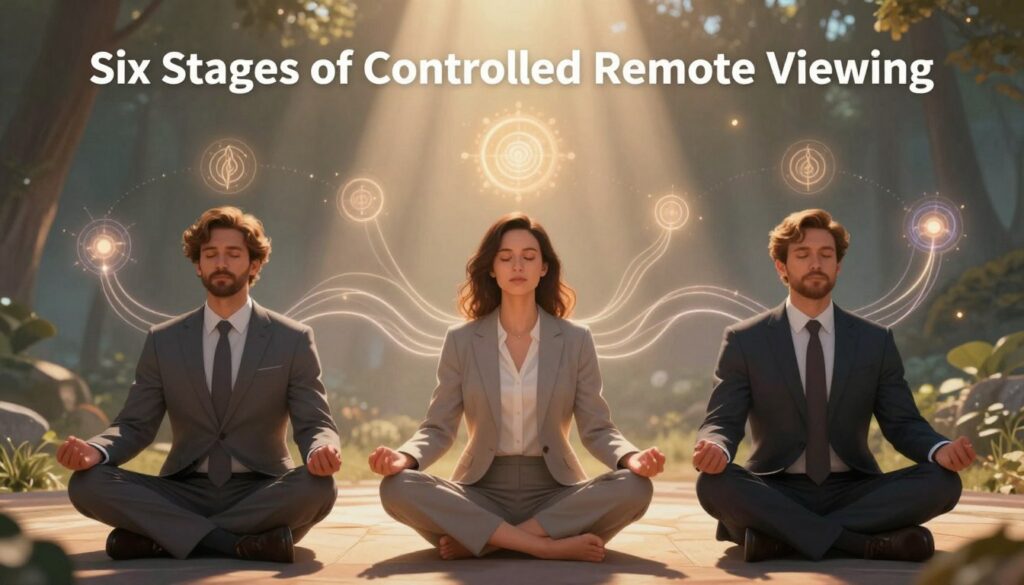
The original protocol broke the session into six clear phases to guide a viewer from a raw impression to a detailed depiction of a target.
Stage order mattered. Each stage focuses on a different kind of information. Early steps capture simple ideograms and basic sensory notes. Later steps shift to sketching form and three-dimensional modeling.
The method helps a remote viewer separate image fragments that come from the target from personal guesswork. By following this number of steps, people report clearer results and fewer errors.
Evidence from program research shows that the six-stage process trained new viewers to produce more consistent data over time. The protocol became the standard in many projects because it offered a repeatable path to useful information.
“Breaking sessions into stages made it easier to assess which impressions matched the target and which were noise.”
To practice the sequence and see how it feels in a real session, try some guided remote viewing exercises.
- Stepwise design reduces personal projection.
- Each stage narrows the range of possible errors.
- Protocol use improved training and program results.
The Debate Over Advanced Stages Beyond Six
Debate has long simmered over whether any formal phases were added to the original six-step process. Enthusiasts and critics both raise questions about who taught what and when.
Tom McNear, a U.S. Army officer, was the first military member trained in all six stages by the originator of the protocol. That training record is a clear piece of historical data.
Claims of Secret Knowledge
Some people claim that extra phases or hidden steps existed. Paul Smith and others who worked closely in New York documented their work and warned against unverified assertions.
“Many claims about additional stages lack the paperwork needed for verification.”
The Historical Record
The U.S. Army program required strict documentation. In practice, most official files show training and results focused on the six-stage method.
Evidence for stages beyond six is sparse. Analysts who review program notes and session logs find that the emphasis stayed on measurable results rather than speculative additions.
- Tom McNear: documented as first military trainee through six stages.
- Paul Smith and associates: cautioned about unsupported claims.
- Program files: stress data, targets, and verifiable outcomes.
| Topic | Documented Fact | Unverified Claim |
|---|---|---|
| Training scope | Six-stage instruction recorded for military personnel | Extra phases taught privately to select individuals |
| Key witnesses | Tom McNear; program staff notes | Anecdotal accounts without archival support |
| Program emphasis | Data, targets, repeatable results | Secret techniques as decisive tools |
| Historical verdict | Focus remained on the original six stages | Claims of additional stages lack consistent evidence |

Analyzing the Stages Document
An archival note catalogs twelve stages, prompting fresh analysis of training intentions.
The “Stages Document” in the university archive lists 12 numbered phases tied to early program work. Its provenance is not fully clear, so scholars treat it as a subject for careful analysis rather than a definitive syllabus.
The paper gives a rare view of how Ingo Swann and Hal Puthoff might have imagined the future of the method. Comparing this list with other training records shows how the number of phases shifted in practice.
Evidence in session logs and program files suggests the twelve stages read more like experimental notes than a required course. Many viewers trained under the six-stage process, and outcomes tracked in data sets match that practice.
“The twelve-stage draft offers ideas, not a classroom mandate.”
Understanding this document helps clarify what results a remote viewer was expected to produce and why some claims about added phases remain contested. The archive thus adds context without overturning recorded results.

The Influence of Military Training Manuals
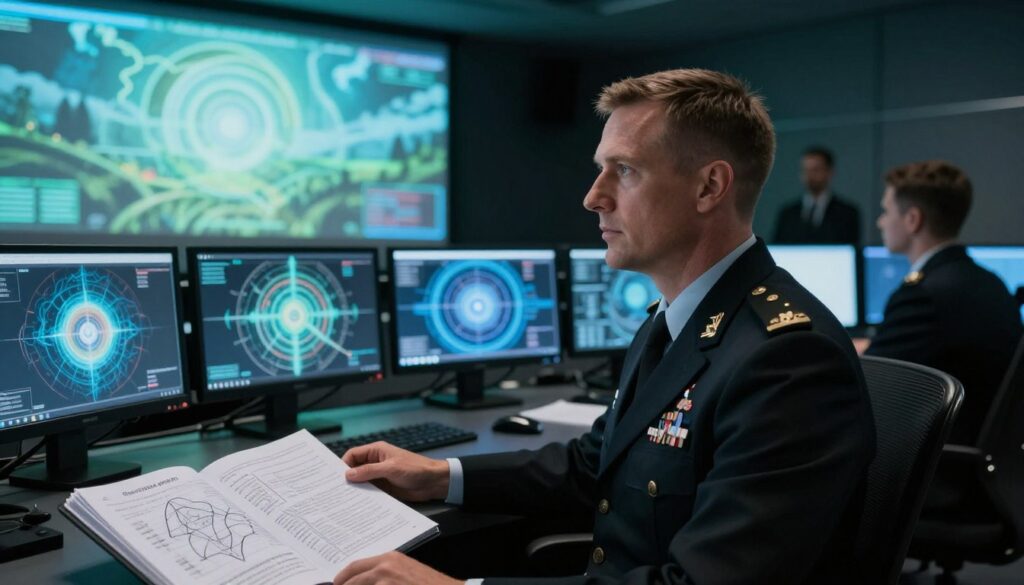
The 1985 CRV Manual, written by Tom McNear and classified by the U.S. Army, became a cornerstone for how people learned to perform remote viewing in government programs.
Military manuals helped standardize the method so each remote viewer followed the same process. That guidance reduced variation and made results easier to compare across time and teams.
The Stargate influence shows in training language and how sensitive targets and information were handled. Manuals spelled out the number of stages, reporting rules, and how to log data for review.
Analysts find clear evidence that a single handbook brought the program into alignment with other intelligence agency work. Consistent procedure made claims easier to test and evaluate.
“A defined process turned impressions into testable information and repeatable results.”
- Standard wording improved data quality.
- Stage definitions guided novice viewers.
- Manuals remain part of the program’s documented history.
| Manual | Year | Role |
|---|---|---|
| CRV Manual (McNear) | 1985 | Training & standardization for U.S. Army personnel |
| Stargate Guidelines | 1980s | Handling targets and classification rules |
| Program Logs | 1980–1995 | Evidence trail for results and review |
Scientific Skepticism and Peer Review Challenges
Critical voices quickly focused on how experiments were designed and how results were scored.
Methodological Criticisms
Early experiments at the stanford research institute, including a 1972 magnetometer test with a noted subject, drew sharp critique for weak controls and scoring ambiguity.
Peers asked for clearer protocols and independent replication. Reviewers noted that inconsistent procedures made it hard to separate chance from a genuine effect.
Critics also flagged small sample sizes and selective reporting. These issues limited how persuasive the evidence appeared in mainstream journals.
“Lack of independent replication remains a central concern.”
- Many researchers sought better controls and transparent data handling.
- Authors such as paul smith examined archival files to assess claims and limits.
- Program reports showed some promising results, but follow-up tests often failed to match initial outcomes.

The Reality of Remote Viewing Results
A handful of sessions yielded details that matched later findings, prompting both curiosity and skepticism.
One famous 1973 session described Jupiter before probe photos confirmed some features. That case is often cited as compelling evidence for the ability of a trained subject to report distant information.
At the same time, other practitioners showed a wide range of accuracy. Reported success rates varied from about 5% up to 95%, depending on the target, conditions, and how results were scored.
The Stargate program amassed large volumes of data, yet rigorous reviews found inconsistent patterns when analysts applied strict controls.
- Some sessions produced clear, verifiable hits.
- Many reports were vague or matched by chance.
- Assessment depends on scoring rules, time, and available data.
Understanding the effect of the viewer’s mind on a distant target remains complex. Careful record keeping, transparent scoring, and open review are needed to separate strong evidence from hopeful claims.
For more on the key figure behind early protocol work, see this Ingo Swann profile.

Comparing Natural Ability to Learned Methodology
Talent can spark results, but a reproducible process often turns that spark into steady performance.
Some people have an obvious knack for perception. Authors such as Ingo Swann and analyst Paul Smith noted that raw ability appears in a few subjects.
Training a remote viewer teaches how to manage impressions and record information about a target. The method reduces guesswork and helps teams compare data over time.
Research shows that remote viewers who follow a disciplined process usually produce more consistent results than those who rely on instinct alone.
| Kind | Strength | Typical outcome |
|---|---|---|
| Innate ability | Strong initial hits | High variance; hard to replicate |
| Taught method | Repeatable technique | Steadier accuracy; easier to validate |
| Combined approach | Talent plus training | Best overall results |
Evidence supports a blended model: people with talent benefit most when they learn a clear process. This helps a viewer turn impressions into testable information.

For readers interested in related skills and exercises, see a practical guide to clairvoyant practice: exploring clairvoyant abilities.
The Legacy of Ingo Swann
The legacy he left blends inventive methods, military work, and ongoing debate. He died in January 2013 in New York, and his passing closed a chapter while opening new study paths.
His pioneering work helped shape formal remote viewing protocols used by the U.S. Army and by other research teams. That collaboration moved unusual claims into organized tests and careful data collection.
Many people still comb his archives for evidence about techniques and results. Scholars and practitioners revisit notebooks, session logs, and training manuals to learn how information was recorded and scored.
The program influence shows in how teams train a viewer and handle a target. Over time, his methods changed expectations about accuracy, the role of time, and how to report data.
| Area | Contribution | Lasting effect |
|---|---|---|
| Method | Pioneer of stepwise protocols | Standardized training and reporting |
| Collaboration | Work with U.S. Army projects | Integration into official programs |
| Records | Session logs and archives | Ongoing analysis of evidence and claims |

To explore related techniques and practical exercises, see this guide to the clairvoyant method. Reflecting on his life helps us weigh successes, limits, and the continuing effect of his work on present research.
Modern Perspectives on Psychic Research
A new generation of studies pairs classic protocol notes with digital tools to re-examine old data. Labs now apply statistical models and sensor tech to ask whether past claims stand up to modern scrutiny.
Researchers build on work by figures such as hal puthoff and programs once labeled star gate. Archivists and an author like paul smith help surface files from the stanford research institute and other research institutes for fresh analysis.
Contemporary projects test how a viewer’s reports match a distant target using larger samples and clearer scoring rules. Teams mine session logs from new york archives and combine them with new experiments to measure the effect over time.
What changes? Better data handling and open methods. That shift makes it easier to flag bias, compare results, and assess evidence about an alleged ability to perceive information beyond the senses.

The continued interest shows that people value careful inquiry. With modern tools, the program’s old results can be re-tested, and curious readers can judge whether claims deserve further study.
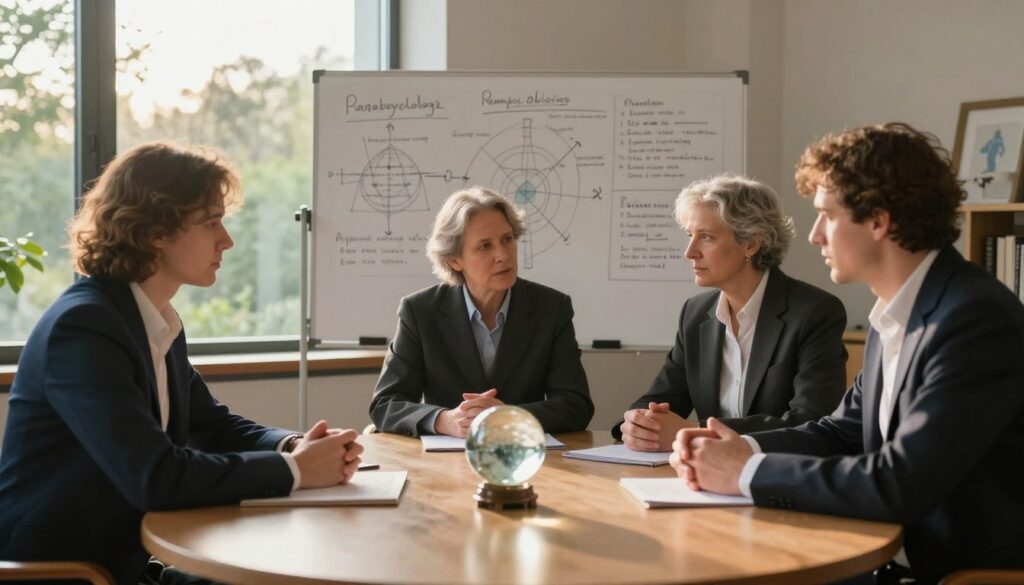
Separating Fact from Fantasy in Parapsychology
Careful sifting of records separates credible results from tall tales in parapsychology.
Claims about abilities often outpace the data. Many individuals have made grand statements that do not match controlled outcomes.
To sort truth from hype, researchers focus on the method and the process used during sessions. That means examining how each session was run, how a target was defined, and how results were scored.
Evidence from logged tests is the key. By studying session notes, transcripts, and ratings, analysts can see what trained remote viewers actually produced over time.
- Compare claims to documented data, not anecdotes.
- Check protocols and scoring to spot bias.
- Favor replicated results across different people and settings.
“Objective review of session logs can cut through decades of exaggerated accounts.”
Keeping a critical perspective helps the field grow. When the program and others show clear methods and repeatable results, people can judge the effect fairly.
Conclusion
What endures from these programs is less a single proof and more a framework for testing unusual reports. Ingo Swann helped build methods that focus inquiry and produce measurable results.
The role of the trained viewer matters: a disciplined approach changes how a mind reports a distant target. Clear note taking and strict data handling improve repeatability and make assessment fairer.
While the overall evidence remains debated, the record shows lasting value in careful methods. Over time, continued study will refine what works and what the archived results truly represent.
FAQ
What is the difference between natural intuition and a disciplined protocol in psychic research?
Natural intuition refers to spontaneous impressions or insights that an individual may experience without formal training. A disciplined protocol, often used in structured training, organizes steps, prompts, and feedback to guide a person’s impressions into reproducible reports. Research at institutions like the Stanford Research Institute and programs linked to the U.S. Army focused on protocol to reduce bias and improve measurable results.
How did early research at Stanford Research Institute shape later programs?
Early work at the Stanford Research Institute provided controlled experiments, documentation, and statistical tracking that convinced some funders to support further research. This groundwork influenced later projects managed by intelligence agencies and the Stargate Project, where formal procedures were adapted for operational evaluation and training of viewers.
What was the Stargate Project and why does it matter?
The Stargate Project was a U.S. government program that tested the usefulness of psychic techniques for intelligence gathering. Managed across several agencies, it emphasized training, quality control, and tasking techniques. The project matters because it generated declassified reports, operational case studies, and debate over practical value versus methodological flaws.
Are there specific stages or steps used in the original protocol?
Yes. Original protocols used a series of stages to guide perception, from broad impressions to finer sensory details. These staged methods aimed to focus a subject’s attention and progressively refine data. Researchers documented stage descriptions, scoring methods, and case histories to assess consistency and accuracy.
Did training manuals or military materials influence the methodology?
Military training manuals and operational guides influenced how procedures were standardized. Manuals emphasized repeatable steps, control conditions, and record-keeping to make results defensible for decision-makers. That influence helped move some practices from anecdote toward systematic testing.
What are the main scientific criticisms of psychic research protocols?
Critics point to methodological weaknesses such as small sample sizes, lack of double-blinding in some studies, sensory leakage, and publication bias. Peer reviewers often request more rigorous controls, pre-registered protocols, and independent replication to validate claims of anomalous information transfer.
How reliable are results from disciplined remote protocols compared with spontaneous reports?
Disciplined protocols often yield more consistent, traceable data than spontaneous reports because they control environment, tasking, and feedback. However, scores vary widely by study. Some controlled trials report statistically significant hits, while others fail to replicate. Overall reliability depends on design, scorer blindness, and sample size.
Were any operational successes documented in government-sponsored programs?
Declassified documents describe instances where trained individuals produced useful leads or corroborating details. Yet agencies routinely weighed those successes against false positives and the costs of validation. Official assessments often took a cautious tone, acknowledging interesting results but calling for stricter science.
Can anyone learn disciplined techniques to improve accuracy?
Training can improve consistency of reporting and task discipline. Courses and protocols teach methods for sketching, targeting, and filtering impressions. That said, individual differences in aptitude, practice, and feedback matter; not all trainees reach operationally useful performance.
Is there evidence for secret advanced stages beyond the documented protocol?
Claims about hidden or advanced stages appear in some accounts, but the historical record and declassified material do not provide clear, verifiable documentation of operationally distinct secret stages. Scholars recommend examining original reports and verified manuals rather than relying on anecdote.
How do researchers score and validate reported data?
Validation strategies include blind scoring against target sets, independent judges, statistical analysis, and inter-rater reliability checks. Good studies predefine scoring criteria and use decoy targets to reduce chance matches and evaluator bias.
What role did investigators like Hal Puthoff and others play in the field?
Scientists such as Harold Puthoff led many early laboratory efforts to measure anomalous cognition under controlled conditions. Their work produced experiment protocols, data sets, and peer-reviewed discussion that shaped how later teams approached testing and operational evaluation.
How should a layperson evaluate extraordinary claims in this area?
Look for peer-reviewed publications, detailed methodology, pre-registered studies, and independent replication. Declassified case files can be informative, but weigh anecdotal success against documented error rates. Healthy skepticism and demand for rigorous evidence are good approaches.
Are there modern research efforts or academic studies continuing this work?
Yes. While mainstream labs are cautious, some independent researchers and academic groups continue studies on anomalous cognition. These projects focus on improving protocols, statistical methods, and transparency to address earlier criticisms and test reproducibility.
Where can I find original reports and declassified material for review?
Public archives, government declassification databases, and university collections host many project reports and memos. Searching the National Archives, Freedom of Information Act releases, and university repositories will yield primary documents for closer study.