

This opening sets a clear aim: to introduce surprising mental abilities that sit at the edge of mainstream study. Short, careful description helps readers grasp why these reports spark debate and curiosity.
Many scientists study these claims with strict methods and healthy skepticism. Jonathan W. Schooler and other scholars appear in journals that test whether such phenomena break known laws or reflect quirks of design and perception.
The balance is key. Good work keeps firm standards while staying open to strong, repeatable findings that could change how we view thought and time.
This article will guide readers through aims, methods, and the main questions. Expect clear examples and careful language that respect both data and doubt.
Key Takeaways
- Studies probe mental reports that challenge familiar models of mind.
- Leading academics publish careful tests in peer venues.
- Clear methods help separate true effects from artifacts.
- Findings may push the limits of current theory if robust.
- Balanced openness and rigor drive credible progress.
Defining Anomalous Cognition
Clear definitions help readers separate well-established mental skills from claims that challenge standard models.
Core Concepts
Psi serves as a practical label for cases that seem to step outside accepted explanations. Scholars use the term to group reports that resist standard accounts.
Anomalous cognition describes processes that appear to work beyond usual sensory channels and known biology. Researchers aim to test whether such reports reflect true effects or artifacts of design and bias.

- Some reports describe accurate perception without normal sensory contact.
- Others claim information appears without a clear causal path.
- Distinguishing routine mental abilities from striking exceptions requires strict controls and clear definitions.
Accurate description and careful testing help teams decide if a reported phenomenon merits further study. Clear language keeps debate focused on data rather than on impressions.
The Historical Roots of Parapsychology
The story of this field traces back to thinkers who urged careful, open-minded study.
William James warned in 1890 that the academic mind moves slowly when facts challenge accepted systems.
“The extreme slowness with which the academic mind acknowledges wild facts that threaten accepted systems.”
Over the last century, hundreds of studies explored claims that thought might reach beyond ordinary senses. Early work set methods that later labs refined.
Major moments include Bem and Honorton (1994), whose meta-analyses reported positive findings that sparked further debate about evidence and replication.
That debate keeps the field tied to core scientific values: clear methods, repeatable studies, and honest appraisal of evidence.

| Era | Key Figure | Findings | Replication Status |
|---|---|---|---|
| Late 1800s | William James | Called for open, careful study | Contextual, limited |
| Mid 1900s | Bem & Honorton | Meta-analyses reported positive evidence | Mixed, follow-up needed |
| Late 1900s–2000s | Various labs | Hundreds of studies with varied outcomes | Ongoing replication efforts |
Understanding What Is Anomalous Cognition in Parapsychology Research
Researchers often focus on tiny but recurring signals that resist easy explanation.
Small effects appear across several controlled studies. Daryl Bem’s 2011 paper on retroactive facilitation of recall brought these patterns into mainstream debate.
Many experiments report modest effect sizes. That leads to questions about statistical power and the true meaning of a reported signal.
Replication proves difficult. Labs struggle to reproduce results consistently, so claims about psi and precognition remain contested.

- Some studies show repeated but small effects that merit careful analysis.
- Effect size often drives discussion about sample size and design.
- Robust replication is essential before a finding gains wide acceptance.
“Bem’s experiments pushed journals and labs to ask harder questions about methods and replication.”
The Role of Bayes Theorem in Scientific Appraisal
A mathematical tool can turn heated disagreement into a clear weighing of evidence.
Bayes theorem gives a formal way to update belief when new data arrive. It forces scientists to state a prior view and then calculate how a new study shifts that view.
Subjective priors matter. For example, Sean Carroll estimated extremely low odds for some claims, so he treats new evidence with great skepticism. By contrast, Brian Josephson has argued that telepathy looks plausible to him, given his physics perspective. These different priors shape how identical results read to each scientist.

Polarized evidence
One study can please one reviewer and alarm another. That split happens because each person combines prior belief and the reported evidence differently.
- Bayes gives a numeric way to show why views diverge.
- It clarifies when more data will move a community toward consensus.
- It shows why strong priors require stronger results to shift a mind.
| Element | Example | Effect on Appraisal |
|---|---|---|
| Prior belief | Carroll: very low odds | Demands large, repeatable results |
| Theoretical support | Josephson: quantum models | Raises openness to small signals |
| New study | Single experiment | May move strong priors little |
For more on predictive claims and precognition, see a concise precognition overview.
Evaluating Personal Experiences as Scientific Data
A single vivid experience can change a scientist’s angle and drive a new line of inquiry. Personal perception often motivates careful study, but it must move from anecdote to testable claim before it counts as solid evidence.

William James famously leaned toward belief after studying mediums. His move shows how a personal view can shift priors and inspire formal experiments.
“Philosophical doubts disappear when confronted by facts.”
Evaluating an experience as data requires rules: document timing, preserve raw notes, and seek independent witnesses. Memory and expectation distort many accounts, so controlled tests help separate true signal from bias.
| Role of Experience | Strength | Limit |
|---|---|---|
| Generate hypotheses | High | Subjective bias |
| Point to patterns | Moderate | Reporting errors |
| Motivate replication | High | Needs formal data |
Bottom line: Personal reports can start scientific work, but rigorous methods must follow to turn that experience into reliable evidence about the nature of mind and perception.
The Debate Over Scientific Methodology
Differences over method shape whether reported cognition findings earn serious attention. Critics argue current designs leave room for bias, selective reporting, and weak controls.
Proponents counter that the hypothesis deserves careful testing with fresh tools and open-minded teams. They urge stronger protocols, preregistration, and independent replication to reduce ambiguity.

Key methodological needs include clear protocols, transparent data handling, and shared materials so others can repeat the work. Without this, claims lack persuasive power.
“Establishing rigorous methods helps turn surprising claims into testable science.”
- Transparent reporting builds trust.
- Balanced critique improves study design.
- Robust controls protect against false positives.
| Issue | Critic View | Suggested Fix |
|---|---|---|
| Control quality | Often weak | Stricter blinding and automation |
| Statistical practice | P-hacking risk | Preregistration and larger samples |
| Transparency | Limited sharing | Open data and protocols |
| Theory fit | Low prior plausibility | Use Bayes and explicit priors |
Careful, open debate matters. For a practical primer on related topics, see this extrasensory perception overview.
Common Challenges in Experimental Design
Careful trial layout prevents subtle cues from skewing an experiment’s outcomes. Small procedural choices can create bias that mimics a real effect.

Counter-balancing Biases
Counter-balancing keeps conditions from favoring one outcome. In one study, Venkatasubramanian et al. (2008) used green and red stars to mark trials. That color cue could influence the receiver and produce a false signal.
Good practice randomizes stimulus features and swaps targets across sessions. This reduces the chance a participant learns a pattern.
Trial Order Randomization
Proper randomization of trial order prevents participants from anticipating targets. If order repeats, an attentive participant may bias results.
- Ensure the number of trials is enough to reach a reliable effect size.
- Use automated random sequences to avoid human error.
- Predefine control checks so study artifacts are obvious.
Takeaway: Rigorous design, balanced cues, and randomized order raise confidence in experimental results. For a practical primer on related methods, see this psychic powers overview.
The Importance of Information Shielding
Robust shielding stops ordinary signals from masquerading as unexpected effects.
Clear information barriers keep standard cues from reaching the receiver. Good shielding proves that any result did not flow through normal channels or simple tricks.
In Achterberg et al. (2005), the team did not state whether contact between the healer and participants was prevented. That omission weakens the credibility of their trials.
To preserve integrity, the target must stay isolated during every trial. Researchers should document control steps and show that no human or technical mechanisms could leak data.

- Separate sender and receiver spaces for all trials.
- Automate randomization so targets cannot be predicted.
- Log and archive all conditions that could reveal information.
| Design Element | Primary Goal | Common Failure |
|---|---|---|
| Physical separation | Prevent face-to-face cues | Unstated contact paths |
| Automation | Remove human handling | Manual sequencing errors |
| Monitoring | Detect leaks | Missing logs or cameras |
“Shielding assures that observed effects cannot be traced to normal communication.”
Addressing Sample Size and Statistical Power
Many studies falter because they enroll too few participants to spot a true effect. Small samples make it easy to miss real signals or to report unreliable significant results.
Button et al. (2013) warned that low sample sizes in neuroscience reduce the reliability of reported effects. Their analysis shows a high risk of false negatives when power is low.
To improve confidence, investigators should increase the number of participants and predefine the expected effect size. Larger samples strengthen the level of evidence and make results easier to reproduce.
Better power improves analysis and helps critics accept findings that hold up under scrutiny. That step moves the field toward clearer, more robust data.

- Underpowered studies often miss existing effects or produce unstable findings.
- Adding participants raises the chance of detecting a true effect size.
- Transparent planning of sample number and analysis reduces ambiguity.
| Issue | Typical Problem | Fix |
|---|---|---|
| Small sample | Low power, false negatives | Increase participants |
| Undefined effect size | Unclear targets for analysis | Predefine expected effect size |
| Poor reporting | Selective results | Preregistration and open data |
Exploring Telepathy and Distant Intentionality
Studies of distant intent test whether minds share signals across physical gaps. Labs look for matched neural patterns and behavioral hits when sender and receiver sit apart.

Standish et al. (2003) reported correlated fMRI activity between isolated participants during telepathy trials. Richards et al. (2005) later replicated similar functional MRI findings with separated subjects.
These cases push the psi hypothesis: some effects might arise outside known biology or physics. Careful control matters. Teams design experiments so a receiver guesses targets and so ordinary information transfer cannot explain results.
- Use strict separation and automated signal selection to block leaks.
- Predefine outcomes and preregister analysis to reduce bias.
- Replicate with different teams to check whether an effect holds.
Bottom line: fMRI matches offer intriguing evidence, but solid conclusions need repeated, well-controlled trials that rule out mundane information paths.
The Science of Precognition
Some experiments claim brain signals register events before those events occur. That claim forms the core of modern precognition work and drives heated debate about time and cause.

One notable case comes from Bierman and Scholte (2002). Using fMRI, they reported presentiment: neural activity that seemed to precede an upcoming stimulus. Supporters cite this as strong evidence for a measurable effect that challenges linear perception of time.
The science community remains split. Critics point to possible artifacts, statistical quirks, or design flaws. Advocates call for more replication and tighter controls.
Key points: precognition tests ask whether the brain can predict future events. The best studies combine blind protocols, preregistration, and larger samples. Only careful work can show whether observed effects are true signals or experimental noise.
“Claims that neural activity anticipates later stimuli demand rigorous methods and open data.”
Ongoing studies will decide if the hypothesis holds as a real phenomenon or an intriguing example of how hard it is to separate signal from bias.
Neuroimaging and the Search for Neural Correlates
Researchers now ask whether distinct neural patterns appear when a receiver reports hits on hidden targets. Functional MRI and EEG let teams watch timing and networks during telepathy and precognition trials.
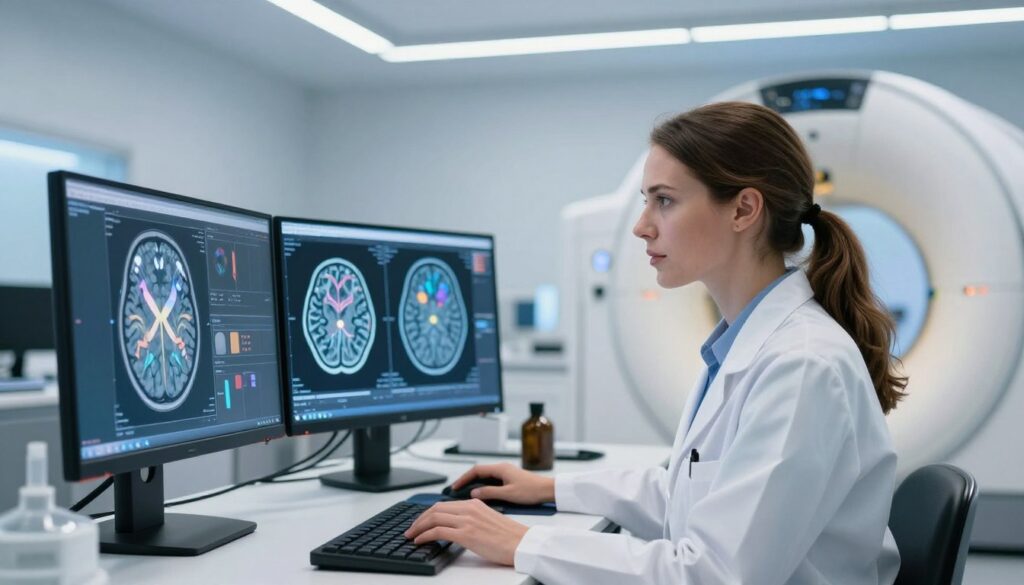
Many studies use brain scans to find a biological basis for reported psi effects. Some papers report suggestive patterns, but other work finds no clear signal.
In 2008, Moulton and Kosslyn published a notable study that failed to support psi. Their results underline how hard it is to get significant results that survive strict controls.
Historical context matters too: Hans Berger’s 1940 EEG work began after a personal telepathic episode with his sister. That story shows how an experience can prompt a long line of study.
Scanner conditions matter. Noise, tight spaces, and timing errors can alter data and lower effect size. Teams must control order, comfort, and logging so analysis compares clean sets of trials.
“Careful imaging work can show whether brain function links to reports of future events.”
- Use preregistered protocols for each study.
- Automate target selection to prevent leaks.
- Report raw data so others can reanalyze results.
The Impact of Participant Comfort on Results
Participant mood and body comfort can change the signal seen on a scanner far more than many teams expect.

Small stressors—tight headphones, noisy cooling fans, or long runs—raise heart rate and shift brain patterns. Those shifts can alter measured effect size and skew results.
Teams should record each participant’s reported relaxation level and include that score as a covariate in analysis. Doing so helps separate true experimental effects from stress artifacts.
For a receiver under strain, a subtle psi signal may vanish beneath noise. Comfort becomes a practical control: breaks, clear instructions, and padding reduce false positives and false negatives.
- Ask participants to rate comfort before each run.
- Use those numbers in the final statistical analysis.
- Standardize rest breaks and the testing set across the number of trials.
| Design Element | Purpose | Practical Step |
|---|---|---|
| Relaxation rating | Control for stress effects | Include as covariate in analysis |
| Physical comfort | Reduce motion artifacts | Pads, headphones, timed breaks |
| Receiver monitoring | Track stress during experiment | Heart rate and self-report logs |
| Standard protocol | Harmonize conditions across participants | Scripted instructions and identical set-up |
Example: adding a single comfort covariate can shrink unexplained variance and boost confidence that an observed effect reflects the experiment, not an upset participant. For techniques that improve participant calm, see a practical relaxation covariate guide.
Distinguishing Between Entertaining and Endorsing Hypotheses
Scientists must keep two mental doors open: one for ideas worth probing and one for claims that need strong proof.
Entertaining a hypothesis means allowing study to continue while asking for better data. This stance encourages careful follow-up without declaring a claim true.
Endorsement requires higher standards: repeated findings, transparent methods, and independent confirmation. Only then should a community accept a major change to accepted views.
The balance protects science from hasty conclusions. It also keeps inquiry humble. Researchers can pursue promising leads while staying cautious about sweeping claims.
- Allow investigation but demand replication.
- Favor open methods, preregistration, and shared data.
- Keep strong priors and Bayes-style thinking to weigh evidence.

Bottom line: stay curious, stay critical. For a concise primer on forward-looking tests, see this precognition primer.
Future of Parapsychological Inquiry
Future studies will hinge on better methods, larger samples, and clear reports that reviewers can check.
Teams that adopt a rigorous scientific approach will gain more traction when they publish a well-documented paper or article in mainstream outlets.

Replication must be a priority. Multiple labs should repeat promising studies with preregistered protocols and shared data.
New experimental designs can better isolate the true nature of psi effects and reduce mundane explanations. That discipline will clarify whether an observed signal reflects a real phenomenon or an artifact.
- Publish clearly: full methods, open data, and preregistration.
- Replicate often: independent teams and larger samples.
- Engage respectfully: skeptical dialogue with mainstream science.
“The ongoing debate over the psi hypothesis pushes method forward and sharpens scientific standards.”
For practical tools and starter experiments, see a short guide to discover telepathic abilities. That resource can help teams design humane protocols and recruit stable participants.
Conclusion
Wrapping up, critical tests and honest data will decide which claims endure. This guide traced the complex landscape around cognition, evidence, and method. It urged clear protocols, Bayes-style thinking, and larger samples.
For the field to move forward, teams must publish full data and repeat promising cases. Future studies will test whether reported effects shift our theory of mind. Stay curious but demand strong, transparent evidence. That balanced view best serves science and the process of discovery.
FAQ
What is the basic idea behind anomalous cognition studies?
These studies test whether people can access information beyond ordinary senses. Experiments present targets—images, locations, or events—and measure whether a receiver can identify them at rates above chance. Researchers track hits, misses, and statistical effect sizes to judge significance.
How do researchers measure success in psi experiments?
Success uses statistical tests and effect size metrics like Cohen’s d or z-scores. Scientists report p-values and confidence intervals. They also look at trial counts, participant numbers, and replication across studies to assess reliability.
What role does Bayes’ theorem play in evaluating results?
Bayes’ theorem helps combine prior beliefs with new data. It formalizes how subjective priors change after observing results, clarifying how strong evidence must be to shift consensus. This makes evaluation more transparent.
Why are control procedures and shielding important?
Controls prevent information leakage and sensory cues. Shielding—physical or procedural—aims to block normal channels. Without strict controls, positive results may reflect artifacts, bias, or experimenter effects rather than any anomalous process.
How do sample size and power affect findings?
Small samples produce unstable effect estimates and low power, raising false positive risk. Adequate participant counts and many trials reduce noise and improve confidence in effect size estimates and replication chances.
What challenges arise from trial order and counterbalancing?
Order effects and learning can bias outcomes. Randomization and counterbalancing distribute practice, fatigue, and expectancy evenly. Proper design ensures that apparent effects don’t stem from predictable trial sequences.
Can personal experiences be treated as scientific data?
Individual accounts offer hypotheses but lack controls and systematic measurement. They can guide formal experiments, but scientists rely on well-designed, repeatable studies to draw reliable conclusions about any phenomenon.
Has laboratory evidence for precognition or telepathy been replicated?
Some laboratories report statistically significant findings across meta-analyses, while others fail to replicate. The field features mixed outcomes; consistent replication, preregistered protocols, and open data remain essential for stronger claims.
What mechanisms have been proposed to explain reported effects?
Theories range from information entanglement and nonlocal correlations to cognitive models emphasizing expectation and pattern detection. No mechanism has gained broad empirical acceptance or clear neural correlates yet.
How do neuroimaging studies contribute to this topic?
Neuroimaging aims to find brain activity linked to reported hits or precognitive events. Results are preliminary; some studies note correlations, but findings lack consistent replication and face challenges like multiple comparisons and small samples.
What constitutes a significant result in this field?
Significance combines p-values, effect sizes, replication, and methodological rigor. A single low p-value is weak unless supported by replication, preregistration, and control for biases that might inflate false positives.
How important is experimenter bias and blinding?
Extremely important. Experimenter expectations can subtly influence outcomes. Double-blind procedures, automated target selection, and independent scoring help reduce bias and strengthen evidence quality.
Are there standard target types used in experiments?
Common targets include photographic images, geomaps, sealed envelopes, or future event outcomes. Researchers select targets that minimize sensory cues and maximize objective scoring to reduce ambiguity in results.
What statistical practices improve credibility of findings?
Practices include preregistration, power analysis, transparent data sharing, correction for multiple comparisons, and reporting effect sizes alongside p-values. These steps reduce false positives and clarify evidence strength.
How do researchers address skeptic concerns about methodological flaws?
They adopt stricter protocols, independent replication, and external auditing. Publishing raw data and lab scripts allows critics to reanalyze results and assess whether effects persist under scrutiny.
What practical steps improve participant comfort and data quality?
Clear instructions, breaks, comfortable settings, and neutral experimenter demeanor reduce stress and variability. Comfortable participants provide steadier baselines, lowering noise in physiological or behavioral measures.
How do studies distinguish entertainment acts from scientific claims?
Science requires transparent methods, repeatability, and rigorous controls. Stage performances often rely on tricks and audience cues. Researchers emphasize repeatable protocols and statistical validation rather than anecdote or showmanship.
What are common sources of false positives?
Multiple testing without correction, selective reporting, small sample sizes, and unblinded procedures often generate false positives. Rigorous methodology and full reporting reduce these risks.
What does future research need to advance understanding?
Larger, preregistered multicenter trials, open data, standardized protocols, and cross-disciplinary work combining psychology, neuroscience, and statistics. Better mechanistic models and independent replication would strengthen conclusions.
Where can I find peer-reviewed literature and meta-analyses?
Look in journals like Journal of Consciousness Studies, Journal of Parapsychology, and mainstream outlets when they cover related topics. Meta-analyses and systematic reviews help summarize evidence and methodological quality across studies.