

This guide explores the best books on ingo swann and remote viewing to help readers navigate a complex chapter of psychic research. It offers clear context about key texts that shaped study and debate in past decades.
Ingo Swann was a pioneering figure who worked with government researchers to probe the human mind. His work linked experimental protocols with claims that reached for the stars in scope.
We examine foundational texts that defined the field and established Swann’s reputation as a hands-on researcher. The selections show how scientific inquiry mixed with metaphysical questions.
Readers will find summaries, historical notes, and practical pointers to understand the legacy left by these investigations. The list highlights significant works that document life, methods, and the wider field of parapsychology.
Key Takeaways
- Clear overview of seminal works tied to Ingo Swann’s research.
- Context about collaboration between researchers and agencies.
- Insight into methods that aimed to test human perception.
- Connections between scientific reports and broader claims.
- Guidance to help readers choose which texts to explore first.
Introduction to Ingo Swann and Remote Viewing
Ingo Swann began his journey at Westminster College in Salt Lake City, Utah, before stepping into a long career as a principal subject in parapsychology labs.
He took part in hundreds of thousands of trials. Because of that volume, Martin Ebon called him “parapsychology’s most tested guinea pig.”
The practice known as remote viewing seeks impressions about distant or unseen targets by sensing with the mind. Researchers designed controlled settings to reduce guesswork and record results.
Early laboratory work helped shape protocols and taught investigators how to judge hits, misses, and ambiguous feedback. Those methods aimed to make subtle impressions measurable.
Some experimenters believed the universe held signals worth accessing. The idea that the stars and vast space might offer information drove certain long-range trials.

“He often served as a bridge between experimental rigor and exploratory practice.”
- College training to lab subject
- Extensive experimental participation
- Structured methods to probe perception
The Best Books on Ingo Swann and Remote Viewing
Several influential texts map how experimental methods met personal testimony in this field.
Foundational texts include Russell Targ’s Limitless Mind, a practical guide that links remote viewing with shifts in awareness. This book offers both method and mindset for readers curious about laboratory protocols.

Foundational Texts
Paul H. Smith, as an author, provides clear reporting on the CIA program and its procedures. His work explains how sealed boxes were used to create test conditions that reduce bias.
Modern Perspectives
Star Fire is a personal account that explores visionary experience amid scientific testing. A special edition updated release brings new notes that connect past trials to later reflections.
- Limitless Mind — method plus consciousness work
- Paul H. Smith — program history and lab detail
- Star Fire — memoir that links stars with inner sight
“These writings form a bridge between experiment and experience.”
Penetration and the Question of Extraterrestrial Telepathy
Penetration asks whether human minds can bridge the gulf between our planet and distant intelligences.

Penetration presents a sustained look at extraterrestrial human telepathy. In this work, ingo swann explores whether innate human faculties can reach across vast space. The book frames the core question extraterrestrial human telepathy poses for study and debate.
Swann proposes that human telepathy may operate beyond usual limits. He links those claims to shifts in consciousness and to protocols that aim to test reach and reliability.
“The possibility of contact forces a rethink of perception’s range.”
- Penetration examines claims about extraterrestrial human telepathy and implications for research.
- The text argues humans might possess channels for long-distance exchange.
- Study of these claims often looks toward the stars for context and comparison.
Secrets of Power and Individual Empowerment
Secrets of Power frames power as a hidden resource that society often teaches people to ignore.
Swann argues that many are conditioned into limited performance. This conditioning keeps latent faculties from emerging.
The text explores individual empowerment as a way of vitalizing individual powers suppressed by social structures. It offers clear steps for readers to reclaim potential.

These books act as a pragmatic roadmap. They show how to move beyond the secrets power dynamics that govern modern life.
“True power is often hidden, like distant stars washed out by city glare.”
By focusing on empowerment, readers learn to unlock abilities within their own information systems. The series serves as a guide to spot mechanisms of control and follow a practical path toward freedom.
For a practical companion on developing inner faculties, see this guide to basic psychic development.
Understanding the Societal Panorama of Power
A clear view of how social systems limit personal agency helps explain why latent talents remain unused. This panorama shows layers of influence that shape beliefs, habits, and opportunity.

Depowerment Mechanisms
Depowerment mechanisms work quietly. Institutions, media, and routine expectations can reduce curiosity and risk taking.
Ingo Swann noted that these systems keep many people in a state of latency. That cycle of restriction repeats across workplaces, schools, and civic life.
Reclaiming Personal Power
Reclaiming personal power begins with simple steps: notice limiting messages, practice small acts of choice, and build steady skills.
The panorama power depowerment cycle is central for anyone seeking individual empowerment societal growth. By spotting the secrets power uses to suppress potential, readers can push back and expand reach—toward higher aims, even the stars.
“Recognize the frame, then change the view.”
- Map local rules that limit action.
- Practice daily choices that build confidence.
- Study texts that explain the empowerment societal panorama.
The Science of Coordinate Remote Viewing
Coordinate remote viewing began as a lab method to convert subtle impressions into testable results. In 1972, ingo swann coined the phrase while working at the American Society for Psychical Research.
The technique asks a viewer to focus their mind on specific geographic coordinates and report what appears. Practitioners often imagine the target inside a sequence of mental boxes to structure perception.
Researchers such as Harold Puthoff and Russell Targ formalized the approach with CIA funding to see if the method had intelligence value. Results sparked long debate: the experimental setup mattered as much as the claimed hits.
The real interest is the success factor in controlled trials. Some labs found repeatable signals; skeptics argued about protocols and bias. Still, the method’s power lies in bypassing distance—much like studying the stars through a telescope.
“Coordinate methods aimed to make subjective impressions verifiable through clear targets.”
- Origin: Term coined in 1972 at ASPR.
- Method: Focus on coordinates; use mental boxes.
- Research: Developed further by Puthoff and Targ with funding.
- Debate: Success factor depends on strict controls.
Memoirs from the Stargate Psychic Spy Program
Memoirs from the Stargate program open a rare window into Cold War experiments that mixed intelligence aims with unusual claims about perception.

Inside the CIA Stargate Program
Key participants described sealed trials that targeted planets such as Jupiter and Mars. The program was declassified in July 1995, making those files public.
The book Memoirs of a Psychic Spy offers a firsthand account of sessions that focused on distant targets. It reports a famous 1973 probe of Jupiter that noted a ring of asteroids — a finding later confirmed by Voyager in 1979.
Personal Accounts and Aftermath
These narratives document the secrets held by intelligence units and the claimed power of psychic espionage during the Cold War era.
- He was a central participant in the declassified program.
- Session logs targeted planets and produced striking descriptions.
- The great lost work of the program is often discussed in these memoirs.
“Looking back at the stars, the sessions showed an uncanny ability to perceive distant locations with notable accuracy.”
For readers curious about the human side of those declassified records, see this short guide to famous psychics that places memoir accounts in a wider context.
Exploring Human Consciousness and Reality Boxes
The human mind often builds simple frames that hide deep wells of awareness.
Ingo Swann explored how our daily reality boxes limit perception. These boxes act as filters. They keep many inner regions unseen, like dark patches in space.

The metaphor of black holes human suggests areas of the psyche that resist easy study. Swann examined these holes human consciousness to show where our sense of power becomes constrained.
He argued the stars mirror the vast potential inside human consciousness. By mapping those gaps, he hoped people could expand sight beyond routine limits.
“Reality boxes shape what we trust as real; exploring their edges opens new possibility.”
- Identify a box: notice repeated assumptions.
- Probe a hole human: practice brief, focused attention.
- Stretch perception: imagine larger contexts, like cosmic scale.
For a concise profile of Swann’s work, see this short guide: Ingo Swann overview.
Scientific Perspectives on Extrasensory Perception
Scientific groups pushed the study of psi from anecdote into experiment by using strict controls and blind methods.
Ingo Swann worked with labs and agencies to test claims under repeatable conditions. His role helped bring extrasensory perception into formal inquiry rather than leaving it a string of stories.

Researchers asked whether the mind can interact with reality in ways that defy usual physical explanations. They probed the limits of consciousness and the supposed power of perception at a distance.
“Rigorous protocols turned subjective impressions into records scientists could analyze.”
- Controlled trials reduced bias and improved scoring.
- Statistical methods sought repeatable signals amid noise.
- Debate remains; some effects resist easy explanation.
| Study Aspect | Goal | Outcome |
|---|---|---|
| Protocol Design | Eliminate cueing and bias | Clearer scoring, mixed replication |
| Statistical Tests | Assess significance of hits | Some positive results, contested |
| Interpretation | Relate findings to mind models | Ongoing theoretical debate |
Comparisons to the stars often appear as a metaphor: distant, subtle signals that may hint at wider capacities. While ingo swann helped legitimize study, the field still needs larger, transparent trials to settle questions about true capability.
Practical Guides for Developing Innate Abilities
Practical guides teach simple steps that help a reader access latent perception and build steady practice.
Accessing innate ability starts with focused attention. Short, daily exercises train the mind to notice subtle impressions.

Accessing Innate Ability
Clear drills include sensory isolations, sketching impressions, and timed sessions. These tasks make inner signals easier to record.
Seeing the Future
Developing the ability see future needs discipline. Practitioners keep logs and compare outcomes. Over time, patterns form that reveal reliability.
“Vital practice, short sessions, steady notes — that builds confidence and measurable skill.”
- Everyday practice: five to ten minutes of focused attention.
- Tracking: keep objective logs to test impressions.
- Empowerment: exercises aim at vitalizing individual powers and personal empowerment.
| Exercise | Time | Primary Benefit |
|---|---|---|
| Sensory Isolation | 5–10 min | Sharpened attention |
| Sketch Protocol | 10–15 min | Concrete records |
| Future-Scenario Drill | 15 min | Pattern detection |
For practical guidance, a short book like Everybody’s Guide to Natural ESP by ingo swann offers exercises for accessing innate ability. These routines link steady practice with individual empowerment and the quiet suggestion that the stars mirror inner reach.
The Role of Psychic Research in Government Projects
Government labs once treated psychic research as a potential tool for intelligence, testing whether trained minds could gather useful data.
Ingo Swann played a pivotal role in those programs, helping shape protocols used to test human ability under strict controls.
During the 1970s, agencies such as the CIA funded trials to see if disciplined viewing could yield reliable reports. Teams designed blind procedures to remove cueing and to score results objectively.
Swann’s methods provided the backbone for many lab routines. His input helped convert subjective impressions into repeatable tasks that intelligence analysts could evaluate.
“Rigorous testing aimed to prove whether human perception had practical value for strategic work.”
The researchers often used the stars as distant targets to stretch protocol limits and to compare outcomes with known data. These experiments showed both promise and controversy.
- Focused trials emphasized blind scoring and replication.
- Protocols sought to measure power while limiting bias.
- Legacy: those projects still influence how science and intelligence assess atypical claims.
For a concise overview of program history and methods, see this guide to remote viewing.
Artistic Visions and the Metaphysical Journey
Art became a language for describing perceptions that lab tests alone could not capture.
Swann was not only a researcher but a visionary artist. His work hangs in the National Air and Space Museum, where canvases hint at cosmic themes.

The book Star Fire captures much of that inner travel. A special edition updated release brings new readers closer to his metaphysical path.
Paintings reveal the secrets of process: layered hues, repeated motifs of light, and painted maps of distant stars.
Through canvas he expressed the power of experience. Visual forms made fleeting impressions tangible for viewers and critics alike.
“Art and experiment were two paths he used to explore the nature of reality.”
- Artwork displayed at a national museum links art with scientific curiosity.
- The special edition updated text pairs memoir with visual study.
- These books and images show how vision and method evolved together.
| Medium | What it Shows | Visitor Takeaway |
|---|---|---|
| Canvas | Visions of cosmic forms | Art as firsthand evidence |
| Memoir | Personal metaphysical account | Context for images |
| Exhibit | Museum display | Public engagement |
Analyzing the Great Apparitions of Mary

The Great Apparitions of Mary is a careful study that treated reported visions as material for close analysis.
In this book, Ingo Swann traced patterns in witness accounts. He argued that common traits linked these cases to wider anomalous reports.
Swann urged readers to keep an open mind. He asked investigators to test claims with the same rigor used for other psychic events.
“Consciousness frames these moments; study means mapping the frame.”
Many researchers found shared features between the great apparitions mary and other strange episodes. The descriptions often used the stars as a narrative backdrop, tying celestial imagery to earthly experience.
- Historical detail matched with parapsychological questions.
- Patterns compared across cultures and time.
- Interpretation emphasized the role of consciousness.
| Aspect | What Swann Asked | Key Insight |
|---|---|---|
| Witness Consistency | Are reports repeatable? | Recurring motifs suggest common processing |
| Cultural Context | How did setting shape visions? | Local meaning alters presentation |
| Phenomenon Link | Relation to other anomalies? | Shared traits point to broader psi patterns |
For program context and further reading, see these detailed program notes.
Essential Handbooks for Modern Remote Viewers
Modern practitioners turn to concise handbooks that translate lab protocols into daily drills.
These guides lay out step-by-step routines inherited from early protocol work by key authors. They stress a clear mind before a session and practical steps for focusing on targets hidden in boxes.
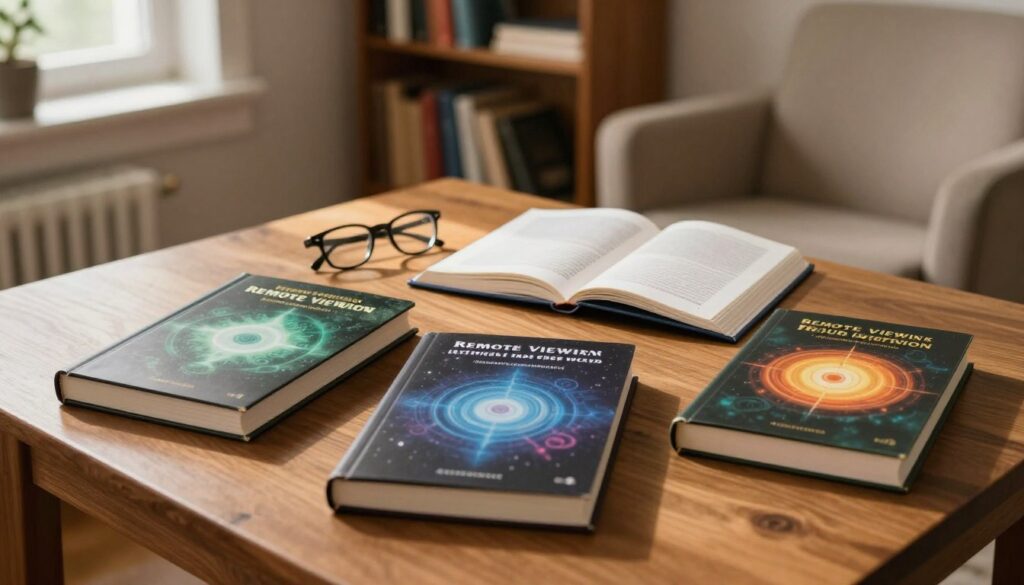
Most manuals include exercises that train sketching, timed reporting, and neutral scoring. These tasks help build steady ability while reducing guesswork.
“Practice short sessions, keep objective logs, and treat each run as data.”
- Author notes: many handbooks show protocol origins and offer case examples.
- Special edition updated releases often add modern scoring tips and fresh drills.
- Practical value: the guides aim to empower readers to test skills and map progress toward wider goals — even gazing at the stars as metaphor for expanding reach.
For anyone serious about the craft, these handbooks are a practical roadmap to mastering method, discipline, and the quiet secrets of performance.
Comparing Theoretical Approaches to Psi Phenomena
Comparative study shows that meaning, method, and mindset each act as a distinct influence on reported psi effects.
Belief often emerges as a decisive factor in experiments. When participants expect results, outcomes shift in subtle ways.
Secrets power dynamics shape interpretations. Researchers from different schools read the same data through varied lenses, which changes what counts as valid evidence.
Some models treat psi as a detectable signal. Others see it as a process tied to altered states. A third group frames it as a shift in the boundaries of daily reality.
| Approach | Core Claim | Implication |
|---|---|---|
| Signal Model | Psi yields measurable data | Emphasize strict protocol |
| Process Model | Mind states produce effects | Focus on training |
| Consciousness Model | Reality expands with intent | Study context and meaning |
“Researchers still look to the stars for metaphors and clues about non-local links.”
- Understanding approaches reveals which factors matter in design.
- The field remains active and vital for anyone curious about human power and hidden potential.
Conclusion
This closing note shows how training attention can shift everyday limits on perception. Small, steady practices make inner signals clearer and more reliable.
By vitalizing individual powers, readers may spot the hidden structures behind secrets power dynamics. That insight supports real individual empowerment and a clearer sense of agency.
Explore recommended materials, try short exercises, and keep a record of results. With curiosity and steady effort, empowerment becomes a lived skill rather than an abstract idea.
FAQ
What core texts introduce Ingo Swann’s work and coordinate viewing techniques?
Swann’s writings and early technical manuals explain fundamentals: protocols for target coordinates, perceptual training, and the use of sketching to record impressions. Look for primary sources that document lab results, session transcripts, and operational guidelines used in formal programs.
How does penetration relate to questions about extraterrestrial human telepathy?
“Penetration” refers to deep investigative sessions where viewers attempt to describe distant or hidden targets. Some practitioners use the term when exploring claims of communication between humans and nonhuman intelligences, treating those accounts as testable assertions rather than mythology.
Are there modern perspectives that update foundational techniques?
Yes. Contemporary authors blend classical protocols with improved controls, structured feedback loops, and cognitive training methods. These works often incorporate findings from cognitive science, consciousness studies, and field-tested exercises for skill development.
Can coordinated protocols be learned by individuals outside formal programs?
Many self-study manuals provide step-by-step exercises for learning coordinate-based sessions, diary methods, and target analysis. Consistent practice, objective scoring, and peer feedback help learners refine accuracy without institutional support.
What evidence supports claims of extrasensory perception in scientific literature?
Evidence includes controlled experiments reporting statistically significant hits, meta-analyses exploring effect sizes, and critical reviews that evaluate methodology. Skeptical and supportive journals both contribute, so assessing experimental rigor and replication is essential.
How do societal power dynamics influence the practice and reception of psychic research?
Social institutions shape funding, publication access, and cultural acceptance. Marginalization, secrecy, or sensationalism can depower practitioners, while transparent methods, peer review, and ethical standards help reclaim credibility and individual agency.
What memoirs or insider accounts detail government programs like Stargate?
Several former participants and declassified reports describe program history, session examples, and operational lessons. These memoirs mix personal reflection with procedural detail and are useful for understanding organizational context and practical constraints.
Are there practical guides for accessing innate perceptual abilities and foresight?
Practical guides focus on attention training, sensory modulation, journaling impressions, and developing descriptive vocabulary. They emphasize repeatable exercises over promises of prophecy and encourage critical evaluation of hits versus misses.
How do researchers address extraordinary claims about extraterrestrial contact and telepathy?
Responsible researchers apply testable hypotheses, blinded protocols, and independent verification. Extraordinary claims require robust, reproducible evidence; many investigators recommend treating reports as data for controlled study rather than accepting them without scrutiny.
What role has psychic research played in government and military contexts?
Governments have funded exploratory programs to assess potential intelligence value. Outcomes varied: some reports claimed operational utility in niche cases, while official reviews often cited methodological weaknesses. Transparency and independent evaluation remain key concerns.
How do artistic and metaphysical perspectives contribute to understanding inner experiences?
Art and metaphysics offer symbolic frameworks for interpreting nonordinary perceptions, helping practitioners integrate subjective visions into personal meaning. These approaches complement scientific methods by addressing aesthetic and existential dimensions.
What resources discuss apparitions and religious visions, such as Marian phenomena?
Scholarship on apparitions combines historical documentation, eyewitness testimony, and cultural analysis. Critical studies compare psychological, sociological, and religious explanations while preserving careful source evaluation.
How can someone compare theoretical approaches to psi phenomena?
Comparative reviews examine models from quantum analogy, transpersonal psychology, information theory, and biological frameworks. Look for works that weigh predictive power, experimental testability, and coherence with established science.
What handbooks support modern practice for individual development and ethical work?
Contemporary handbooks offer structured curricula, scoring methods, guidelines for ethical sessions, and protocols for maintaining mental health. They emphasize reproducibility, peer critique, and clear reporting standards for results.
Where can I find accessible introductions that meet rigorous standards without sensational claims?
Seek introductory texts by respected researchers that include methodological transparency, annotated session examples, and references to peer-reviewed literature. Balanced works stress skill-building, critical thinking, and cautious interpretation of unusual reports.