
Answer up front: Michel de Nostredame passed away in Salon-de-Provence on July 1 or 2, 1566.
He suffered years of painful gout that progressed to edema. Historical accounts note a will made in late June 1566 and a final, eerie report that he told his secretary Jean de Chavigny he would not be alive at sunrise.
The physician-turned-astrologer gained fame with Les Prophéties (1555). His almanacs and medical work drew patrons at court and across Europe, and his prophecies sparked debate across the world for centuries.
This introduction previews a clear, friendly walk-through of his nostradamus life, from Saint-Rémy-de-Provence and plague work to royal connections and the quatrains that shaped his reputation.
We will weigh sources and dates carefully, since editions and translations sometimes vary. American readers, especially in New York and media centers, often meet him through sensational claims; the article will separate well-sourced facts from later embellishments.
Follow along as we trace the years, events, and predictions that made his name endure and explain why his death date still draws attention.
Key Takeaways
- He died in Salon-de-Provence on July 1 or 2, 1566, with some sources differing on the exact date.
- Long illness from gout to edema and a late June will frame his final days.
- Les Prophéties and his almanacs made his predictions a global topic for centuries.
- Eyewitness notes about his last night add tradition to the historical record.
- The article will trace his life, major events, and how later retellings shaped public perception.
- Read more context and sources at this related biography.
The Historical Timeline of Nostradamus’s Life
Mapping the years of his life shows why medical setbacks pushed him toward prophecy.
Birth and family origins in Saint-Rémy-de-Provence
He was born on 14 or 21 December 1503 in Saint-Rémy-de-Provence. His family had converted from Judaism to Catholicism around 1459–60, a fact that shaped social ties and his family name.
From apothecary to physician and astrologer
Early studies at the University of Avignon ended when a severe plague forced the school to close. That outbreak linked his education to public health and steered him into work as an apothecary.
Later he enrolled at Montpellier but faced expulsion for practicing a manual trade. Those challenges over time redirected him from formal medicine toward publishing and consultation.
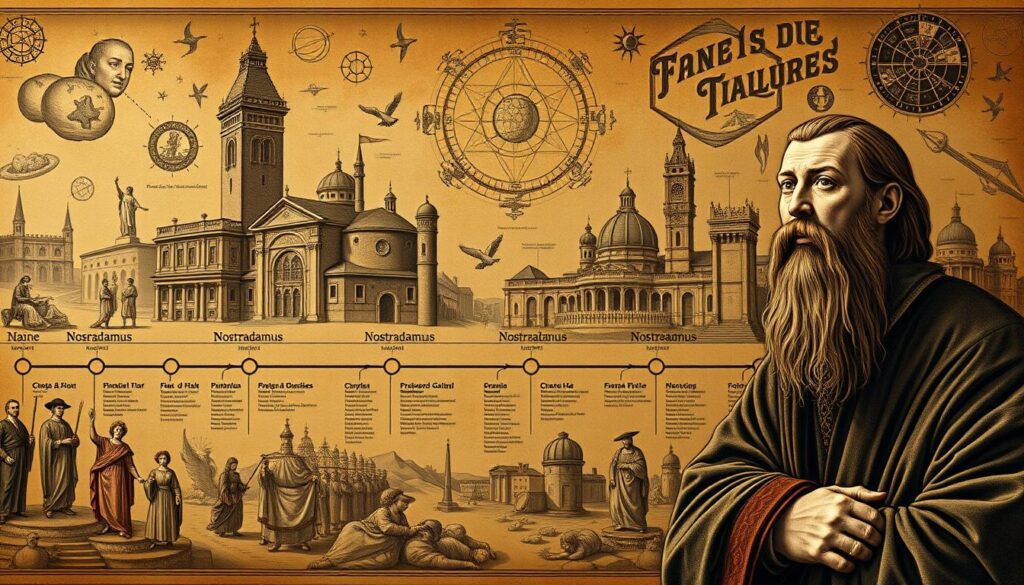
- 1503: Birth in Saint-Rémy-de-Provence.
- 1520s: Avignon studies cut short by plague.
- 1530s: Apothecary work and Montpellier expulsion.
- 1555 onward: Almanacs and the book of quatrains that made his prophecies famous.
| Period | Event | Impact | Notable Detail |
|---|---|---|---|
| 1503–1520s | Birth; family conversion | Formative identity | Saint-Rémy origin |
| 1520s–1530s | Avignon, plague, apothecary | Public health experience | Plague closure |
| 1530s–1550s | Montpellier & expulsion | Shift from medicine | Manual trade conflict |
| 1555–later years | Almanacs; Les Prophéties | Public fame | Patronage and son César’s portrait |
This concise chronology ties major events to the broader 16th century turbulence. It also notes how interruptions from plague and institutions altered his path.
Understanding these milestones helps place later claims about his quatrains and prophecies into verifiable context.
Early Life and Background in 16th-Century France
In Saint-Rémy, a mix of faith and hardship set the scene for his childhood.
Jewish ancestry and conversion to Catholicism. The paternal line had converted around 1459–60 and adopted the name Nostredame (Our Lady). That change shaped family identity in Provence and influenced how neighbors viewed the household in the 16th century.
Family lore versus recorded dates. A local tradition says he learned at the knee of his maternal great-grandfather, Jean de St. Rémy. Surviving records fade after 1504, so historians balance the story with verifiable facts and the known birth dates of 14 or 21 December 1503.
Saint-Rémy home life and customs. Daily routines followed regional religious practice. Children helped with chores and learned from elders. These traditions fostered practical skills and respect for books and oral teaching.
The shadow of plague. Recurring outbreaks closed schools and ended studies in Avignon for a time. That public health disruption steered many young people toward hands-on trades and early medical work.
Those early pressures — religious change, communal expectations, and disease — formed a backdrop that nudged him toward remedies, learning, and the book-based study that would shape his later life.
| Topic | Detail | Impact |
|---|---|---|
| Conversion | Paternal family adopted Catholic name circa 1459–60 | Shaped social identity in Provence |
| Early education | Tradition of study with Jean de St. Rémy; records limited | Mix of lore and verifiable dates |
| Childhood setting | Household rituals and communal duties | Practical skills and respect for books |
| Health crises | Recurring plague closed universities | Shift toward practical medicine and trades |
Education and Medical Career: Avignon to Montpellier
Formal study and hands-on pharmacy work shaped his early professional path.
He left Avignon after the university closed for plague and later enrolled at Montpellier in the year 1529 to seek a medical degree.
Official records (Register S 2 folio 87) show an expulsion tied to rules that barred apothecaries from university status. Those facts explain how law and practice clashed in his time.
He kept treating patients and developed practical methods as an apothecary. The famed “rose pill” became part of his popular medical work and helped build a local reputation.
Astrology was woven into medical curricula then, so celestial observation often guided diagnosis and treatment timing. That overlap of stars and remedies reflected common medical thought.
Later publications include a paraphrase and translation of Galen (1557) and the Traité des fardemens, showing how classical texts informed vernacular practice. His medical training and writings gave lasting credibility to a life that moved between care and broader public influence.

For deeper chronological detail and related predictions by year, see this predictions by year resource.
Marriage, Family, and Work Against the Plague
Personal tragedy and civic duty shaped much of his middle years.
He married in Agen about 1531. A few years later his first wife and two children died, likely from plague. Those losses left him in deep grief for several years.
In 1547 he married Anne Ponsarde and together they had six children. This household brought renewed stability and steady work in Salon-de-Provence.

He served alongside Louis Serre in Marseille (1545) and led responses in Salon and Aix. Public health events repeatedly drew him into crisis care.
His name became linked to determined service during epidemics, and those duties affected the rhythm of his writing. Practical demands shaped the almanac entries and the later book output.
| Period | Event | Impact |
|---|---|---|
| 1531–1534 | First marriage; family loss | Years of grief; increased public work |
| 1545–1547 | Plague response in Marseille; remarriage | Return to family life; six children |
| 1556–1567 | Canal de Craponne investment | Civic improvement; regional irrigation |
These events shaped his nostradamus life and helped explain why practical medicine and public projects appear throughout his later writings and almanacs.
For a modern look at later prophecies, see predictions 2025.
From Medicine to the Occult: The Shift Toward Prophecy
A steady stream of printed almanacs transformed a local healer into a sought-after advisor across Provence. His first almanac appeared in 1550, and he Latinized his name to gain wider notice. These pamphlets built trust and created demand for private counsel.

Almanacs and the rise of an astrological consultant
Almanacs opened doors to clients of means who wanted seasonal advice and personal predictions. He became an astrologer for patrons, offering charts and timing for business, health, and travel.
Les Prophéties: structure, language, and quatrains
In 1555 he published the book of quatrains that we now call Les Prophéties. The verses mix French, Latin, Greek, and Provençal and use dense, allusive syntax to hide clear meanings.
- Methods: He often relied on clients to supply birth data and on practical rules rather than formal calculation.
- Errors: By modern standards, chart work sometimes contained technical mistakes.
- Impact: The oblique tone protected him and sparked curiosity across social classes.
| Form | Use | Effect |
|---|---|---|
| Almanacs | Practical forecasts | Built client base |
| Quatrains | Literary prophecies | Invited interpretation |
| Consultation | Astrological advice | Court and civic patrons |
Overall, this shift shows how medical practice, occult taste, and print culture combined to make his prophecies a lasting part of cultural life. These works soon found powerful patrons and helped define his legacy in court circles and beyond.
Royal Patronage and Court Connections
Catherine’s interest in his printed forecasts pulled him into the center of court life.
Catherine de’ Medici and horoscopes for the royal children
After reading a lengthy book-length almanac, Catherine summoned him to Paris. She asked for horoscopes for her children.
He produced charts for the queen’s son who later became King Charles IX. Over the years his role shifted from local healer to court astrologer.
Court attention changed his public profile. A royal invitation brought him to Paris for specific events, then back to Salon-de-Provence. Time at court gave him protections most writers lacked.
| Client | Service | Outcome |
|---|---|---|
| Catherine de’ Medici | Horoscopes for royal children | Personal invitations to court |
| Charles IX (son) | Counsel and medical care | Named Counselor and Physician-in-Ordinary |
| Royal household | Astrology for ceremonies | Elevated public name |
He feared religious persecution, but his short 1561 imprisonment was over publishing permission, not heresy. Royal endorsement, especially amid King Henri’s circle, amplified his reach and secured a rare level of legitimacy.
For a look at how his quatrains spread after court patronage, see the quatrain collection.
When did Nostradamus die
Records put his final hours in Salon-de-Provence at the turn of July 1566. The exact date is disputed: reputable sources list either July 1 or July 2, 1566.
The disputed date: July 1 or 2, 1566 in Salon-de-Provence
Late June brought a marked decline. He had suffered severe gout for years and the condition progressed to edema by summer.
Facing that decline, he summoned a lawyer and wrote a clear will in late June 1566. The document laid out property transfers and a specific sum — 3,444 crowns — to support his wife and children under set conditions.

Gout, edema, and the last will and testament
Contemporary accounts record a small, time-stamped tradition: on the evening of July 1 he told his secretary they would not find him alive at sunrise. He was found dead the next morning in Salon-de-Provence.
Whether the date is July 1 or July 2, 1566, both appear in reliable records. His careful will and the reported last words show he planned for the end of life.
Even at death, his name remained linked to his prophecies; admirers and critics alike noted the circumstances. For further context on later predictions, see predictions.
Death and Immediate Aftermath
A reported conversation before sunrise helped turn an ordinary passing into enduring lore. Eyewitness notes say he told Jean de Chavigny he would not be alive at sunrise. The next morning he was found beside his bed and a small bench.

Last words and the sunrise discovery
The simple scene—a warning, a bedside, a dawn discovery—became part of local tradition. That detail shaped accounts of the final hours and reinforced public interest in his work and words.
Burial, re-interment, and the enduring tomb
He was first buried in the Franciscan chapel in Salon. During the French Revolution his remains were moved to the Collégiale Saint-Laurent, where his tomb remains today.
His son, César, later helped shape the family image through portraits and memorial efforts. Over the years, legends about relics or amulets surfaced, mixing fact with fiction.
Such reports show how events around a single time can spread across the world. The persistence of his tomb mirrors the lasting hold of his prophecies on cultural memory.
Works and Writings Beyond the Quatrains
A careful reader finds that his legacy rests as much on almanacs and medical recipes as on the celebrated verses.
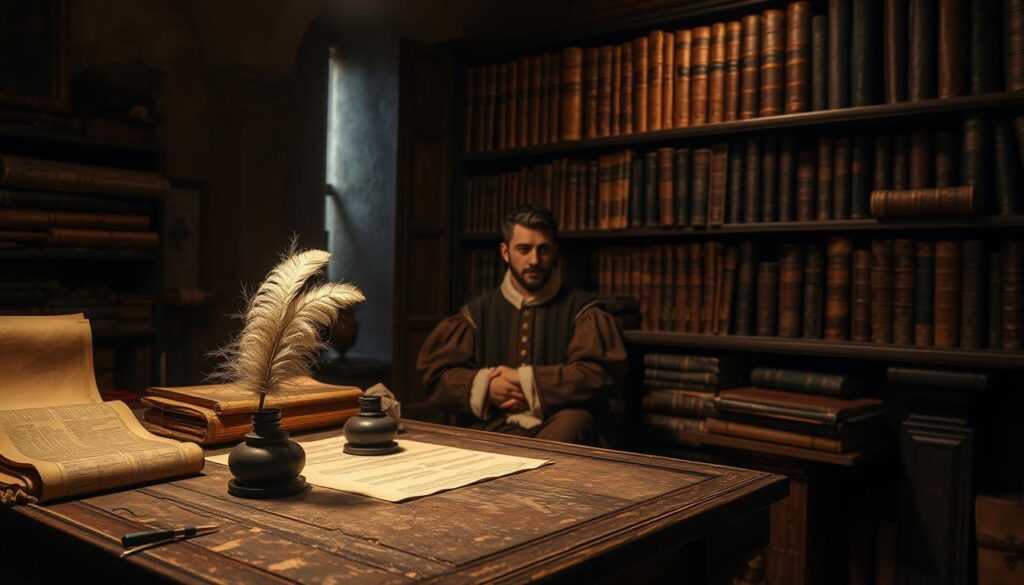
Almanachs, Prognostications, and Presages
From the year 1550 onward, printed almanacs became his most popular works. Small, affordable pamphlets spread seasonal advice and short prognostications to a wide public.
Medical Texts and Practical Manuals
He published a paraphrase of Galen (1557) and the Traité des fardemens. These volumes moved medical know-how into everyday French and showed a practical bedside work ethic.
Printing quirks, editions, and translations
Type-setting from dictation, variant punctuation, and local printers created many textual variants. That means the same quatrains or book lines can differ across editions and translation attempts.
- Range: almanachs, prognostications, medical manuals, and poetic verses.
- Scope: Les Prophéties survives with many quatrains in differing copies.
- Impact: Translation and transmission shaped how later readers met the prophecy texts.
| Item | Type | Note |
|---|---|---|
| Almanacs | Practical | Broad readership from 1550 |
| Galen paraphrase | Medical | 1557, vernacular teaching |
| Les Prophéties | Poetic | Multiple editions of quatrains |
Interpreting the Prophecies: Methods, Sources, and Style
His approach pairs judicial astrology with comparative horoscopy to make sense of events. That combination treats charts as diagnostic tools and compares current planetary patterns to past cases.
Methods included judicial astrology to judge the quality of events and comparative horoscopy to draw analogies. Critics like Laurens Videl pointed out technical errors, but the method still guided many readings.

Mirabilis Liber and classical models
He drew on Mirabilis Liber and on historians such as Livy, Suetonius, and Plutarch. In the Renaissance it was common for authors frequently copied or frequently copied paraphrased material without modern citation.
Obscurity by design
Les Prophéties mixes French, Latin, and Provençal and often uses a “Virgilianized” syntax to conceal specifics. This layered style resists a single clear translation and fuels ongoing debate over the quatrains.
Why it matters
Understanding sources and methods helps readers evaluate the works on their own terms. He addressed King Henri II and avoided the label “prophet,” framing the verses as studied warnings rather than divine revelation.
“I do not call myself a prophet; I present signs and warnings from study.”
Nostradamus in History and Pop Culture
Across centuries of retelling, a handful of quatrains have been matched to major world events with surprising frequency.
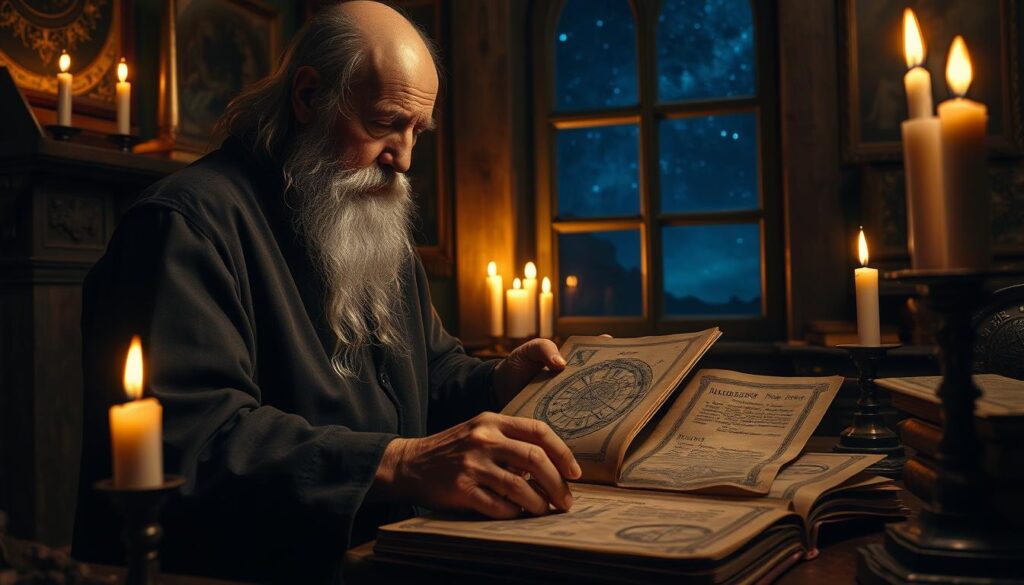
Famous attributions and why they stick
Readers often link verses to the Great Fire of London and to figures like Napoleon or Adolf Hitler.
These matches rely on vague language and flexible reading. After a great fire or a political shock, editors pick lines that seem to fit and publish them as proof.
End-of-the-world readings and media cycles
Apocalyptic end world claims rise in crises because the quatrains offer an elastic range of meanings.
In New York and other media hubs, broadcasters and publishers revive these prophecies during big global headlines.
Why quatrains are frequently copied and paraphrased today
Many authors frequently copied older prophetic tropes (see Mirabilis Liber), so lines are often reused.
Short excerpts are frequently copied paraphrased in blogs and books. Detached context makes the claim seem stronger than it is.
| Attribution | Typical Evidence | Scholarly view |
|---|---|---|
| Great Fire of London | Vague fire imagery in quatrain lines | Retrospective fit, not dated prediction |
| Napoleon | Names and war-like imagery | Generic parallels; borrowed tropes |
| Adolf Hitler | Violence and leader-language | Selective quoting after events |
Death and the court aura around his life add drama, but careful reading shows most links are post-event interpretations rather than clear forecasts.
Reputation Then and Now: Skepticism and Legacy
Scholars have long treated his verses as literary puzzles rather than strict forecasts. Academic critics argue that many apparent matches rely on loose translation and selective reading. These methods create a modern reputation that outpaces the underlying facts.
Academic critiques and translation issues
Researchers note printing variants, punctuation shifts, and editorial choices that change meaning. That makes precise predictions hard to support. Skeptical publishers in Buffalo, New York, and elsewhere have collected essays showing how retrospective selection produces apparent hits.

Even his own statements avoided the title prophet, framing the verses as studied warnings. Yet, in a crisis the world still revisits these lines. The result: his name stays shorthand for prophecy even as scholars place his work in Renaissance literary context.
| Critique | Effect | Evidence |
|---|---|---|
| Vague language | Flexible fits | Many translations |
| Printing variants | Altered meaning | Different editions |
| Retrospective matching | Apparent hits | Skeptical studies (New York & Buffalo) |
For a modern perspective on clairvoyant claims and methods, see a detailed look at clairvoyant secrets.
Conclusion
The end came in July 1566 in Salon-de-Provence, closing a life that mixed clinical care, print, and public notice.,
Answer up front: he passed on July 1 or 2, 1566, anchoring the final time and years of a notable 16th century figure.
The era’s upheavals pushed him from pharmacy to a printed book of quatrains and practical almanacs. Service in royal circles, including links to king henri, raised his profile while he avoided claiming divine status.
Textual variants and multiple editions complicate clear readings of any single prophecy, and academic work shows many attributions are retrospective.
Appreciate the literary allure of the nostradamus prophecies, but weigh them against evidence. In the end, these verses reflect as much about readers and their world as about the events they seem to predict.
FAQ
When did Nostradamus pass away, and what legacy did he leave?
He died in early July 1566 in Salon-de-Provence. His reputation rests on Les Prophéties, a collection of quatrains that shaped popular views of prophecy, influenced writers and translators, and kept him in public discussion through modern events linked to his verses.
Where and when was he born, and what was his family background?
He was born in Saint-Rémy-de-Provence in the early 1500s into a family with Jewish roots that converted to Catholicism. Family life in Provence, local traditions, and the social mix of the region shaped his upbringing.
How did he move from apothecary work to practicing medicine and astrology?
He trained as an apothecary, studied at universities such as Montpellier, and treated plague victims with remedies including his so-called “rose pill.” Over time he added astrology and prognostication, publishing almanacs that broadened his audience.
What role did the plague play in his life and career?
Plague recurred through his youth and adulthood, motivating his medical work and many treatments. He gained practical experience treating outbreaks, which informed both his medical writings and his public reputation.
Did he receive formal university training, and was he ever expelled?
He attended the University of Montpellier but faced issues over his apothecary background and was effectively blocked from a full medical degree. Nevertheless, he continued medical and botanical work and published practical treatments.
What do we know about his marriage and children?
He married and had children, though family tragedies struck—his first wife and children died during a plague outbreak. Later marriages and descendants appear in records, but details vary across sources and editions of biographies.
How did he transition from medical writings to prophetic works?
He published almanacs that mixed weather, health advice, and forecasts. Success with those led him to compose Les Prophéties, which used quatrains and blended historical sources, astrology, and elliptical language to present predictions.
What is the structure and language of Les Prophéties?
The work is arranged in centuries (groups) of quatrains. He mixed French with Latin, Greek, Italianate forms, and archaic phrasing. The style is deliberately obscure, often using symbolic place names and compressed images.
Did he have connections to the French court?
Yes. He composed horoscopes and provided counsel that reached Catherine de’ Medici and other court figures. Royal patronage helped spread his fame and gave his writings wider circulation.
What date is recorded for his death, and why is it disputed?
Sources list either July 1 or July 2, 1566, as the date in Salon-de-Provence. Variations stem from differing contemporary reports, calendar practices, and later copies of wills and chronicles.
What ailments have historians cited as causes of his death?
Accounts mention gout and edema as contributing conditions. His last will and other documents describe failing health in his final months, consistent with those diagnoses.
Were any last words or dramatic discoveries reported at his death?
Some contemporary accounts record reported last utterances and a discovery at sunrise, but these details vary and often entered later legend. Reliable primary records focus more on the will and burial arrangements.
Where was he buried, and what happened to his tomb?
He was buried in Salon-de-Provence. The tomb has undergone re-interments and restorations over centuries, becoming a site of interest for visitors and scholars curious about his legacy.
Besides the quatrains, what other works did he produce?
He wrote almanachs, medical treatises including a Traité des fardemens, and paraphrases of Galen. He also produced Prognostications and presages on weather and health, many printed in multiple editions and translations.
How did printing practices affect the reception of his works?
Early printing quirks, variant editions, and translations introduced errors and shifts in meaning. Those variations fed both fame and controversy, as readers copied and paraphrased quatrains for new contexts.
What methods did he claim for composing prophecies?
He used judicial astrology, comparative horoscopy, and classical sources. He also drew on compendia like Mirabilis Liber and often echoed historians and authors who were frequently copied by Renaissance writers.
Why are his verses intentionally obscure and mixed in language?
Obscurity protected him legally and enhanced mystique. Mixed vocabulary, compressed images, and “Virgilianized” syntax created open texts that readers could interpret for events across time.
Which major events have people linked to his quatrains?
Readers have associated his verses with the Great Fire of London, Napoleon’s rise, and Adolf Hitler, among other major world events. Such attributions rely heavily on retrospective interpretation and translation choices.
Is he blamed for predicting the end of the world?
Some readers have read doomsday scenarios into his quatrains, but most scholars see those claims as modern extrapolations. His language invites apocalyptic readings, yet direct end‑of‑world dating is not clearly stated in the core texts.
Why are his quatrains frequently copied and paraphrased today?
Their brevity, evocative imagery, and ambiguous phrasing make them easy to reuse. Popular media and authors often paraphrase lines to link them to recent events, which spreads altered versions widely.
How do modern scholars assess his reputation?
Academics criticize mistranslations, hindsight bias, and vague phrasing, while recognizing his influence on culture. Skeptics highlight methodological errors; others study him as a product of 16th-century astrology and print culture.