
Short answer: Scholarship notes that the seer never stamped the year with a direct date, even though modern readers tie his lines to current events.
The 2026 total solar eclipse across parts of Europe has become an eye-catching hook. Enthusiasts link the sky’s “darkened sun” language to bold predictions and renewed prophecies.
Interpreters also reuse verses like “Seven months, great war” in tense times and play numerology games with quatrain numbers. Critics point to Middle French ambiguity and variant manuscripts that make retrofits easy.
This intro will guide you through what is grounded in the text and what is modern myth-making. We’ll show why the eclipse and recent events pull verses back into public talk, and how history and cultural anxiety shape those reads.
Key Takeaways
- Scholars find no explicit dating of the year in primary quatrains.
- The 2026 eclipse fuels public interest and bold interpretations.
- Many cited lines are broad and get repackaged when the world feels unstable.
- Numerology and selective readings often link quatrain numbers to future years.
- Critics highlight language ambiguity and variant manuscripts that invite retrofitting.
- For a year-by-year view of nostradamus predictions, see nostradamus predictions by year.
Why 2026 Is in the Spotlight Right Now
A rare solar shadow crossing parts of Europe has pushed celestial language back into the headlines. The eclipse is the first of its kind there in 27 years, and that timing sparks renewed searches through centuries-old verses for phrases like “darkened sun” and “celestial fire.”
The spectacle creates a media moment that amplifies modern predictions. At the same time, current geopolitical tensions and regional conflicts make lines about a coming war—including the oft-cited “Seven months, great war”—feel urgent, even when the source gives no date.
A headline eclipse over Europe and a surge in interpretations
The eclipse brings attention to the stars and sky imagery. Interpreters link visible astronomical events to symbolic quatrains and treat this single marker as a timeline anchor.
Today’s tensions: war, climate extremes, and technological upheaval
Climate extremes and fast-moving global events make dramatic readings more compelling. Some observers jump from an eclipse to warnings of a looming world war, while others see cultural pattern-seeking at play. Enjoy the spectacle, but keep perspective.
| Trigger | Why it matters | Common reaction |
|---|---|---|
| Total solar eclipse | Visible, rare, media attention | Surge in celestial-based prediction |
| Geopolitical strains | Heightened anxiety in Europe | Quatrains read as warnings of war |
| Climate extremes | Persistent disasters and heat | Sense of historical turning point |
For a year-by-year look at earlier forecasts, see predictions for 2025.
What does Nostradamus say about 2026?
Scholars agree the original quatrains never pin a specific calendar year to any verse. That conclusion is the baseline for modern discussion and helps separate text from later claims.
No explicit date in the quatrains, according to scholarship
Close readings of the early manuscripts show no line that names a numbered year. The astrologer-physician wrote in layered symbolism, so a single prophecy often reads as many things to different readers.
The eclipse temptation
The 2026 total solar shadow invites matching images like “darkened sun” or “celestial fire.” Those motifs are common Renaissance astrological images, not tied to a single year, yet they fuel lively modern interpretation.
The “26” numerology game
Some map quatrain numbers such as I:26 or II:26 onto the year. That linking is a modern choice, not an instruction found in the text. Treat such mappings as retrospective readings rather than direct dated prophecy.
| Claim | What the text shows | How readers react |
|---|---|---|
| Explicit year | No numbered year appears in quatrains | Scholars reject direct dating |
| Eclipse imagery | Common astrological motifs | Readers tie symbols to events |
| Numerology | Quatrain numbers exist, not dates | Some map numbers to years |
For broader context and yearly inquiries, see nostradamus predictions.
The quatrains most cited for 2026 and how they’re interpreted
A handful of verses get pulled forward in times of crisis and framed as direct forecasts. Readers match vivid images to current events, though the original quatrain lines carry no explicit calendar dating.
“Seven months, great war”: Europe, conflict, and the pull of contemporary events
“Seven months great war, people dead through evil / Rouen, Evreux the King will not fail.”
This passage is the go-to example during European strain. It names 16th‑century places and offers no modern year. Still, it often appears in headlines tied to world war and rising conflict.
A light in the sky mistaken for fire: comet signs, stars, and fear versus awe
Verses describing a strange light are commonly read as comet imagery. Readers alternate between fear and awe, seeing a skyward sign as either portent or spectacle.
That interpretation leans on poetic symbolism rather than a dated prediction.
Rise of an unexpected leader: power, people, and divided readers
Commentators project a rapid rise of an unexpected leader onto certain quatrains. The idea of a figure who gains power and splits people into supporters and critics is a modern overlay on ambiguous verses.
“Gold turns to poison”: markets, prediction, and economic shock
Lines paraphrased as “gold turns to poison” feed economic readings. Analysts use that image to discuss shocks, liquidity crunches, and shifts in confidence. The language works as a metaphor more than as a literal financial forecast.
Fires and heat: climate signals, burning summers, and the world on edge
Fire and heat images are tied to long summers, drought, and visible disasters. These readings reflect climate anxiety and the tendency to map symbolic verses onto immediate environmental worries.
- Key point: The quatrains supply images — war, fire, light, blood, and power — that can fit many timelines.
- Treat each quatrain as poetic source material; any specific year mapping is an interpretation, not a textual date.
- For related context and broader nostradamus predictions, see nostradamus predictions.
Scholarship, skepticism, and why prophecies endure
The mix of Middle French, variant copies, and poetic ambiguity helps prophecies stay relevant through centuries of history. Scholars point to deliberate vagueness and occasional Latin lines that invite layered reading.
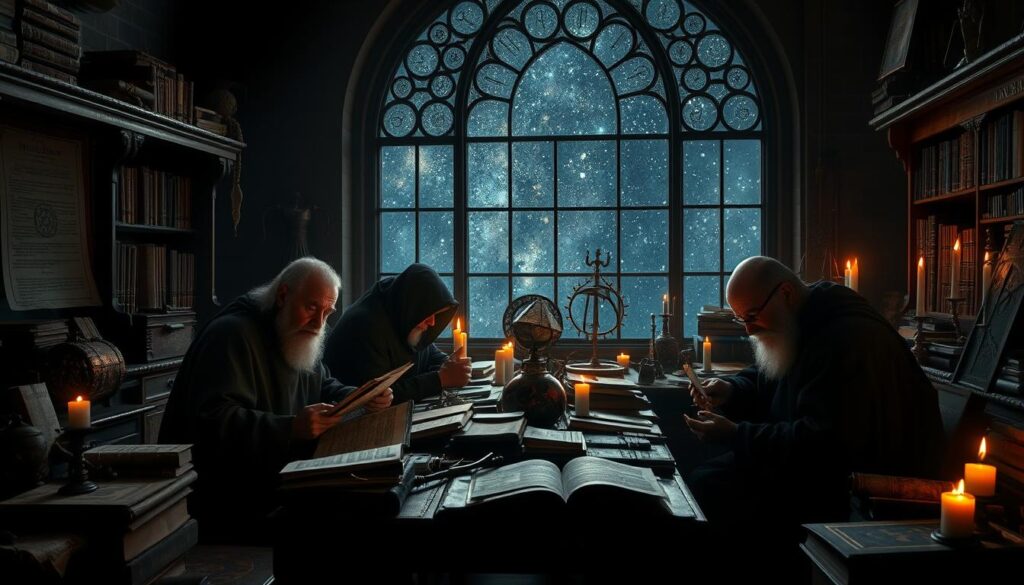
Middle French, murky manuscripts, and the risks of retrofitting
Multiple competing manuscripts and variant spellings give translators room to shift meaning. Small changes in punctuation or a single word can alter a line’s sense.
That makes it easy for others to map verses onto recent events. The astrologer-poet’s style invites many plausible interpretation options.
Confirmation bias, culture, and the modern hunger for prediction
After dramatic events, people often find lines that match their fears. This confirmation bias fuels the spread of sweeping claims.
Mass media today plays the role the printing press once did: it amplifies fits of pattern-seeking across a culture hungry for order and prediction.
| Factor | How it helps prophecies persist | Practical question to ask |
|---|---|---|
| Ambiguous language | Allows many readings across time | Which translation choice matters most? |
| Manuscript variants | Enable retrofitting to new events | Does the match rely on a chosen copy? |
| Confirmation bias | People fit lines after events | Could this be coincidence? |
Not every pattern is false, but a balanced view helps. For wider context on precognitive topics, learn about precognitive abilities.
Conclusion
A single sky shadow and a flux of news can turn poetic lines into urgent predictions overnight. Readers fold images of light, stars, and fire into modern debates over war and social strain.
Bottom line: the quatrains give symbols, not a calendar. Scholarship warns that ambiguous Middle French and variant copies allow retrofitting, so any linked year or explicit timeline is an interpretation, not proof.
Keep curiosity high and credulity low. Enjoy the literature, note how predictions shape culture, and let evidence guide views of conflict, climate, markets, and power. For a related spiritual perspective, see how to know if you are a Pleiadian.
FAQ
What are the main claims linking Nostradamus to 2026?
Many modern commentators connect quatrains mentioning eclipses, “celestial fire,” or political upheaval to the year 2026. Scholarly editions show no explicit date. Most links come from interpretation, numerology, and reading vintage French loosely into current events.
Is there a specific quatrain that names the year 2026?
No authenticated quatrain contains a printed year. The practice of assigning dates comes from later readers who match numbers in manuscript sequences or use numerology to map quatrain numbers to calendar years.
Why do people point to an eclipse and "celestial fire" as signs?
Eclipses and bright sky phenomena appear in several quatrains. Writers often equate those images with comets, fires, or disasters and then tie them to known upcoming celestial events. That method uses symbolic language as literal forecast rather than historical-context reading.
How do scholars treat the “seven months, great war” lines?
Academics emphasize the vagueness of the phrase and note many medieval and Renaissance texts used month counts as rhetorical devices. Interpreting it to predict a modern military campaign requires selective reading and ignoring broader linguistic and historical context.
Could a quatrain about a "light mistaken for fire" mean a comet or weapon in 2026?
It could, but such readings are speculative. The same metaphor has been used for atmospheric phenomena, meteor showers, auroras, and optical illusions. Context and translation choices shift meaning more than any direct prophetic signal.
What about claims of an unexpected leader rising in 2026?
Prophecy fans often map generic phrases about leaders and power shifts onto current political figures. Historians warn this is retrospective fitting — many quatrains address leadership changes in broad, archetypal terms that suit many eras.
Are predictions linking markets and "gold turns to poison" reliable?
No reliable forecasting method comes from such phrases. Economic metaphors in the quatrains are poetic. Financial analysts rely on data and models; tying markets to a centuries-old stanza risks misleading readers with symbolic language.
Do quatrains mention climate signals like fires and heat relevant to today?
Images of fire, heat, and drought recur in prophetic literature. While they resonate with modern climate concerns, the quatrains don’t describe greenhouse science. They reflect long-standing human fears about famine, war, and natural disaster.
How much does language matter when interpreting these verses?
Language matters greatly. Nostradamus wrote in Middle French with puns and classical references. Small translation choices change tone and meaning. Professional editors stress careful philology rather than sensational paraphrase.
Why do modern readers keep returning to these prophecies?
The appeal comes from pattern-seeking and cultural habit. In uncertain times—war, climate anxiety, and rapid tech change—people seek narratives that promise foresight. Confirmation bias and media amplification keep the cycle alive.
Can astrology or star charts from the 16th century pinpoint modern years?
Astrology in the Renaissance worked differently from modern charts. While astrologers of the period set dates for events, transplanting those methods to the present requires many assumptions. Scientific forecasting uses different tools.
How should readers evaluate bold claims about 2026 and prophecy?
Treat claims skeptically. Check translations, consult academic editions, and seek historians of early modern France or reputable sources in astrology history. Distinguish poetic metaphor from literal forecast before accepting predictions.
Are there credible historical examples where quatrains matched events closely?
Some interpretations align with later occurrences, but these are usually postdictions—read after the fact. Credible historic matches require specific, verifiable detail present before an event, which the quatrains rarely provide.
Who are reliable sources for learning more?
Look for university scholars in early modern studies, translations by academic presses, and specialists in Renaissance astrology. Major libraries and peer-reviewed journals provide context that popular summaries often omit.