

Public curiosity rose sharply after the passing of pope francis at 88, and many turned to centuries-old quatrains for context.
The mix of history and modern news fuels a search for clear lines in an often-ambiguous prophecy. Writers point to a “very old Pontiff” and phrases about a successor who might “weaken his seat.”
This intro frames a careful look at sources, context, and how life in the catholic church intersects with these verses. Interest spiked because lines seem to echo real events tied to pope francis death.
We will separate poetic imagery from modern interpretation and link readers to deeper analysis, including a detailed resource at this overview. Expect a balanced, informative review rather than sensational claims.
Key Takeaways
- Recent news renewed public interest in prophetic quatrains after pope francis‘s passing.
- Ambiguous verses invite many modern predictions, but require careful context.
- Connections between text and real-world events often reflect interpretation more than certainty.
- The article will examine phrases like “weakens his seat” and “very old Pontiff” closely.
- Readers will get balanced information to judge what the quatrains likely support.
Why Nostradamus’ Papal Prophecies Are Back in the News
News cycles latched onto a short prophecy after a prominent pontiff’s death at an advanced age. Reports noted pope francis died at 88 following prolonged health struggles, and that timing pushed a line about a “very old pontiff” back into headlines.
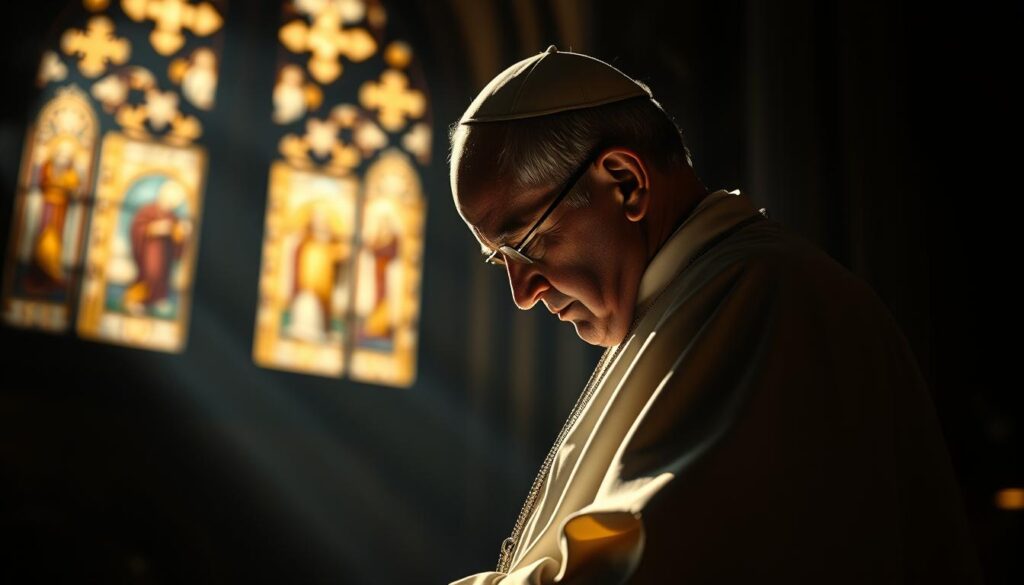
Pope Francis’ death at 88 and the revival of a “very old pontiff” prediction
Readers had tracked health updates for months, so when francis death arrived, many saw a match with centuries-old wording. That match fed fresh interest and speculation about succession and continuity in the catholic church.
“Weakens his seat,” the “Black Pope,” and the “City of Seven Hills” explained
“Weakens his seat” is often used to describe reforms or leadership shifts rather than literal collapse. The label “Black Pope” points to Jesuit ties—relevant because Francis belonged to that order—but links are mostly speculative.
Rome’s nickname, the City of Seven Hills, naturally draws attention to Vatican events. That geography helps explain why prophetic phrases get tied to modern papal news.
From quatrains to headlines: why these prophecies resonate after major events
Concise quatrains make easy hooks. Their ambiguity lets different readers map lines onto recent events, so cycles of commentary reappear whenever a high-impact death or transition happens.
“Centuries of commentary and a vivid line can make any pontiff part of a larger story.”
For deeper timelines and yearly listings that trace these moments, see a detailed overview at prophecy predictions by year.
what did nostradamus say about the last pope
A terse quatrain about an elderly pontiff keeps resurfacing whenever leadership changes stir public curiosity.
The quatrain: “Through the death of a very old Pontiff… a Roman of good age will be elected”
Through the death of a very old Pontiff / A Roman of good age will be elected. / Of him it will be said that he weakens his seat / But long will he sit in biting activity.

Interpreting “weakens his seat,” “Peter the Roman,” and open quatrains
Readers split on “Roman of good age” and “good age.” Some take it as literal Roman heritage or a reference to Rome itself. Others read it as symbolic language that fits many successors.
“Weakens his seat” can mean reform, challenge, or simply controversy. That flexibility helps these brief verses map onto different eras and popes.
Astrologers historically faced political risk when forecasting leaders. A guarded, cryptic style let these prophecies survive and be reused by later commentators and astrologer readers.
Short, allusive quatrains act as prompts: people project signs onto them rather than find fixed forecasts.
For a deeper review of linked predictions and timelines, see a detailed overview.
New Pontiff, Old Prophecies: Pope Leo XIV, Saint Malachy, and 2027 Theories
When a new name rises in Rome, medieval lists and modern calendars often meet in public debate. The surprise election of Pope Leo XIV—reported as the first American pontiff—made that dynamic visible. His greeting, “Peace be with you,” and the name Leo fed a popular “lion on the throne” image tied to strength, crisis, and even end-age narratives that circulate around world news.

The Malachy list and the “Peter Roman” idea
Saint Malachy’s medieval list ends with an entry many read as Peter Roman. That label fuels claims linking a final leader to tribulation and to scenes of war or collapse.
Why 2027 keeps surfacing
Some commentators use numerology and a 1585 anchor tied to Sixtus V to reach 2027 as a charged year. This mixing of number patterns and news creates a years-focused countdown that sparks fresh predictions and public speculation.
Astrology, horoscopes, and political risk
Astrology once sat inside papal courts. Historic cases, like an astrologer’s risky forecast under Urban VIII, show how horoscopes and bold predictions could become political flashpoints.
Read more context and yearly analysis in this 2025 predictions overview: 2025 predictions
Conclusion
Centuries of short, ambiguous quatrains keep returning after major Vatican events and fast-moving news cycles.
That terse quatrain, layers of commentary, and modern curiosity link to many predictions. Readers map signs onto names and dates, from Saint Malachy lists to 2027 timelines.
Public interest in life and demise around leadership is natural. History warns that bold prediction about a pope can be risky, and past forecasts had real consequences.
Balance matters: check sources, weigh context, and treat each headline as a prompt to revisit the texts. For deeper context and a personal perspective, see a detailed guide on clairvoyant methods and the main site at HannahBrites.
FAQ
Who was Michel de Nostradame and why are his writings linked to papal futures?
Michel de Nostradame, known as Nostradamus, was a 16th‑century French apothecary and seer. He wrote collections of four‑line prophetic verses called quatrains. Modern readers and journalists often apply his vague imagery to current events, including papal succession, because the language invites multiple interpretations.
Which quatrain mentions a “very old pontiff” and what does it imply?
One widely cited quatrain refers to “the death of a very old Pontiff” followed by the election of a “Roman of good age.” Scholars caution that translations vary and context is sparse, so the passage offers room for speculation rather than a precise prediction.
What do phrases like “weakens his seat” and “City of Seven Hills” mean in these texts?
Such phrases are symbolic. “Weakens his seat” can suggest political or physical decline of authority, while “City of Seven Hills” is a longstanding poetic name for Rome. Interpreters often blend literal and metaphorical readings to link quatrains to specific papal events.
Is “Peter the Roman” a genuine Nostradamus term or from another source?
“Peter the Roman” does not appear in Nostradamus’ quatrains. It originates from the separate, controversial medieval list called the Prophecy of the Popes, attributed to Saint Malachy. That list names a final pope as “Peter the Roman,” a phrase often conflated with Nostradamus by popular media.
How reliable are these prophecies for predicting modern events like a pope’s death?
Prophetic quatrains are notoriously vague and were written centuries ago. They lack verifiable dates and clear context, making them unreliable for precise forecasting. Most historians treat them as literary curiosities rather than factual guides.
Why has Pope Francis’ health and age renewed interest in apocalyptic prophecies?
High‑profile figures naturally attract speculation when health or age is in the public eye. Media cycles and social platforms amplify connections between current events and historical prophecies, especially when phrases like “very old” seem to fit.
Do astrologers and numerologists use Nostradamus to predict a specific year, such as 2027?
Some astrologers and numerologists blend quatrains with calendrical patterns to propose specific years. These methods are interpretive and not supported by mainstream scholarship. Claims pointing to years like 2027 should be viewed skeptically.
What role does Saint Malachy’s “Prophecy of the Popes” play in this conversation?
Saint Malachy’s list, attributed to a 12th‑century Irish archbishop, assigns short epithets to successive popes, culminating in a final, apocalyptic figure. Many historians consider the list a 16th‑ or 17th‑century forgery. Still, it feeds modern interest in end‑time scenarios and papal succession myths.
Could a future pope be the “first American pope” or take the name Leo XIV as some predict?
Any pope’s choice of name and origin can prompt symbolic readings. Suggestions about an American pope or a Leo XIV come from pattern‑seeking and name symbolism, not from a single authoritative prophecy. Such scenarios remain speculative until confirmed by the Vatican.
How should readers evaluate news that links current popes to Renaissance prophecies?
Check primary sources, consult historians or Vatican statements, and favor evidence over sensational headlines. Recognize that quatrains are open to interpretation and that confirmation bias often drives connections between prophecies and events.
Are there historical examples where Nostradamus’ verses matched later events?
Commentators have retroactively matched quatrains to many historical events, from wars to assassinations. These attributions usually rely on loose phrasing and after‑the‑fact fitting rather than foresight demonstrated before events occurred.
Can interest in these prophecies affect the Catholic Church or public perception?
Yes. Speculation can influence public anxiety, fuel conspiracy theories, and distract from official church discourse. Church officials typically respond with calls for prudence and faith rather than engagement with speculative prophecy.
Where can I find credible analysis of these quatrains and papal prophecy claims?
Look for academic works on Renaissance literature, reputable historians of the papacy, and translations with scholarly notes. Avoid sensationalist outlets that mix unrelated texts like Saint Malachy’s list with Nostradamus without evidence.