

Welcome. This friendly guide shows how a simple practice can help you sort choices and gain calm insight.
Think of it as a reflective tool you can use when you have a clear question and need a fresh view. The process is practical: pose a focused question, draw cards, and study patterns to gather information — not to promise fate.
The guide will lay out a clear order: definition and history, how the suits work, how to choose a deck, step-by-step methods, common spreads, timing, ethics, study tips, and resources. Anyone can learn this approach; everyday people build knowledge over time and grow more comfortable with practice.
Use a good question to shape the session. Pair this method with journaling or talking with friends for balanced reflection. You can also explore related intuitive practices at a guide on clairvoyant skills to widen your view.
Key Takeaways
- This is a down-to-earth tool for reflection and decision-making.
- The method uses a focused question plus cards to collect information.
- Anyone can learn; skill grows with practice and time.
- The guide covers history, suits, decks, spreads, timing, and ethics.
- Combine this practice with journaling or conversations for balance.
What Is Tarot Card Reading and How It Works Today
Begin by naming a single, precise concern; the method then guides how to explore it.
This practice is a form of cartomancy used to gain insight into past, present, or future themes. In plain terms, you ask a focused question, select a spread, draw from a shuffled deck, and interpret the symbols in context.

Why the question matters: a clear, specific question narrows what the session highlights. That makes it easier to link meanings to real-life choices and avoid vague results.
From a clear question to interpreting a spread
Simple flow: center yourself, set the question, shuffle and cut, choose a spread, lay the cards, then note symbols, positions, and relationships. A standard deck has 78 cards split into Major and Minor Arcana, which shape broad themes and daily details.
Insight, not certainty: using tarot as a reflective tool
This is about perspective, not prediction. The method helps you weigh options and spot patterns, like a conversation that surfaces ideas you might miss alone.
- Be consistent—regular practice builds familiarity with meanings and boosts confidence.
- Capture thoughts during the session so links to the question stay fresh.
- Both new and experienced readers benefit from a repeatable process to stay grounded.
To explore related intuitive skills, see how to develop clairvoyant abilities.
A Brief History of the Tarot: From Italian Cards to Modern Readings
The story of these packs begins in 15th‑century Italy and winds through centuries of reinvention.
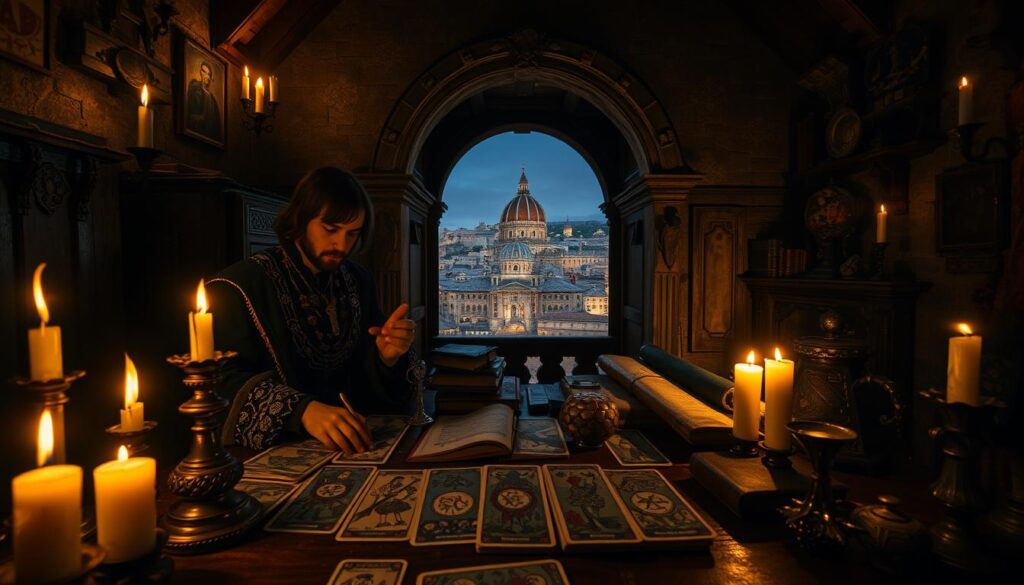
First written references appear around 1440–1450 in northern Italy (cities such as Milan and Ferrara) as carte da trionfi. Back then, extra allegorical trumps were added to the four-suit playing sets and the items served mainly for games.
From Games to a New Use in 18th‑Century France
Through the 1500s–1600s these packs stayed recreational. It was not until the 1780s in France that use for divination began to appear in print.
Scholars note there is no solid evidence for cartomancy before that late‑18th century shift.
Key Influencers and Occult Systems
Several authors shaped later meanings. Antoine Court de Gébelin (1781) suggested exotic origins. Etteilla systematized upright and reversed meanings and published methods in the same era.
“Influences from Lévi, the Golden Dawn, and later authors transformed the symbolic map readers use today.”
Éliphas Lévi linked trumps to the Hebrew alphabet and the sefiroth. The Hermetic Order of the Golden Dawn (founded 1888) formalized many correspondences used around the world.
Modern Decks and Authors
The Rider‑Waite‑Smith deck (A. E. Waite; art by Pamela Colman Smith, 1909) made fully illustrated minors common in the English‑speaking world. Later, Aleister Crowley and Lady Frieda Harris produced the Thoth system (published with The Book of Thoth, 1944), offering a distinct esoteric lens.
- Trace origins to 15th‑century northern Italy as playing packs with added trumps.
- Cards stayed recreational for years; divination rose in France in the 1780s.
- Key people—Court de Gébelin, Etteilla, Lévi—shaped occult meanings.
Context helps. Knowing this history gives a reader useful information to place modern practice in perspective without accepting every esoteric claim. For a practical example of symbolism in use, see an article on the Eight of Pentacles.
Inside the Deck: Major Arcana, Minor Arcana, and Suits
A standard deck is an organized map of themes, from sweeping life lessons to everyday moments.
Major Arcana: life themes and archetypes
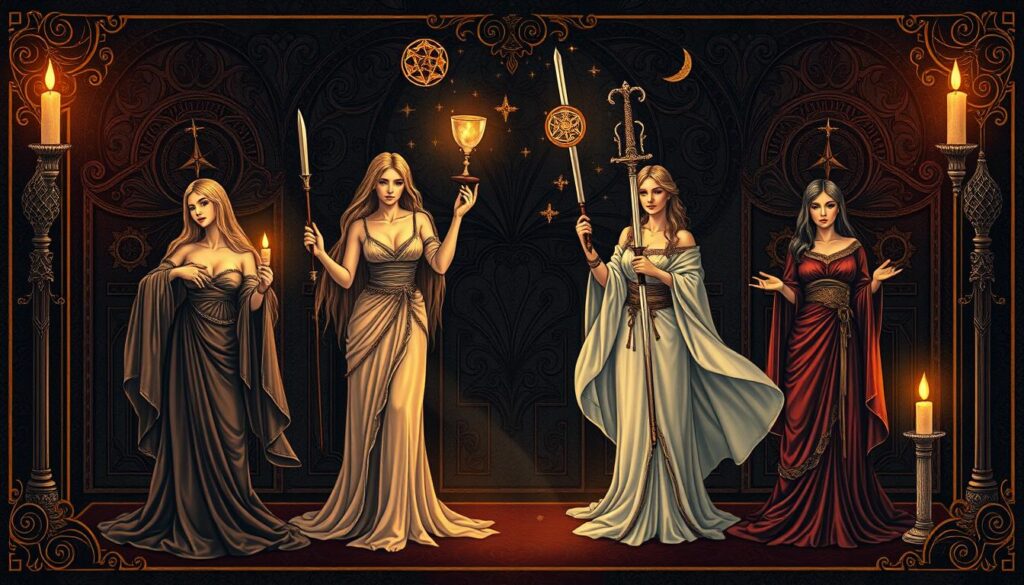
The set includes 78 cards total: 22 Major Arcana that show large archetypal narratives. These trumps point to life themes and turning points.
Minor Arcana and the four suits
There are 56 Minor Arcana divided into four suits. Wands link to fire and drive. Cups connect to water and feelings.
Swords pair with air and thought. Pentacles tie to earth and resources. This symbolism helps anchor short-term situations.
Court cards: people and roles
Pages or Princesses suggest beginnings. Knights imply movement or action. Queens show inner mastery. Kings indicate structure and leadership.
- The number order (Ace–10) adds a clear progression that shapes meaning and context.
- Rider‑Waite‑Smith’s illustrated minors make intuitive divination easier for new learners.
- Different authors and traditions tweak titles, but the core order and structure stay similar.
Tip: Learn meanings card by card, then watch patterns across suits and numbers to unify how a spread speaks to a question.
Choosing Your First Tarot Deck and Getting Set Up
Start by finding a deck whose imagery makes you pause and want to study it. That spark helps you return again and build comfort.
Many beginners pick the Rider‑Waite‑Smith. Its illustrated minors and clear scenes made it a teaching standard since 1909. Books and courses in the English‑speaking world often use it to explain symbols.
What to look for in a first deck
Choose art that fits your taste. Colors and the artists’ style should invite you to look closer.
Handle decks in person if possible. Check card size, stock, and shuffle feel. Comfort matters when you use cards often.
Pick readability: strong contrast and clear symbols help a new reader link scenes to meaning.
“The best first choice is the one you’ll use; familiarity grows with hands‑on practice.”
| Feature | Why it matters | Good example | Who benefits |
|---|---|---|---|
| Illustrated minors | Makes scenes easier to interpret | Rider‑Waite‑Smith | New readers |
| Card stock & size | Affects shuffle and handling | Standard 2.75″ x 4.75″ | People who practice daily |
| Art style | Determines personal resonance | Modern or classic artists | Anyone wanting a long‑term work deck |
- Simple setup tip: a cloth, quiet space, and a notebook will improve your practice.
- Over years many people keep one main deck and swap others for mood or clients.
Tarot Card Reading Step by Step: From Question to Insight
Before you begin, set a clear aim. Decide the issue and the time frame you want to explore. This focus shapes how you interpret each symbol and position.

Formulating a precise question
Keep it specific. Try: “What’s the best way to handle my job change over the next three months?” Time and scope help narrow meanings and keep the session useful.
Shuffle and cut
Prepare the shuffled deck with calm, mindful shuffles. Make a clean cut to mark the shift from thought to the reading process.
Draw and lay cards
Choose a spread that fits the goal: a single card for quick clarity, three cards for past‑present‑future, or a larger ten‑card layout for depth. Lay cards in order and note each position’s purpose.
Interpretation flow
Read symbols first—figures, elements, numbers—then link those meanings to each placement. Finally, weave patterns across the spread into a clear narrative. Close by writing one or two actionable steps you can try in the next few days.
| Spread | Purpose | When to use |
|---|---|---|
| Single card | Fast clarity | Daily decisions or confirmations |
| Three-card | Simple timeline | Short-term transitions |
| Ten-card | Deep, structured view | Complex issues needing context |
Popular Tarot Spreads to Try
Pick a layout that fits the issue you want to explore today. Start small and grow into longer formats as your confidence rises. Many sessions begin with a clear question before any draw.

Single card draw: fast clarity for the moment
Use the single card for quick guidance. Pull one card to capture the day’s energy or the heart of a situation. This works well across times when you need a fast nudge.
Three-card sequences: flexible timelines
Try past‑present‑future, situation‑challenge‑advice, or you‑others‑outcome. These short spreads give structure while keeping interpretation simple.
Celtic Cross: a comprehensive 10‑part layout
The Celtic Cross maps many factors. It places positions in order so you can trace core issue, crossing influence, foundation, recent past, potentials, and likely outcome. Reserve it for complex choices or pivotal moments.
| Spread | Cards | Best use | Why it helps |
|---|---|---|---|
| Single | 1 | Daily checks | Fast focus on energy |
| Three‑card | 3 | Short transitions | Shows movement over time |
| Celtic Cross | 10 | Major decisions | Detailed context and outcome |
Reading the Cards: Meanings, Symbols, and Context
Meaning grows from the mix of a card’s core symbolism and the role it plays in the spread. Start by naming the placement’s purpose, then ask how the image answers your question.

Anchoring base meanings to positions
Take a card’s basic meanings and then weigh its spread position. A supportive slot softens challenge cards. A future slot can make urgent themes seem less immediate.
Symbols to watch
Look at numbers, suits, posture, direction, and color. These details add nuance and link individual images to larger themes.
Archetypes and common misreads
Golden Dawn systems align trumps with archetypes. The Fool’s journey is a clear arc of growth and risk across the majors.
Death signals transformation and endings that free space for new starts. The Tower points to sudden revelation or clearing of false structure, not literal doom.
| Element | How to use it | Example |
|---|---|---|
| Position | Gives functional meaning | Challenge vs. outcome shifts tone |
| Repeating suits | Shows theme strength | Many Swords → mental focus |
| Order | Early vs. late changes urgency | Early Death → imminent change |
Treat the deck as a practical tool for perspective. Ask, “How does this symbolism relate to my question?” to turn images into useful insight.
Reversals and Timing: When, How, and Whether to Use Them
Use reversals and gentle timing cues to map how energy moves, rather than to assign fate. Treat these options as added nuance that can highlight delays, inner work, or a need to revisit the basics.

Interpreting reversals without fear
Historically, Etteilla cataloged upright and reversed meanings. Today many practitioners prefer flexible language: reversed can mean blocked energy, internal focus, or a lesson in progress.
Simple methods work well. Read a reversal as a weakened upright energy, as a shadow side, or as an invitation to pause. Pick one method and keep it consistent so your notes form a clear order over time.
Approaches to timing and “the right time” to read
Timing gives windows and trends, not exact dates. Look for suit dominance, repeating numbers, and position labels in a spread to suggest pacing.
- Ask a timing-focused question like, “When is it most helpful to begin this change?”
- Shuffle with intention, make one clean cut, and lay cards in steady order to keep flow.
- If you prefer alternatives, use elemental dignities or paired cards to assess momentum.
Bottom line: reversals and timing are tools. Use them only if they add clarity and never to create fear. For a focused example of nuance in practice see this Four of Cups article.
Ethics, Skepticism, and Responsible Practice
Setting clear boundaries protects both the person seeking help and the practitioner. Begin each session by stating what topics you will and will not address. This keeps expectations realistic and safe.

Setting clear limits and consent
Tell others which areas you won’t handle, such as medical or legal issues, and be ready to refer people to professionals.
Ask permission before a session and confirm confidentiality. Respect privacy and never work without consent.
Skepticism and clear communication
Historical research shows divination claims only appear in print after the late 18th century. Acknowledge skepticism openly.
Frame your work as a reflective tool that offers perspective and information, not fixed answers. Use plain language and avoid deterministic statements.
- Keep a simple code of ethics for transparency.
- Honor cultural differences and avoid stereotypes.
- Record pulls and outcomes to learn with evidence and critical thinking.
Building Skill Over Time: Study, Journaling, and Reflection
Small daily efforts and clear records help you spot patterns years later. Keep short, dated notes after each session to track questions, spreads, interpretations, and outcomes.
Journaling turns loose impressions into testable data. Over months you will see which symbols and suits repeat for certain topics. This makes real-world links clearer and speeds up interpretation during a live reading.
Study images and histories to deepen your knowledge. Read deck guidebooks and reputable histories to learn why certain images appear and how different artists shape meaning.

Daily habits that move skill forward
- Do small, focused draws to build fluency without burnout.
- Review past entries to see how meanings card by card changed for you.
- Compare multiple artists’ takes on major trumps to broaden visual vocabulary.
- Ask trusted people for feedback when you read for others; use it to refine phrasing.
| Practice element | What to do | Benefit |
|---|---|---|
| Journal | Log date, question, spread, notes, outcome | Track patterns over years |
| Study | Guidebooks, histories, artist notes | Deepens symbolism and meanings |
| Hands-on work | Short daily draws and monthly goals | Builds confidence and speed |
Set monthly study goals and adjust as you learn. For creative practice and visual study, see a guide on becoming a psychic artist to expand how you observe images and symbolism.
Common Mistakes to Avoid in Card Reading
Small habits can quietly undermine useful sessions and leave results unclear.
A clear question matters. Vague prompts scatter focus and make it hard to draw practical conclusions. Ask one specific thing at a time to keep sessions sharp.
Don’t overload a spread. Too many cards will muddy the message. Match the format to the scope of your issue.
Resist repeating the same question in short times. Act on guidance first and return later with a fresh angle if needed.
- Watch confirmation bias: honor the full order and positions instead of picking only what fits.
- Avoid memorizing meanings without linking images to the situation; that disconnect weakens insight.
- Skip sessions when tired or emotionally flooded; a calm reader makes better use of symbols.
- Finish by noting one or two actionable steps so the session leads to practical change.

“A clear question and a simple spread beat many pages of unfocused pull.”
| Mistake | Why it hurts | Quick fix |
|---|---|---|
| Vague question | Scatters meaning across many possibilities | Refine to one specific outcome or time frame |
| Too many cards | Overcomplicates pattern recognition | Use single or three-card spreads |
| Bias and cherry-pick | Skews interpretation to wishful answers | Read positions in order and take notes |
For a concise example of how position changes meaning, see a practical four of swords example.
Resources to Continue Your Journey with Tarot Cards
Mix classic systems with modern tools to build practical, lasting knowledge.
Start small: pick one historic system and one modern learning tool, then practice consistently. The Golden Dawn lineage, the Rider‑Waite‑Smith (Waite and Pamela Colman Smith, 1909), and the Thoth system (Crowley and Lady Frieda Harris, 1944) form a useful base for symbols and correspondences.
Classic systems and trusted sources
Explore Golden Dawn‑influenced systems to learn core correspondences that shape much of today’s materials.
Choose a respected author or course that explains positions, spreads, and practical application with clear historical context.
Free and paid tools for study and practice
Use reputable online libraries and deck guidebooks to compare imagery and store reliable information. Keep one high‑quality companion book with your deck to anchor study and hands‑on work.

- Join a study group or find a friend for regular practice and feedback.
- Try apps and print journals to log daily draws and track progress.
- Read interviews with artists to learn why imagery choices were made.
- Save short history summaries for quick reference as you learn.
“Combine a solid reference with steady practice to turn information into usable skill.”
| Resource | Why it helps | How to use |
|---|---|---|
| Classic systems | Provide core correspondences and structure | Study majors, suits, and dignities |
| Author guidebooks | Offer clear methods and historical information | Read with your deck and take notes |
| Apps & journals | Support daily practice and tracking | Log pulls, outcomes, and lessons |
Conclusion
Wrap up by treating this method as a steady companion for decisions big and small.
This practice offers a calm view and quick insight when you need perspective. Start small, keep notes, and return over time to watch how meanings deepen.
Remember archetypes like Death and The Tower mark transformation and truth-telling moments. Used well, a good deck helps you meet those shifts with more grace.
Next steps: choose a starter deck, try single-card pulls, and build to longer spreads when you feel ready. Share pulls with a trusted friend or community to gain confidence.
Thank you for exploring. Your voice as a reader grows naturally as you work with your cards and with steady practice.
FAQ
What is a typical session like when someone seeks insight for life’s journey?
A session usually begins with a clear, specific question. The reader and seeker settle, the deck is shuffled, and cards are placed in a spread. Each position adds context, and the reader connects imagery and suit symbolism to the seeker’s situation. The goal is reflective insight rather than absolute prediction.
How does this practice work today for people who want guidance?
Modern practice blends historical symbolism with intuitive interpretation. A focused question sets the frame, a chosen spread organizes information, and the reader synthesizes meanings with the seeker’s life details. Many use the result as a tool for decision-making and self-reflection.
Is this method meant to give certainty or just insight?
It offers insight, not certainty. Think of it as a mirror that highlights patterns, possibilities, and blind spots. Readers emphasize interpretation and options, leaving choices and timing to the person consulting the deck.
Where did these image-based decks originate?
Early playing decks appeared in 15th‑century Italy and later evolved across Europe. By the 18th century in France, some began using them for divinatory purposes. Over time, artists and occult writers shaped the symbolic system used today.
Who influenced the occult use and modern designs?
Key influencers include 18th and 19th‑century writers who linked imagery to esoteric ideas, followed by groups like the Hermetic Order of the Golden Dawn. Later popular decks, such as the Rider‑Waite‑Smith and Aleister Crowley’s Thoth, helped standardize many meanings and visuals.
How are decks organized and what do the major sections represent?
Most decks divide into a Major set that covers life themes and archetypes, and a Minor set split into four suits that reflect daily situations and energy types. Court figures represent people or personality facets in readings.
How should a beginner choose their first deck?
Many beginners pick the Rider‑Waite‑Smith imagery for clarity and accessibility. Look for artwork that resonates, clear symbolism, and a feel that invites regular use. Comfort with the deck makes study and practice easier.
What are the essential steps from question to interpretation?
Start with a focused question, prepare the deck by shuffling and cutting, draw cards in a chosen spread, and interpret each position. Combine imagery, suit meanings, and positional context to build a coherent message.
Which layouts are best for different needs?
Single draws offer quick clarity. A three‑position layout explores past, present, and future or situation, action, outcome. More detailed concerns benefit from a Celtic Cross or other multi‑card spreads that map influences and obstacles.
How do meanings and symbols interact with spread positions?
A card’s imagery gives a core meaning, while its placement modifies that meaning to address timing, influences, or outcomes. Effective interpretation looks at relationships between cards and recurring motifs across a reading.
Should reversed positions be used and how are they interpreted?
Reversals are optional. When used, they can indicate delays, internalized energy, or blocked expressions of a card’s core meaning. Many readers develop consistent rules for whether and how to apply reversed meanings.
Can these methods suggest timing for events?
Timing approaches vary. Some readers use seasonal or lunar cues, suit associations, or positional indicators. Timing is inherently flexible; use it as a general sense rather than a fixed schedule.
What ethical boundaries should a reader observe?
Readers set limits on medical, legal, and life‑safety issues and encourage professional help when needed. They obtain consent, respect privacy, and avoid creating dependence by framing sessions as empowering rather than deterministic.
How can someone build skill over time?
Keep a practice journal to track spreads, interpretations, and outcomes. Study symbolism, historical sources, and artists’ takes on imagery. Regular practice, feedback, and reflective notes help deepen understanding.
What common mistakes should be avoided?
Avoid vague questions, overreliance on one deck or book, and making absolute predictions. Also steer clear of reading while emotionally overridden; clear focus yields better insights.
Where can seekers find reputable resources and tools to learn more?
Look to classic systems from the Golden Dawn lineage for structured study and to well‑regarded modern teachers and publishers for practical guides. Both free online courses and paid workshops, plus practice apps and printed guidebooks, support steady learning.