

Ingo Swann shaped how many people think about extrasensory perception. He was born in 1933 and passed away in 2013, leaving a large archive of papers that scholars still study today.
His work helped frame remote viewing as a structured practice. Early notes and field reports show how protocols grew from informal tests into repeatable steps. That growth pushed the field of parapsychology toward clearer methods.
Swann spent much time testing boundaries and training others. The Star Gate program stands out as a famous, government-backed effort that used remote protocols to explore anomalies.
Studying the archive helps people understand viewing techniques and the debate that followed. For a wider look at notable figures who influenced public interest, see famous psychics.
Key Takeaways
- Swann’s papers remain a key source for archival study.
- Remote viewing evolved into a structured discipline.
- The Star Gate program brought government attention to these methods.
- Understanding viewing requires careful review of protocols.
- Contemporary work still traces back to his early experiments.
The Life and Artistic Vision of Ingo Swann
An artist’s eye and a scientist’s curiosity shaped his public persona and private notes. He balanced studio practice with methodical inquiry while living and working in new york city.
Artistic Background
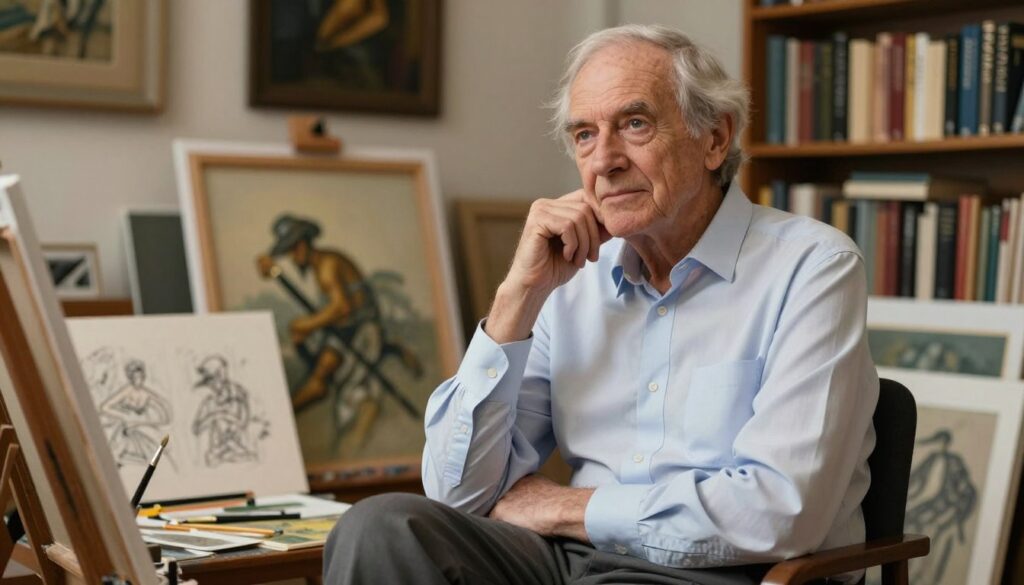
He trained as a painter and used visual routines to map inner experience. This creative practice informed much of his work and helped him explain abstract ideas clearly.
Intellectual Articulation
“One of the most intelligent and articulate psychics in the world.”
That praise came from a noted author who encouraged readers to consult his book and later books. These collections form an important part of his public record.
- Artist and experimenter: ideas met imagery.
- New York offered a lively backdrop for creative exchange.
- Published collections capture years of disciplined practice.
Early Involvement in Parapsychology Research
Formal lab work began for him in 1969, starting many years of controlled study into remote viewing. He joined structured sessions that aimed to turn informal skills into measurable data.
Collaborations with the Stanford Research Institute let him take part in landmark experiments. These tests pushed limits on how viewing could be verified under lab rules.
The Society for Psychical Research and related forums discussed results and debated methods. That dialogue helped shape how protocols were judged by peers.
By the time he left New York, he had become a central figure in psychical study. Early work focused on making viewing replicable and suitable for a research institute setting.
| Year | Site | Role | Focus |
|---|---|---|---|
| 1969 | Stanford Research Institute | Participant | Controlled remote viewing experiments |
| Early 1970s | Society Psychical Research | Presenter | Method debate and protocol review |
| Years after | University West archives | Contributor | Documentation and replication notes |
The Legacy of Ingo Swann in Modern Parapsychology Research
Contemporary scholars still consult his notes to shape current remote viewing methods.
Swann’s approach gave the field a repeatable way to test claims. That structure helped teams move from anecdotes toward testable protocols.
Today, researchers revisit those steps to refine controls and address critics. This keeps the topic part of serious study and helps bridge gaps with mainstream science.
“Systematic methods turn experience into data, and data drives clearer debate.”
Key impacts include clearer session rules, training templates, and archived examples that guide new work. These outcomes mean his influence will shape the field for years.
| Area | Contribution | Benefit |
|---|---|---|
| Protocols | Standard session steps for remote viewing | Improved repeatability |
| Training | Templates for novice to expert practice | Faster skill development |
| Archival notes | Detailed session records | Baseline for new studies |
Contributions to the Star Gate Program
The Star Gate program adapted several practical methods to make psychic data usable for analysts. Remote viewing moved from anecdote to standard session steps during these years. That shift let teams compare results across trials and agencies.
Remote Viewing Protocols
Hal Puthoff worked closely with ingo swann at the Stanford Research Institute to tighten controls. Together they designed protocols that aimed to capture actionable information from distant targets.
The experiments at the research institute focused on reproducible cues and blind target handling. Teams ran sessions in New York and other sites to test consistency and reduce bias.
- Practical role: Swann helped convert theory into repeatable viewing steps.
- Experimental design: Sessions sought usable data for analysts.
- Archival value: The program left detailed notes for later study.
“Structured protocols allowed viewing to be evaluated against measurable criteria.”
Theoretical Perspectives on Psychic Phenomena
He treated precognition as a usable subject, mixing case notes with careful experiment logs. This section surveys key themes he explored: foreknowledge, astrology and intuition, and healing events tied to mind and body.
Precognition Studies
One chapter in his book chronicles personal experiences that question linear time. He linked dream content to later events and ran small scale experiments to test timing and recall.
Astrology and Intuition
As an amateur astrologer, he argued that intuition acts as a signaling system for the mind. He suggested astrological patterns could map tendencies, not predict fixed outcomes.
Healing Phenomena
He recorded cases like John Traynor at Lourdes and discussed how focused attention seemed to affect the body. Teams noted several psychokinesis examples during attempts to document changes.
- Precognition: chapter-based reports and targeted experiments.
- Astrology: intuition used as a working hypothesis.
- Healing: documented case studies and bodily recovery events.
“Systematic notes can make strange experiences easier to compare and test.”
| Topic | Data / Case | Implication |
|---|---|---|
| Precognition | Dream-linked events, documented experiment logs | Challenges simple time models |
| Astrology & Intuition | Astrological charts, intuitive reports | Maps patterns, guides viewing practice |
| Healing Phenomena | John Traynor case, psychokinesis notes | Suggests mind-body interaction |
Exploring Geomagnetic Fields and Biological Heritage
A thread of work explored whether small environmental fields nudge the mind toward unusual experiences. Michael Persinger ran targeted experiments that tested geomagnetic shifts and how the human system responds.

Swann suggested a “psychic‑biological heritage” where living creatures exchange signals via electrical or magnetic means. That idea pushed attention toward how the body might tune to external events.
Persinger’s studies supplied measured data linking magnetic fluctuations to changes in subjective reports. Some findings imply the dream state may be more receptive to external fields than waking states.
“Small field events can correlate with altered awareness and reporting.”
For practitioners, this led to a practical note: timing and environment matter for successful remote viewing. Understanding field interactions helps frame better session design and invites careful study of psi phenomena.
For a broader archive view, consult the Ingo Swann archive to follow original notes and related work.
The Significance of the University of West Georgia Special Collections
At 1601 Maple Street, Carrollton, GA, a single repository preserves thousands of pages that shape scholar work today.
The special collections at University West Georgia houses the primary papers and unpublished manuscripts that matter to students of parapsychology and psychical research.
These materials include draft notes, session logs, and correspondence. They give readers a clear view of how ideas developed over time.
Visiting scholars can study manuscripts that no library holds elsewhere. The subject is vital for anyone tracing method, practice, or biography.
“Primary archives let new questions appear where the text once seemed fixed.”
- The special collections act as the definitive repository for these papers.
- Thousands of pages document the evolution of the subject over decades.
- Researchers traveling to West Georgia gain access to unpublished material and rare drafts.
| Item | Content | Value to scholars |
|---|---|---|
| Unpublished manuscripts | Drafts, notes, session logs | Reveal process and changes to ideas |
| Correspondence | Letters with colleagues and institutes | Context for collaborations and debate |
| Archival guides | Catalogs and finding aids | Help visitors plan focused study |
For background on associated investigators, see a profile of Hal Puthoff, which helps place archived items in context.
Analyzing Swann’s Published Works and Manuscripts
Early notebooks reveal a steady effort to define terms and to make subjective reports usable as data.
Among the papers at University West Georgia, staff found the manuscript for Psychic Literacy and the Coming Psychic Renaissance. That draft, plus numerous unpublished manuscripts, sheds new light on his methods and years of practice in New York City.
Unpublished Manuscripts
The special collections hold glossaries and lists—terms like “information-glut” appear often to help readers navigate complex ideas.
Many manuscripts give concrete examples drawn from books and experiments. Those pages show how remote viewing was taught, tested, and applied to practical problems.
- Vast papers: unpublished drafts map protocol changes across years.
- Practical examples: book excerpts illustrate how viewing solved tasks.
- Archive value: the University West Georgia collection helps any researcher verify data found in published work.
“Careful notes turn impression into testable information.”
For an adjacent perspective on applied methods, see this short piece about a notable clairvoyant method.
Navigating the Skeptical Critique of Parapsychology
Skeptical attention pushed practitioners to tighten methods and record fuller detail. That pressure shaped how the author handled critique in a clear, public way.
Ingo Swann knew being labeled kooky came with this work. He devoted a chapter to common objections and to the lack of repeatability in many experiments.
Critics cite fraud and error to dismiss phenomena. Swann and the Society Psychical Research addressed those charges by publishing detailed session notes and by highlighting cases that survived scrutiny.
He used books and data to answer skeptics, offering examples and attempt logs that show how viewing can be tested. The material at University West and other archives gives researchers concrete files to review.
“Balanced critique helps the subject grow, not retreat.”
For further discussion of protocols and public debate see this short guide to remote viewing critiques. These resources make clear that questions persist—but so do measured responses and new experiments.
The Future of Psychic Literacy and Human Potential
A clear path to wider psychic literacy starts with study, training, and public dialogue. Scholars argue that recognizing how psi phenomena appear in daily life will help turn private skills into shared tools.
The work begun by Hal Puthoff at the Stanford Research Institute and the sessions led by ingo swann set a model. Those early experiments gave the field methods that can be refined with modern tests.
Paying attention to the special collections at University West Georgia offers a roadmap. Archivists preserve session notes, case files, and training chapters that teach how to run repeatable viewing sessions.

Moving forward means blending archived information with careful experiments. Teachers, labs, and public programs can help the mind and body learn to notice signals, dream material, and subtle experiences.
“Wider psychic literacy will grow when method meets education and public attention.”
- Practical goal: Turn session notes into training curricula.
- Research focus: Replicate viewing steps in new labs and field sites.
- Archival role: Use West Georgia files to guide future studies.
Conclusion
Collected papers at University West Georgia trace how an author shaped a field through trials, teaching, and published work.
The special collections hold notebooks, manuscripts, and a steady run of books that map session methods and reporting. These items make viewing practices clear and testable for future readers.
For anyone curious about training, session notes, or a guiding book, the archive is central. Studying these papers helps readers see the care behind remote viewing and the effort required to record it well.
Explore related material and applied methods via this short guide to psionic practice for practical context and next steps.
FAQ
Who was Ingo Swann and why does he matter to studies of psi?
Swann was a prominent artist and investigator who helped shape protocols used to test remote perception and psychokinesis. He worked with researchers at the Stanford Research Institute and influenced programs that explored human information access beyond the senses.
What role did Swann play in the early development of remote viewing?
He helped design and refine remote viewing methods, participating in experiments and offering practical feedback that led to more structured protocols used by military and academic teams, including researchers linked to the Star Gate program.
How did Swann’s artistic background influence his approach to psi phenomena?
His training as a visual artist gave him tools for vivid imagery and disciplined observation. He often described impressions in painterly terms and encouraged techniques that blended sensory detail with disciplined reporting.
Which institutions hold important materials related to his work?
Collections and archives connected to the University of West Georgia and other repositories maintain papers, manuscripts, and correspondence that document experiments, protocols, and published articles tied to his career.
What is the connection between Swann and the Star Gate program?
Swann collaborated with investigators who later became associated with Star Gate. His methods and trial results were part of the body of work that informed program activities investigating remote perception for intelligence applications.
Did Swann publish books or papers that are still cited today?
Yes. He authored several books and articles describing experiments, personal techniques, and theoretical ideas. Researchers and historians still consult these works to understand early methodological choices and reports of striking cases.
Are there unpublished manuscripts or notes that researchers can access?
Some unpublished drafts and correspondence survive in institutional special collections. Scholars can request access through library archives, which may hold notebooks and experimental records useful for historical analysis.
How did peers and skeptics respond to his claims and data?
Responses ranged from interest to critique. Some scientists praised his disciplined reports and experimental detail, while skeptics highlighted methodological gaps and urged stricter controls. That debate helped push improvements in experimental design.
What kinds of phenomena did he investigate besides remote perception?
Swann explored precognition, psychokinesis, and intuitive processes. He also discussed links between bodily states, geomagnetic factors, and subjective experiences, proposing hypotheses that invited empirical follow-up.
Can modern researchers build on Swann’s methods safely and rigorously?
Yes. Contemporary teams can adapt his descriptive techniques while applying current controls, statistical methods, and replication standards. Combining historical insight with modern protocol improves reliability and ethical oversight.
Where can I find credible secondary sources about his work?
Look for peer-reviewed articles, university archives, and books by historians of psi. Papers from organizations like the Society for Psychical Research and reports from the Stanford Research Institute provide contemporary context and documentation.
How does his work inform debates about human potential and training?
His case studies and training methods suggest that disciplined practice, clear reporting, and feedback can shape subjective performance. That idea informs current programs that study skill development in anomalous perception.