

Les Propheties first appeared in 1555 as a compact book of quatrain verses that drew readers across centuries. The short four-line stanzas sparked debate when later readers tied lines like “golden cage” and “blood of the just” to famous events.
Fans point to dramatic examples—from a royal joust that killed a king to the Great Fire in 1666 and modern tragedies linked to wars, leaders, and blasts. Skeptics reply that vague language, mixed-language phrasing, and retroactive readings make matches easy after the fact.
This intro will set a clear route: a quick tour of the big alleged hits, a plain look at the original quatrains, and a fair comparison of believer and critic views. You can follow a short guide and use the linked summary for deeper reading at a detailed overview.
Key Takeaways
- Les Propheties is a 1555 collection of quatrains that inspired centuries of debate.
- Many famous events are later tied to lines that are often vague or symbolic.
- Skeptics point to translation issues and hindsight bias when assessing matches.
- The article will compare each famous case to the quatrain text and context.
- By the end, readers will have tools to weigh claims with a clear eye.
Setting the stage: how a 16th‑century quatrain book became a modern list of “hits”
A mix of Latin, French, and cryptic verse turned a small Renaissance book into a modern cultural touchstone.
Les Propheties was first printed in 1555 as a slim volume of four-line quatrain stanzas. Over the centuries the text moved from private shelves into public conversation. Modern publishers still print the work, and media often cite a single line when big events unfold.
The process that links a verse to an event asks readers to match imagery to news. Short, metaphor-rich lines allow people to read many meanings across time. Critics point out that translation shifts and retroactive fitting make matches easier after the fact.
Below is a quick reference comparing why a verse endures and how it gets reused.

| Feature | What it looks like | Effect on readers |
|---|---|---|
| Language mix | Latin, old French, snippets of Italian | Ambiguity that invites multiple meanings |
| Form | Four-line quatrain | Short, memorable lines easy to quote |
| Time span | Published 1555, cited across centuries | Gives the book perceived lasting relevance |
| Common imagery | Fire, rulers, blood, storms (e.g., great fire) | Verses map onto many historic events |
Royal blood and burning cities: from King Henry II to the Great Fire of London
A single quatrain is often tied to a broken lance and a fatal wound that reshaped royal memory. Below we examine three famous links and the facts behind them.
“Two wounds made one” and the “golden cage”
In July 1559 a tournament lance splintered and pierced a visor during a joust. Fans point to the phrase wounds made one when citing the king henry incident.
The shard struck the eye and temple, and the injured monarch endured about ten days before death henry. Supporters note the “golden cage” image and lion heraldry to tie the verse to a field combat scene. Critics say a friendly tournament is not the same as a battle.
The Great Fire in ’66: blood and an “ancient lady”
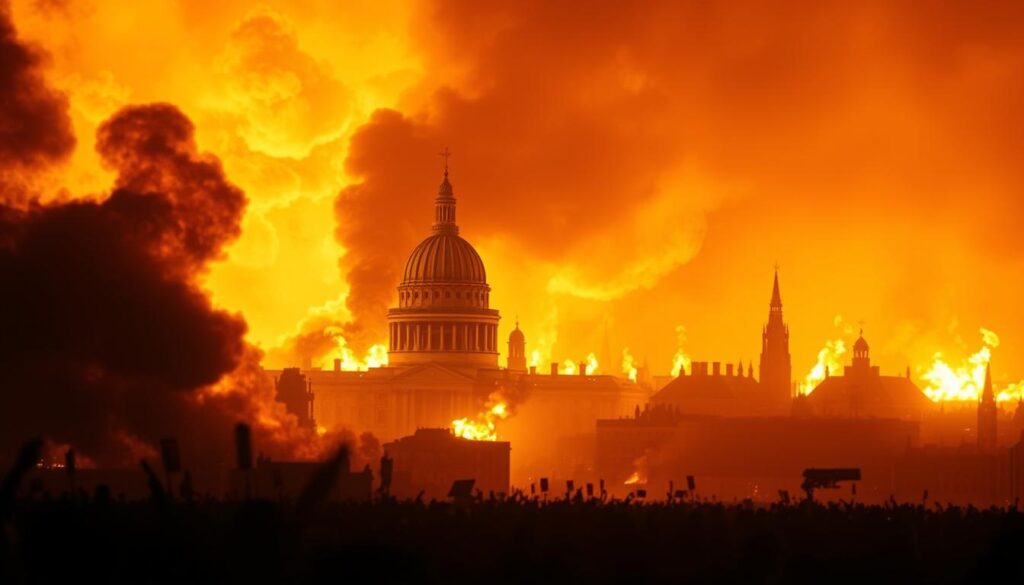
Fire london began on Pudding Lane on September 2, 1666 and burned for roughly three days. Some link the quatrain line about blood to plague victims and dying rats, and call London the “ancient lady.”
Philip II: seven years, fleets, and a “young onion” foe
Another stanza mentions seven prosperous years, an Arab fleet defeat (Lepanto, 1571), then later setbacks like the 1588 Armada. Readers map those lines to royal rise and reversal.
Revolution and empire: chants, demands, and the rise of a “great man”
Short, vivid lines about songs and prisons have long been tied to the unrest that swelled in Paris in 1789 during the french revolution.
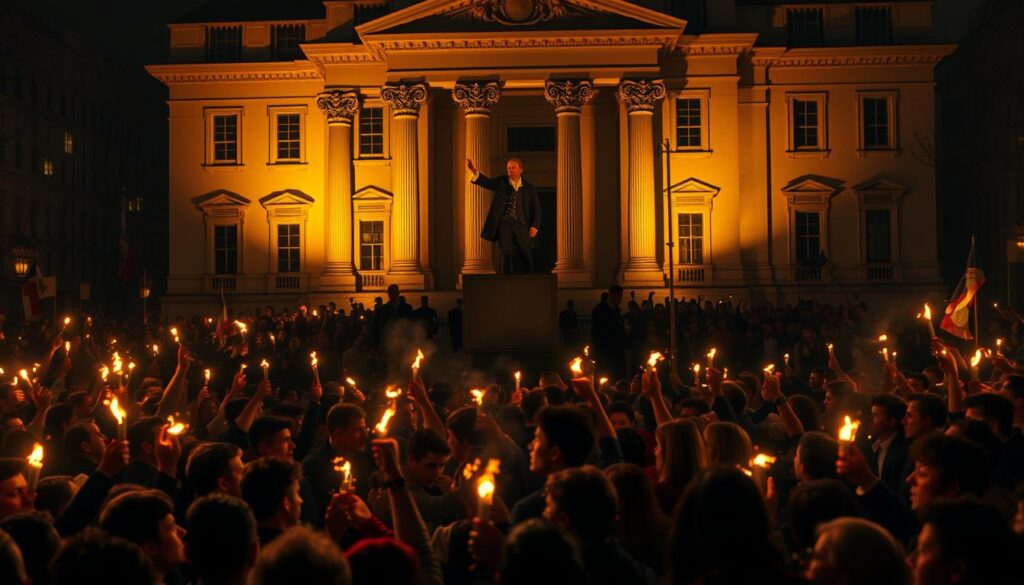
Readers link a quatrain mentioning chants and public demands to the storming of the Bastille. That prison stood as a royal symbol until crowds seized it and forced a rapid collapse in royal authority.
The French Revolution: songs, prisons, and the fall of the Bastille
Some interpreters point to street songs and calls for rights when matching the stanza to the people who rose up. They frame the street fighting as a kind of field combat, arguing that urban clashes read like battles in miniature.
Historians caution that many lines are broad. They note that public anger, factional politics, and long-term crises better explain the king’s loss than a single verse.
Napoleon’s conquest: Pau, Nay, Oloron anagrammed into a “great man”
Another quatrain lists place names — Pau, Nay, Oloron — which later readers rearranged into a name for a man who rose fast. Supporters say the phrase “more of fire than of blood” fits his outsider roots and harsh rule.
People point to his swift rise in just a few years and to campaigns and battle after battle that built an empire. Skeptics reply that anagram reading plus hindsight builds a tidy story where history was messy.
| Claim | Verse feature | Historical context |
|---|---|---|
| Bastille link | chants, songs, demands | Popular uprising, symbolic prison seizure in 1789 |
| Urban fights as battle | imagery of combat | Street clashes and pitched fights across Paris and provinces |
| Napoleon anagram | Pau, Nay, Oloron → name | Rapid military rise, empire-building in few years |
| Interpretation gap | vague lines | Historians stress political causes beyond poetic wording |
Takeaway: The verses invite dramatic links to revolution and empire. Still, careful reading by historians shows social forces drove events more than any single short stanza. Ask whether the prediction feel comes from the text or from our habit of fitting lines to later facts.
Science and scandal: Pasteur celebrated, then “dishonored”
A single stanza about a celebrated scientist has long drawn readers into a modern debate over honor and science.
Louis Pasteur advanced germ theory, developed pasteurization, and worked on rabies and anthrax vaccines. A quatrain in the book mentions a name praised, then attacked, and a line about the moon finishing its great cycle.
Germ theory, the vaccine row, and public memory
Supporters map the verse to Pasteur’s breakthroughs and the pasteurization process. Readers point to long scientific shifts across centuries when they link the moon line to slow change.
“Pasteur will be celebrated… but by other rumors he shall be dishonored.”
In 1995 a study argued Pasteur used a rival’s findings for the anthrax vaccine, an event some call the later dishonor. Historians debate lab notes and priority rather than moral failure after his death.
| Claim | Verse detail | Evidence |
|---|---|---|
| Name match | Explicit naming and praise | Verse wording and later readers’ notes |
| Moon cycle | Line about a completed cycle | Interpreted as long scientific timeline |
| Anthrax controversy | Dishonor by rumor | 1995 study and archival debate |
The key question is whether the prediction depends on a name match or on reading history after the fact. For a wider review, see the detailed yearly guide.
Dictators, generals, and war: Hister, de Gaulle, and the bombs over Japan
Several quatrains are tied to 20th‑century conflict, naming figures whose actions changed whole regions.
Hitler’s rise: “Hister,” the Danube, and a seductive tongue
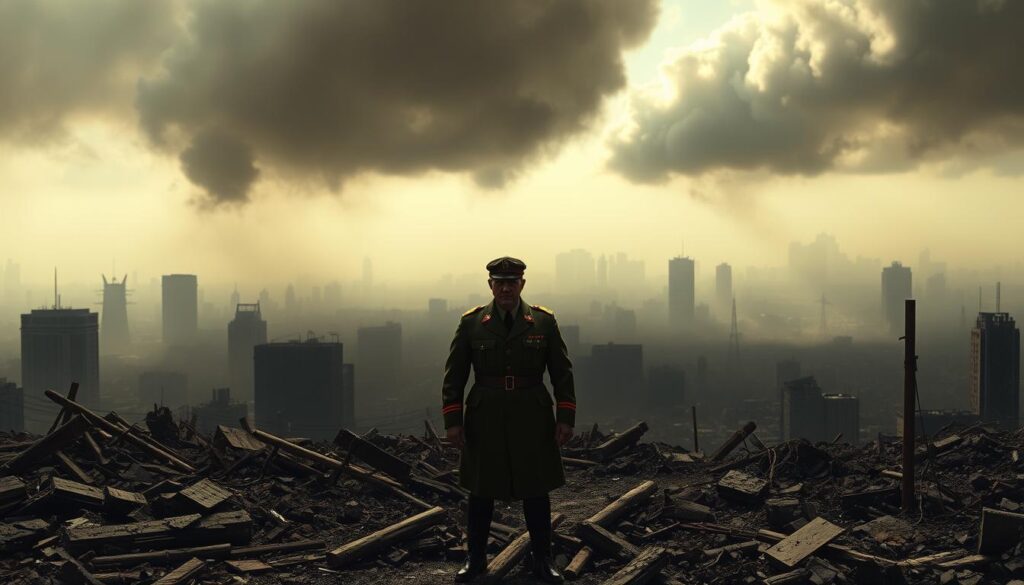
One stanza mentions a child from the West whose tongue seduces troops and whose fame reaches the East. Readers map the odd word Hister to the Danube near a later leader’s birthplace.
Interpreters point to his speeches and the years he rallied Axis powers across field and city. Critics note that river names and vague praise can fit many men.
Charles de Gaulle: three-stage leadership
A quatrain that contains a clear name match is often linked to De Gaulle. He led Free France, the provisional government, then became president in 1959.
That explicit name match is one of the strongest textual cases, yet historians still weigh context over single lines.
Hiroshima and Nagasaki: “heavenly dart,” clouds in the sky
Another verse speaks of a heavenly dart and a stone in the tree. Readers tie that image to the bombs over Japan and the terrible deaths, fire, and shock that followed.
Those lines capture the mushroom clouds and the grim turn in modern warfare, but retrospective linking remains a key question.
For a contemporary take, see the 2025 predictions review.
An American century in the quatrains: Dallas and New York
Two modern tragedies in the United States have been read into a few terse lines about attack from above and a blamed innocent. These cases show how vivid scenes and public grief shape matching between verse and event.

JFK’s assassination: “from on high,” an accused innocent, and guilt in the mist
A quatrain mentioning a strike “from on high” and a “dead innocent” is often linked to the 1963 assassination. Supporters point to Lee Harvey Oswald’s protest that he was a patsy and his murder in police custody as fitting the verse’s sense of mist and doubt.
September 11 in New York: “the sky will burn” over a “great new city”
Another stanza that speaks of the sky burning and fire near a great new city is tied to the 2001 attacks in new york. Readers cite television footage and the towers’ collapse as powerful matches for the text’s imagery.
| Claim | Verse detail | Reality or debate |
|---|---|---|
| Strike from above | Attack “from on high” | Assassination shot; competing eyewitness and forensic accounts |
| Blamed innocent | “Dead innocent” / accused patsy | Oswald’s claim and murder in custody fuel doubts |
| Sky will burn | Fire, smoke, falling towers | Hijacked planes, widespread footage, many witnesses |
| Forty‑five degrees | Number cited in some readings | Interpreted as angle, latitude, or symbolic — no consensus |
Takeaway: Abundant footage and witnesses make these modern links feel close. Still, careful reading asks whether grief and a famous man at the center lead us to graft names onto short, evocative phrases. For the original quatrain text and deeper notes, see this quatrain summary.
Why so many “hits” feel convincing: the mechanics behind Nostradamus’s reputation
Sparse, symbolic verses often read like prophecy once a crisis supplies the missing facts. Readers bring events to the lines, not the other way around.

Vagueness and ambiguity
Short lines leave space for many meanings. A single image can point to war, fire, or famine, so a prediction seems exact when it is not.
Retroactive fitting
Postdiction is common: matches are proposed after time and context make a story neat. Historians warn that this flips cause and effect.
Translation and interpretation hurdles
Mixed languages and archaic spellings produce multiple readings. Each version nudges readers toward different outcomes across time.
Selective reporting and lack of evidence
People repeat striking wins and ignore scores of misses. Big themes — war, plague, rulers — have recurring appeal, giving verses staying power beyond specific facts.
- Brief lines feel precise after a disaster.
- Post-event matches grow into accepted stories.
- Mixed texts let interpreters flex meanings to fit events.
Takeaway: Demand clear evidence for any single claim and watch for selective emphasis by those who expect prophetic powers.
Context matters: educated guesses versus mystical foresight
Context shapes whether a verse reads like a clever insight or a mystical forecast. Readers who study politics, medicine, and war can often spot recurring patterns that later seem like prophecy.
Historical trends, wars, plagues, and broad disaster imagery
Quatrain lines that mention blood, fire, or sky draw easy matches after a crisis. Those images are vivid and reusable across centuries.
Scholars note that learned observers in the 1500s expected cycles: epidemics, famine, and pitched conflict. Noting those cycles does not equal magic; it is pattern-spotting based on evidence.

Leader-focused verses often highlight one archetypal man who rises and falls. That archetype appears repeatedly in history, so many eras find a fitting figure.
- Compare educated reading with mystical claims: one looks at trends, the other invokes fate.
- Broad imagery like blood and sky applies to many crises without naming one event.
- The great fire motif gets recycled from medieval towns to modern skylines.
“Context often does the heavy lifting when verses seem to match a new headline.”
The goal here is practical: learn to spot resonance versus real evidence. With that skill you can better judge whether a short verse helped to predict future events or simply echoed known risks.
So, how many of Nostradamus predictions came true?
Supporters point to clear cases: a royal death, a city fire, and leaders who changed nations. These vivid examples make the verses feel specific.
Counting exact hits, however, proves tricky. Many matches rest on short lines that admit more than one meaning. Translation shifts and post-event readings widen the choices.

- Strict standard: dated detail, unique names, verifiable timing.
- Loose standard: broad image, symbolic wording, retrofitted event.
“Under tight rules, almost none stand up. Under looser rules, several can be read as matches.”
| Criterion | Strict test | Loose test |
|---|---|---|
| Specificity | Place, date, unique name | Vivid image or archetype |
| Timing | Clear year or era | Any later fitting era |
| Text fit | Direct wording match | Metaphor or broad phrase |
In short, you can made one count under loose rules, but under tight rules only a very small number qualify. The plain takeaway: apply standards before accepting a bold claim.
Conclusion
Conclusion. Vivid images—golden cage, wounds made one, the ancient lady, and burning sky—explain why readers link short quatrains to king henry, great fire london, and later crises like hiroshima nagasaki.
Those lines gain power when people stitch a verse to a well‑known scene. Assassination cases (Dallas, New York) and the memory of bombs earn urgent readings because mist, fire, and grief shape interpretation.
Apply strict standards: named places, dated detail, and clear wording, or accept looser matches that let one verse be made one with many events. For a practical next step and a place to explore further, see a short guide to predict future.
FAQ
How reliable are Nostradamus quatrains for predicting events?
Quatrains use vague, symbolic language that allows many interpretations. Scholars note that broad imagery and archaic phrasing make it easy to match lines to later events. That flexibility creates impressions of accuracy even when specific forecasting is absent.
Did a line about “two wounds made one” really refer to King Henry II’s death?
The famous line about two wounds has been linked to Henry II’s jousting accident, but the match depends on interpretation. Critics point out that the quatrain’s wording is ambiguous and could fit other incidents. Historians treat the connection as speculative rather than definitive.
Can a quatrain describe the Great Fire of London in 1666?
Some readers connect phrases about fire, blood, and an “ancient lady” to the London blaze. Yet the text lacks clear identifiers like dates or place names. Most experts say the passage is broad enough to allow retroactive fitting instead of being a precise forecast.
Were quatrains used to predict the French Revolution and the fall of the Bastille?
Lines referencing chants, demands, and prison unrest have been read as nods to the Revolution. Interpreters argue these themes reflect recurring social tensions common in many eras, so linking them directly to 1789 is uncertain.
Is there a genuine reference to Napoleon as a “great man” from Pau, Nay, Oloron?
The anagram interpretation of place names into a “great man” like Napoleon is creative but speculative. Linguistic rearrangements and loose translations often drive these claims more than clear textual evidence.
Do quatrains mention early science figures like Louis Pasteur and later controversy?
Some lines have been read as celebrating medical advances then warning of dishonor. These readings typically depend on broad terms such as “cure,” “disease,” or “dishonor,” which fit many scientific stories over centuries rather than pinpointing one person.
Did any quatrain anticipate Hitler or World War II?
Passages mentioning a leader from western Europe or a name like “Hister” are often cited for Hitler. Linguistic coincidences and translation shifts play a large role. Most historians warn against accepting these as direct prophecies of specific 20th‑century figures.
Are lines linked to Hiroshima and Nagasaki clear predictions of atomic bombing?
Some interpreters point to images like a “heavenly dart” or “stone in the tree” as atomic references. These metaphors are open to many readings. No quatrain includes unmistakable technological details that confirm an atomic bomb prediction.
Do any quatrains explicitly name New York or events like September 11?
References to a “great new city” or skies that “burn” have been tied to New York and air attacks. Such phrases are poetic and not specific, allowing retroactive association with 9/11 or other tragedies rather than serving as clear forecasts.
How do translators and editors affect perceived accuracy?
Translation choices, OCR errors, and editorial insertions can alter meaning significantly. Multilingual wordplay and archaic French require careful scholarship; loose translations amplify ambiguity and boost apparent matches to modern events.
Why do so many people accept matches between quatrains and major events?
Cognitive bias plays a big role. People remember hits and forget misses. Confirmation bias, selective reporting, and dramatic storytelling all make some quatrains seem prophetic when, in reality, many others fail to match facts.
Can statistical analysis answer whether quatrains truly predict history?
Quantitative studies show that vague statements can yield numerous false positives when tested against a long timeline. Rigorous analysis typically finds no better-than‑chance predictive power once ambiguity and postdiction are controlled for.
Is it possible some quatrains reflect educated guesses about future trends?
Yes. Observing political tensions, religious conflict, and technological change in the 16th century could inspire plausible conjectures. Many lines read more like general forecasts of recurring human crises than supernatural foresight.
Which events are most commonly cited as successful matches?
Popular matches include King Henry II’s injury, the Great Fire of London, the French Revolution, Napoleon’s rise, World War II, Hiroshima and Nagasaki, JFK’s assassination, and September 11. Each pairing depends on interpretive choices that historians debate.
Should people treat quatrains as historical evidence or entertainment?
Treat them primarily as literary and historical curiosities. They reflect Renaissance imagination and the appeal of prophecy. For factual decision‑making or serious forecasting, rely on documented historical analysis and modern forecasting methods.