

This famous card is often feared, but its true role is practical and hopeful.
The image shows a skeletal knight on a white horse and a black flag. It points to endings that affect all people equally and to a clearing away of what no longer serves.
At its core, the symbol stands for transformation, release, and the start of a new chapter. In the Major Arcana it marks a major shift rather than a literal loss.
Upright keywords include transformation, endings, change, and letting go. Reversed meanings warn of resisting change, repeating old patterns, and stagnancy.
Use this sign as a guide: ask what habit, belief, or attachment needs to end to make room for growth. This approach turns fear or pain into practical steps forward.
Key Takeaways
- The card signals major transformation and the close of a chapter, not a literal end.
- Classic imagery highlights inevitability, purification, and equal change for all people.
- Upright keywords: transformation, endings, change, letting go.
- Reversed keywords: fear of change, resisting change, repeating negative patterns.
- See it as a tool to identify what’s outgrown so you can choose a healthier way forward.
Start Here: What the Death card really means in modern tarot readings
Today it often appears as a practical nudge toward transformation instead of literal finality. Think of it as an invitation to close a major phase so a new one can begin.

Keywords first: anchor your reading with three simple words — transformation, transition, and letting go. These keywords give quick clarity in any card reading.
- The modern meaning frames endings as cleansing, not punishment.
- Upright signals change in motion; reversed flags fear, stuck beliefs, or repeating patterns.
- It often arrives when a cycle has reached its natural end, nudging where to direct energy next.
“Uncomfortable endings point the way to a freer chapter.”
Apply this to one area now — love, work, or personal growth — and note small first steps. Pay attention to surrounding cards, timing, and the spread to refine the pace of transition.
For related guidance on emotional endings and new openings, see a focused example like three of swords.
Death Tarot Card Description and Symbolism in the Major Arcana
A lone armored figure, a pale steed, and a waving emblem create a visual lesson about life cycles.
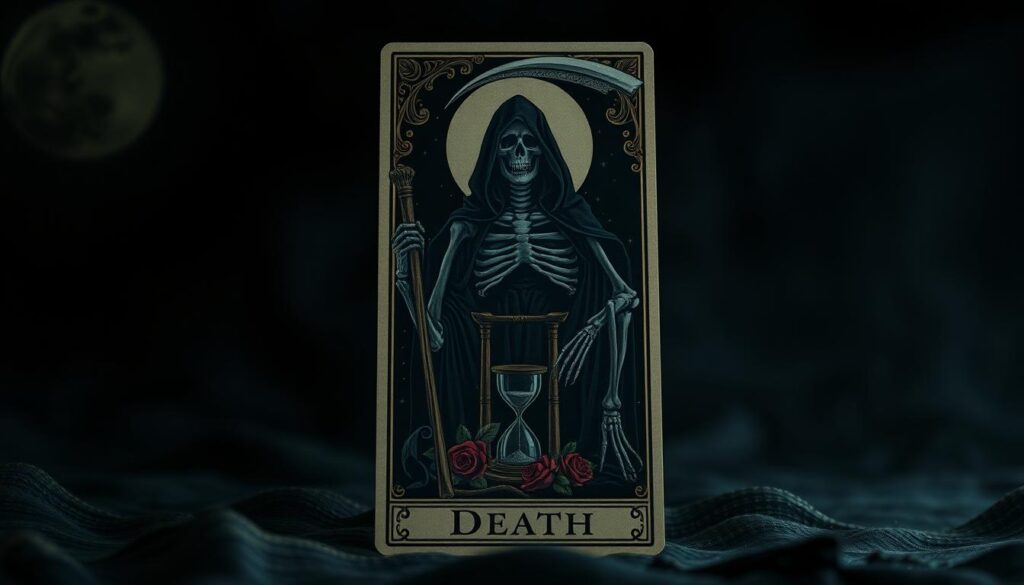
The armored skeleton and the power of inevitability
The armored skeleton shows endurance and inevitability. The armor implies that this force cannot be broken. The skeletal body points to what remains after old patterns fall away.
The white horse, black flag, and purity through endings
The white horse signals purity and forward motion. The black flag, marked with a pale emblem, suggests renewal born from paradox — light inside darkness. Together these elements show how endings can cleanse and start new cycles.
All people before Death: the great equalizer across class and status
Figures from king to pauper appear in the scene to remind us that this force treats all people the same. That visual equalizer shifts focus from status to the shared process of change.
Quick exercise: notice which symbol draws your eye first. That focal point will guide the energy you emphasize in a reading.
| Symbol | Visual cue | Interpretive prompt |
|---|---|---|
| Armored skeleton | Armor and bones | Unstoppable change; what remains after loss |
| White horse | Pale steed in motion | Purity, forward movement, new direction |
| Black flag | Dark banner with emblem | Renewal through endings; paradox of growth |
| People | All classes kneeling or fallen | Shared process; universal transition |
How to read the Death card upright: a step-by-step guide to change, endings, and rebirth
An upright appearance often points to a clear ending that invites practical steps toward renewal. Start by naming which area of your life needs transformation, then narrow the scope so the message becomes an actionable plan.
Spot the upright keywords
Transformation, transition, release. Ask which word maps to your situation. That focus turns a symbolic reading into a step-by-step map you can use today.
Translate “an ending” into next steps
Clarify what is complete and list two concrete actions for the week. Examples: cancel a subscription, have a boundary talk, or create a simple timeline for change.
Letting go rituals: move insight into action
Choose one small ritual: declutter a drawer, write and release a note, or rehearse a new habit. These rituals shift energy from thought into motion.
- Visualize the next version of you to reframe fear.
- Pick one replacement habit to displace a stuck pattern.
- Check surrounding cards for pacing; if support appears, schedule the first step now.
| Action | Why it helps | First step |
|---|---|---|
| Clarify the ending | Makes the process concrete | Name three things that are done |
| Physical purge | Signals release to your body | Declutter one drawer tied to the issue |
| Ritual & journaling | Turns lessons into new choices | Write what you learned and one new rule |
Mini-checklist: what ends, what starts, what to release today, who to inform, and one small celebration to anchor the rebirth. For focused practice on skill and craft during transitions, see a related guide like eight of pentacles.
How to read the Death card reversed: working through resistance and repeating patterns
A reversed placement frequently signals hesitation, where old patterns keep replaying instead of resolving. It points to holding on, stalled momentum, and a sense that the process has gone quiet instead of moving forward.

Recognize reversal signals: watch for fear of change, stagnancy, and slow decay in routines. These show where the work is stuck and where energy leaks occur.
Diagnose the block
List specific fears, obligations, or comforts that stop action. Notice rumination, perfectionism, or avoidance as common drains on energy.
Reframe the spread
Scan for supportive others or cards offering skills, mentors, or clarity. Choose one safe next step to lower risk and restart movement.
“Reversed is not a verdict — it’s a map to where you can begin again.”
- Use a stop-start-continue list to interrupt repeating patterns.
- Try an affirmation like “I embrace change in all forms.”
- Revisit the reading in a week and draw a clarifier: “What am I resisting?”
| Issue | Signal | First step |
|---|---|---|
| Fear of unknown | Indecision, avoidance | Write one micro-goal for seven days |
| Repeating role | Stuck in same outcomes | Set one boundary or decline one request |
| Energy leaks | Rumination, perfectionism | Schedule a 15-minute review habit |
For a related practice on framing slow shifts, try a reflective spread work that helps you name what to release and what to keep.
Love and relationships: using the Death card to navigate transitions
For relationships, the arrival of this symbol asks: what needs to change so your bond can breathe? Use the message as a practical lens to spot patterns that help or hurt the connection.

Couples: embracing growth, ending cycles, or closing a chapter
Upright: encourage honest growth. Look for repeating fights, old roles, or habits that block progress. If growth is blocked, the reading may advise a compassionate end so both people can find healthier paths.
Turn insight into one loving action: schedule a calm conversation, revisit shared goals, or try a two-week trial of new agreements. These small steps make transformation feel safe and real.
Singles: shedding old beliefs to create space for connection
Upright for singles: examine beliefs or behaviors that close you off. Let go of outdated rules about dating, and try one practice—like value-based dating—to open space for real connection.
Reversed: watch for clinging to familiar but unhelpful patterns. If you sense stagnation or dependence, plan gradual changes: new routines, gentle boundaries, or coaching to test different ways of relating.
- Invite your partner in if it feels safe; align on what ends and what you want to create next.
- Use surrounding cards in a reading to time action—supportive suits favor heart talks, while analytical suits suggest clarity first.
- Honor pain and relief both: end with care, set clear boundaries, and offer yourself compassion.
| Situation | First step | Goal |
|---|---|---|
| Stuck routine | Schedule one new shared activity | Restart connection |
| Old beliefs | Try one value-based date | Test new patterns |
| Need to end | Plan a clear, compassionate talk | Close with respect |
“What one change would make your relationship more alive this week, and how will you support it?”
Career and work: reading Death for job transitions and purpose
In a career reading, this symbol commonly points to a chapter that is ending to make room for new purpose.

Upright: expect role shifts, leaving an unfulfilling job, or fresh opportunities that match your purpose. Use this as validation to plan concrete steps like updating your resume, lining up informational interviews, and setting a target date for a move.
Practical next steps
- Update skills and network so change meets preparation.
- Set a 3–6 month runway: savings, job-search cadence, and support.
- Scan nearby cards for resources (Pentacles) or momentum (Wands) to pace action.
Reversed: notice repeating workplace patterns—overcommitting, conflict avoidance, or impostor feelings. Pinpoint one habit to replace and add weekly accountability to break the loop.
“Treat misfit roles as lessons: list what ends and what new criteria will guide your next choice.”
For emotional closure and related guidance during transitions, see a focused example like five of cups.
Money and resources: interpreting financial shifts with Death

Financial upheaval can feel raw, but it also opens a clear opportunity to rethink what you value.
Upright readings often point to a real loss or change in income that forces adjustment. Name the ending clearly—overspending in one area, a job shift, or a sudden bill—and pick two immediate budget changes that match your new reality.
If money drops, focus on essentials first. Negotiate bills, pause non-essentials, and set a minimal viable budget so breathing room returns fast.
Practical ways to rebuild
- Automate small transfers to savings or debt to build momentum.
- Create an emergency buffer or start a side income experiment.
- Do a values audit: direct funds to health, learning, security, or giving.
- Track weekly wins so transformation feels real and repeatable.
Reversed readings show resistance—clinging to lifestyle inflation or avoiding hard conversations. Swap one habit at a time to make changes sustainable.
Support your body during stress: steady sleep, regular meals, and short walks keep thinking clear and decisions calmer.
“Name the ending, pick two small financial moves, and protect your energy while you rebuild.”
| Signal | First step | Why it helps |
|---|---|---|
| Income shift | Set a 30-day essential-only budget | Creates immediate clarity and control |
| Overspending | Cut two recurring subscriptions | Frees cash and shows quick wins |
| Resistance to change | Replace one spending habit per month | Makes transformation steady and lasting |
Advanced layers: astrology, elements, numerology, and sequence
Layering astrology and numerology reveals how endings translate into structure and rebirth. This view helps you add depth without overcomplicating a simple spread.

Astrology and planetary rulers
Scorpio anchors the meaning, with Mars as the old ruler and Pluto as modern power. Think of the Tower for sudden clearing (Mars) and Judgement for long-term resurrection (Pluto).
Elemental current and emotional depth
The water elements link this motif to the Moon, the Hanged Man, the High Priestess, and the Chariot. That current signals surrender, somatic release, and emotional truth as agents of transformation.
- Map Scorpio + Mars/Pluto to pruning and eventual rebirth.
- Spot the Tower for fast clearing; Judgement for slow resurrection.
- Follow the water series for surrender, depth, and inner work.
Number and sequence
Numerology 13 reduces to 4, tying endings to the Emperor’s structure — a disciplined rebuilding after loss. In sequence, this card sits after the Hanged Man’s sacrifice and before Temperance’s healing.
“Pain and dissolution are part of the alchemical path to wholeness.”
| Theme | Signal | Practice |
|---|---|---|
| Astrology | Scorpio, Mars, Pluto | Track timing and inward work |
| Elements | Water current | Notice somatic release |
| Numerology | 13→4 | Create structure after change |
How to place the Death card in your spread: positions that clarify meaning
Where the card lands tells a different story about endings and openings. Placement helps you decide whether the theme is a process, a result, or a timing cue.

Past–Present–Future and Celtic Cross roles
In a Past–Present–Future reading, read the death card in the Past as a recent end still shaping today.
In the Present it signals active release work. In the Future it warns of an upcoming end that will create space.
On a Celtic Cross the same glyph can appear as a crossing (what must end), a foundation (root patterns), or the near future (when the shift will unlock the story).
Signifier versus outcome
Use the card as a signifier when a full reading centers on transformation; you name the process rather than promise a fixed result.
As an outcome, it marks a chapter concluding. Pair it with surrounding cards to see what opens next and where to act—love, career, or home transitions often clarify who to tell and when.
- Ask timing cards if you need time windows rather than fast fixes.
- When fear arises, pull a clarifier: “What supports this transition?”
- Document the layout and name one first conversation or calendar action to start the change.
For a practice that balances rest and active change, try a short card reading focused on recovery and next steps.
Death tarot card: timing, signals, and the pace of transformation
Not every big shift arrives with noise; some clearings come as a steady tide that reshapes the shoreline.
Sense the tempo by watching surrounding cards. A Tower suggests sudden upheaval, while Temperance or the Hanged Man points to slow integration.
Reading tempo: sudden towers, slow cycles, and real-life timelines
Calibrate expectations by contrasting a steady cycle with abrupt clearing. Start with a practical window: weeks for first moves, months for deeper transitions.
Listen for signals: early whispers, a mid-process shedding, and a final release that closes the loop. Mark anniversaries or seasons—they often align with the rhythm of change.
- Tempo clues: Tower or Wands speed things up; Pentacles or Temperance slow them down.
- Practical timing: plan micro-steps now and larger shifts over three to six months.
- Stabilize energy: steady sleep, movement, and a weekly review help you stay grounded.
If you need actual milestones, ask a clarifier spread for “what happens first,” “what happens next,” and “what marks completion.” Map those answers to concrete dates and checkpoints.
“A transformation can begin inside long before it shows up outside — trust the internal timing and adjust actions as you go.”
For related guidance on endings that become openings, see a focused example like ten of swords.
Comparing Death across tarot decks: visuals that shift your interpretation
Different decks rewrite the same scene, and those visual choices change how you read transitions.

Rider‑Waite‑Smith keeps a stark skeleton on a white horse with a black flag and people of varied ranks. That arrangement highlights finality and sweeping social change.
Modern decks often soften the image. Moon phases, butterflies, or a snake appear to stress cycles, lineage, and renewal rather than shock.
Visual cues that change the meaning
- Horse posture: forward charge feels urgent; calm stance suggests slow integration.
- Symbols: moons and serpents point to elements and cyclical processing.
- Bodies: ancestors or infants shift focus to family and long-term transformation.
Colors and symbols matter. Stark palettes signal decisive endings; blended hues invite healing. When you switch decks, recalibrate keywords to match what the artwork amplifies.
Tip: Browse a few decks and pick imagery that supports how you want to work with change.
| Deck type | Key imagery | Suggested focus |
|---|---|---|
| Rider‑Waite‑Smith | Skeleton, white horse, black flag, people | Clear endings, purification |
| Modern symbolic | Moons, butterflies, snake | Cycles, lineage, gentle renewal |
| Minimal/soft art | Blended tones, calm figures | Integration, emotional processing |
Conclusion
Use the Major Arcana’s lesson to name what ends and create room for the life you want next.
This tarot card is a compassionate guide to endings that lead to beginnings. Name what’s over, pick one next step, and add a small ritual or realistic timeline to support the process.
Apply these meanings across love, career, and relationships—center connection with self and others as chapters shift. Expect pain sometimes; meet it with kindness and clear boundaries.
Use astrology, elements, numerology, and sequence as lenses when you need nuance. Notice the artwork in your deck to fine‑tune interpretation, and try a short practice: write one belief to release and one new habit to anchor change.
Keep learning to read tarot; return to this series and the spreads often. Thanks for reading, and keep taking one clear action at a time. For related guidance on partnership and balance, see Two of Cups.
FAQ
What does the Death card mean when it appears upright in a reading?
Upright, this Major Arcana image signals transformation more than literal loss. Expect endings that clear space for new growth, a transition in roles or beliefs, and the chance to rebuild with purpose. Look for nearby supportive cards that point to action steps and timing.
Is the Death card ever about actual physical death?
Rarely. Most readers use this card as a symbol of change, shedding, or closure. It often marks emotional, relational, career, or spiritual endings that lead to renewal rather than a physical passing.
How should I interpret the card when it appears reversed?
Reversed, it often shows resistance to necessary change — fear, avoidance, or stuck patterns. The spread may reveal where energy leaks or why progress is blocked, and what rituals, boundaries, or practical shifts will release momentum.
What visual symbols should I notice on this image and why do they matter?
Key symbols include an armored skeleton (inevitability), a white horse (purity through endings), and a black flag (transformation). These images remind you that endings equal opportunity and that change is impartial to status or wealth.
How do I turn the card’s message into actionable next steps?
Translate “ending” into concrete moves: list what must go, set small deadlines, communicate boundaries, and design a letting-go ritual. Use follow-up spreads to map resources, allies, and practical changes to rebuild.
What does this image mean in love and relationships?
For couples, it can signal growth through shared change or the close of an unhealthy cycle. For singles, it encourages shedding old beliefs to make room for authentic connection. Context and surrounding cards clarify whether the shift is mutual or one-sided.
How should I read this card for career and work questions?
In career readings, the image points to job transitions, endings of roles, or a call to realign with purpose. Upright suggests new paths; reversed warns of repeating workplace patterns and the need to change strategy or skills.
Can this card indicate financial issues or opportunities?
Yes. It can highlight loss, restructuring, or a chance to redefine value and spending habits. Approach financial shifts with intention: budget, prioritize essentials, and plan rebuilding steps rather than reacting from fear.
How does astrology, numerology, or elemental correspondences deepen meaning?
The image often links to Scorpio, Mars, or Pluto energies — intense, catalytic change. Numerology ties 13 to structural transformation and the number 4’s stability. Water elements point to surrender and emotional processing. Use these layers to refine timing and tone.
Where is this card best placed in a spread to get clear guidance?
Strong positions include outcome, obstacle, or the “future” spot in Past–Present–Future and the Celtic Cross. A signifier placement can highlight whether the transformation applies to the querent directly or the situation at hand.
How can I tell if the change will be sudden or gradual?
Read tempo from adjacent cards: sudden, disruptive cards suggest rapid endings; slow, stabilizing cards indicate gradual transition. Personal context — readiness, resources, and relationships — also affects the pace.
Do different decks change how I should read this card?
Yes. Visual differences — from Rider–Waite–Smith to modern decks — shift emphasis on symbols like horses, flags, or figures. Let the deck’s imagery guide your intuition while keeping core themes of endings and renewal in mind.
What are healthy rituals to support the card’s message?
Simple practices help: journaling to release old patterns, symbolic clearing (decluttering, donating), mindful goodbyes, and setting a short-term plan for next steps. Pair these with practical actions like updating resumes, budgets, or relationship agreements.
Which keywords should I remember when this card appears?
Keep these in mind: transformation, release, transition, rebirth, endings, renewal, and closure. Use them as prompts to explore where change is needed and what to salvage for the future.