

Associative remote viewing for predicting future events explores how the human mind can link images to outcomes. In the 1980s, pioneers Russell Targ and Harold Puthoff began systematic research that changed how we study this practice.
Over 3.5 years of trials produced data that suggest trained and untrained participants can sense outcomes ahead of time. One notable experiment used untrained people and still returned surprising results.
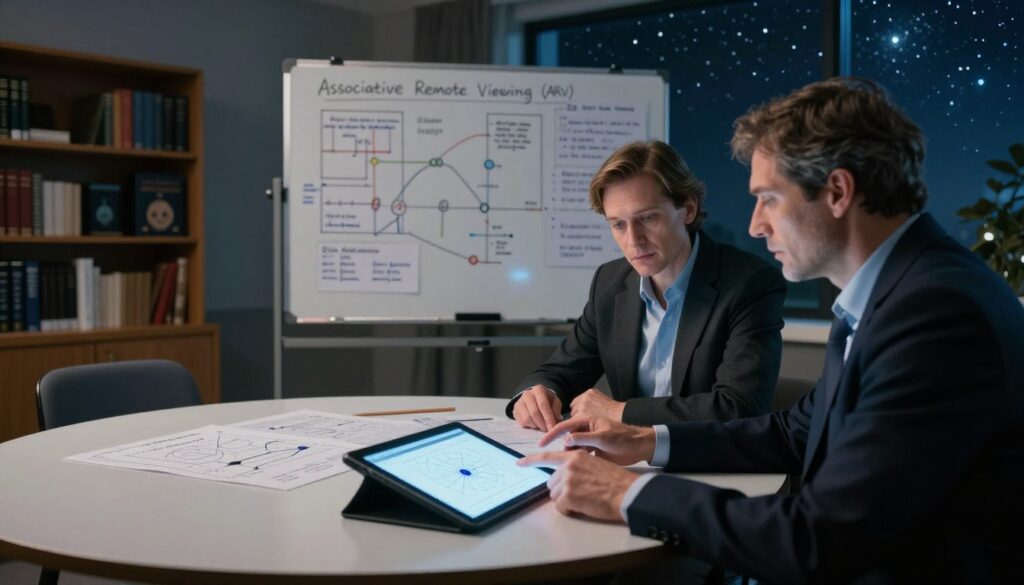
The process asks a viewer to focus on a target image tied to an outcome before tomorrow arrives. Each session acts as an experiment in consciousness and prediction. By studying past trials and results, researchers seek patterns that improve how we predict future trends in the world.
Key Takeaways
- ARV blends image matching with prediction to test how the mind reads outcomes.
- Russell Targ and Harold Puthoff launched formal research in 1984.
- Data from multiple years and trials show notable, repeatable results.
- Even untrained participants have given meaningful outcomes in experiments.
- Try guided exercises to learn methods: remote viewing exercises.
Understanding the Principles of Associative Remote Viewing
Clarity in the chosen photo lets the mind sort energy patterns and report meaningful impressions. A central rule is using two distinct photo targets so a viewer can match their impression to one clear outcome.
Core idea: link a single target image with a possible outcome. This turns a session into a focused test where the viewer’s mind reads subtle information and assigns a match.
Think of the process as a controlled game of chance with reality. Staying objective keeps personal bias from coloring the information the mind provides.
The author of ARVOPTIMAL stresses that a crisp photo target preserves session integrity. Separating the past from the future helps the viewer aim energy toward the specific event and improve chances of an accurate match.

- Use clear photos to reduce ambiguity in outcomes.
- Focus on the future to align attention and energy with the target.
- Remain objective to keep impressions free of personal bias.
Want to learn practical approaches? Try this guide to related techniques: exploring clairvoyant abilities.
Historical Research and Scientific Trials
Early laboratory trials turned curiosity into measurable tests of how human perception links images to outcomes.
In 1984, Russell Targ and Harold Puthoff created a protocol that set standards for how remote viewing is used in research labs. Their work made it possible to compare sessions with clear rules and blind scoring.
At the University of Colorado Boulder, Christopher Carson Smith, Darrell Laham, and Garret Moddel ran a notable study with 10 untrained participants. Each remote viewer described a photo target that was revealed after the market day closed.
The team reported seven successful matches out of seven trials tied to the Dow Jones Industrial Average. This outcome showed that even without experience, a viewer could match impressions to real-world outcomes more often than chance.
| Year | Study | Participants | Successful Matches |
|---|---|---|---|
| 1984 | Targ & Puthoff protocol | — | Protocol established |
| University study | Smith, Laham, Moddel | 10 untrained | 7 of 7 DJIA matches |
| Trials | Photo target method | Untrained viewers | Consistent outcomes |
For more context on the wider research into precognition and how image targets are used, see this overview on precognition research.
How to Use Associative Remote Viewing for Predicting Future Events
Start each session by keeping the task simple: the tasker selects two crisp photo targets, one mapped to a market rise and the other to a fall. The remote viewer stays blind to which image links to which outcome until the day ends.
Follow a strict protocol. Keep the viewer isolated from results while they describe impressions. This preserves the test and reduces bias in judgment.
The judge then compares the session data to the photos. Matching the description to a photo decides the prediction for tomorrow. This method is how researchers have used ARV to make stock-day calls.
Christopher Carson Smith’s team offers a clear example: untrained participants described an image that was revealed after market close, and matches were scored against actual outcomes.
- Use two distinct photo targets to reduce ambiguity.
- Run the session blind so the mind focuses on energy and impressions.
- Compare descriptions to photos to select the likely outcome.
- Treat each trial as an experiment bridging mind and reality.

Want hands-on guidance? Try a trusted option like psychic readings to learn protocols and practice as a remote viewer.
Optimizing Accuracy with Modern Software Protocols
Modern tools now tighten the link between clear photo targets and reliable outcomes. Software removes routine pairing errors so the viewer can treat each session as a clean experiment.

The Importance of Target Pairing
ARV Studio’s ARVOPTIMAL algorithm creates distinct photo pairs. This step cuts poor pairing by about 90% and keeps targets crisp.
The PREMIUM 1300 collection supports 358,000 unique binary photo target pairs. That large pool reduces repetition and keeps each trial meaningful.
Reducing Session Misses
Across 3.5 years and 600 trials, research showed poor pairing causes most misses. Using software reduced ARV misses by roughly 10%.
Automating pairing also frees a remote viewer to focus on impressions, improving the quality of the viewing session and the resulting predictions.
Data Security and Local Storage
Version 3.3, released August 20, 2025, keeps all data on the local computer. That design protects sensitive session data and removes cloud exposure.
| Feature | Benefit | Impact |
|---|---|---|
| ARVOPTIMAL algorithm | Distinct photo pairs | 90% fewer poor pairings |
| PREMIUM 1300 collection | 358,000 binary pairs | Less repetition, clearer targets |
| Version 3.3 local storage | On‑device data | Improved security for session data |
Example: with clearer targets and secure data handling, a team can run a remote viewing session with fewer misses and stronger outcomes.
If you want hands-on practice with protocols that protect data and sharpen target quality, see guidance on how to send healing energy.
Final Thoughts on the Future of Remote Viewing
Today, practitioners pair sharper targets with strict protocols to improve session accuracy and real predictions.
The energy of the human mind still plays a key role when people test impressions against clear photo targets. Small teams and labs keep refining methods to better predict future outcomes.
Past successes by researchers like Russell Targ show how one day of careful work can shift understanding. Each accurate match strengthens the case that consciousness can interact with the world in measurable ways.
Ready to explore? Try a guided option such as psychic phone readings or an online psychic session to learn protocols and practice your own viewing.
FAQ
What is ARV and how does it aim to predict outcomes?
ARV (Associative Remote Viewing) pairs mental impressions with visual targets to forecast binary outcomes, such as win/lose or yes/no. In practice, a viewer describes impressions during a session. Those impressions are then matched to a set of photos or images that were preassigned to each possible outcome. The image match determines the predicted result.
How does ARV differ from other intuitive techniques?
ARV uses a structured protocol with target pairing and blind scoring, unlike free-form intuition. It relies on a controlled experiment design, clear target pools, and double-blind procedures to reduce bias. This makes it more testable in research settings compared with casual guessing or tarot-style methods.
Is there credible research supporting ARV?
Several studies and field trials, including work by military and parapsychology researchers in the 1970s–1990s, reported above-chance results in some experiments. Results vary widely by protocol quality, client training, and statistical methods. Recent replications emphasize rigorous controls and transparency to clarify effectiveness.
Can untrained people participate in ARV sessions?
Yes. Early trials showed that untrained participants can produce useful data under strict protocols, though trained practitioners often achieve more consistent output. Clear instructions, neutral feedback, and coached practice can improve raw results from novice participants.
What does a typical ARV session look like?
A session lasts 20–60 minutes. The viewer receives a blind cue or panel ID, then records impressions, sketches, and sensory notes. Judges later compare the session product to the paired images without knowing which outcome the images represent. The best match indicates the predicted outcome.
How are target pairs chosen and why does that matter?
Target pairing assigns distinct images to each possible outcome ahead of time. Choosing diverse, nonoverlapping images reduces ambiguity and improves scoring reliability. High-quality pair selection is crucial because poor pairs can make accurate scoring impossible, even with strong session data.
What steps reduce session misses and increase reliability?
Use clear target pools, multiple independent judges, pre-registration of trials, and separation between session data and scoring teams. Multiple sessions per event, consensus scoring, and statistical monitoring also help detect and reduce false hits and misses.
How can modern software improve ARV protocols?
Software streamlines target randomization, secure storage of images, automated blind assignment, and timestamped recording. It also aids in scoring workflows and reproducible statistical analysis. Well-designed tools reduce human error and enforce protocol integrity.
Are there privacy or data security concerns with ARV tools?
Yes. Images, session transcripts, and outcome records can be sensitive. Local encrypted storage, offline randomization, and access controls prevent leaks that could bias results. Avoid cloud services without vetted encryption and audit trails for experimental work.
Can ARV be used to guide financial or betting decisions?
Some practitioners have applied ARV to markets and betting, but outcomes are mixed and risk remains high. Ethical and legal considerations apply. Relying solely on this method for money decisions is risky; combine it with conventional analysis and strict bankroll management if you choose to experiment.
How long before an event should an ARV session be run?
Timing ranges from hours to days before the event, depending on the experiment design. Some protocols run sessions minutes before an outcome, while others allow days for logistical reasons. Consistency and pre-registration of the timing window are important to avoid retroactive adjustments.
What common mistakes undermine ARV experiments?
Frequent issues include ambiguous target images, inadequate blinding, small sample sizes, selective reporting, and poor documentation. Avoiding these keeps results interpretable and reduces the likelihood of false positives driven by methodological flaws.
How should researchers report ARV results?
Report pre-registered protocols, exact scoring methods, sample sizes, raw data, and statistical tests. Share target pools and judge decisions when possible. Transparent reporting allows others to replicate and evaluate findings fairly.
Is there a standard training path for becoming an ARV practitioner?
Training varies. Many start with basic protocol study, practice sessions, and feedback from experienced judges. Courses offered by established institutes or independent trainers cover session structure, sketching, and scoring. Ongoing practice and peer review accelerate skill development.
What ethical issues should practitioners consider?
Obtain informed consent when working with clients, avoid making medical or legal claims, and be transparent about success rates and limits. Respect privacy and avoid exploiting vulnerable people seeking certainty about important outcomes.