

Curious whether a reading can really reflect your life? Many people seek clarity about career, relationships, and choices. A skilled reader often treats this practice like a diagnostic tool — similar to an X-ray — that highlights what is unfolding right now, rather than fixing the future.
Think of a session as a mirror. Cards often show patterns, options, and probabilities. In virtual sessions, practitioners commonly pull three to seven cards. Typical pricing ranges from brief 20‑minute slots to longer 30‑minute consultations.
Modern use grew after the Rider‑Waite deck added clear imagery to the Minor Arcana. That change made interpretation more accessible and helped people translate symbols into practical insight.
We’ll explore how and why readings can feel meaningful, what shapes quality, and where limits exist. Thanks for keeping an open mind as we examine the balance of curiosity and healthy skepticism.
Key Takeaways
- Readers often use the practice as a reflective tool to reveal present patterns, not fixed fate.
- Accuracy is usually judged by relevance and usefulness, especially for career and life choices.
- Imagery from the Rider‑Waite deck helped modern interpretation become more approachable.
- A session that resonates can clarify the mind and point toward a clear path.
- First‑time clients value actionable ideas even if they test whether the tool predicts outcomes.
Understanding “Accuracy” in Tarot: What People Really Mean
Many clients really want to know if a session can outline the next likely steps in their life. That question often mixes two ideas: firm prediction and helpful probability.
Fiongal Greenlaw puts it plainly: this work is not fortune telling but a mirror of current reality. The focus is on likely outcomes tied to present actions and beliefs. The rule she offers is simple: take what’s helpful, leave what isn’t.

Predictions vs. probabilities: mirror of the present
A good reading reflects patterns active now. It helps a querent see links between choices, timing, and results.
“Think of a session like an optometrist’s test: it helps you see more clearly, not promise perfect vision forever.”
Relevance and resonance over “getting it right”
Rather than chasing a perfect hit, quality depends on relevance and resonance. If the message fits a person’s context and keeps making sense as thoughts change, it has value.
- Messages highlight possibilities and likely dynamics.
- Intuition and meanings work together to form a helpful story.
- Different readers can show useful, non-contradictory views from the same deck.
| What People Ask | What It Really Means | Practical Takeaway |
|---|---|---|
| Can a session predict future events? | Can it describe the current situation so next steps make sense? | Use readings to test choices, not to lock in fate. |
| Will a forecast be exact? | Often one of several possible outcomes tied to present actions. | Focus on clarity and options, not a single inevitable line. |
| How do readers help? | They use deck imagery and intuition to craft a useful view. | Choose readers who translate meanings into clear, relevant advice. |
For those curious about professional practice, see this guide on how to become a paid psychic for practical next steps.
Are Tarot Card Readings Accurate? Pros and Cons at a Glance
A quick way to judge value is to list clear pros and cons and match them to what you actually need.
Pros: clarity, self-reflection, and decision support
Self-reflection often improves. Symbols on the cards can translate messy feelings into plain themes. That helps a person spot patterns and choose next steps.
Many clients report that a session highlights the right situation themes—like conflicting needs for structure and spontaneity, or a move in progress. Those moments feel validating.
Decision support is a practical strength. A reading can map possibilities, weigh trade-offs, and point to where effort will matter most now.

Cons: fixed-future myths, broad interpretations, and bias
One major downside is the myth that a session will predict future events with exact certainty. Greenlaw stresses practitioners work with present choices, not fate locked in.
Broad statements can feel like hits, which creates bias. Platform reviews (Purple Garden, Keen, Kasamba, Everclear, Mysticsense) note both helpful guidance and sessions that felt vague or drawn out.
Where accuracy tends to show up—and where it doesn’t
Strength shows when a reading reflects active dynamics: relationship stress, a career pivot, or a move. Those topics tie to real actions the querent already faces.
Accuracy falls for tight, time-stamped predictions. Small changes in decisions shift outcomes, so practical readings name conditions and signals rather than promise a single result.
| Strength | Typical Result | Practical Takeaway |
|---|---|---|
| Self-reflection | Clear themes and priorities | Use insights to plan short-term decisions |
| Decision support | Outlined possibilities and trade-offs | Test options; focus effort where it helps now |
| Prediction limits | Low reliability for exact timings | Treat forecasts as conditional signals |
| Platform variability | Mixed user experiences | Choose readers with clear, ethical communication |
How Tarot Works: Cards, Spreads, and Reader Interpretation
Deck structure and imagery shape how a session unfolds and what messages emerge. A modern 78-card deck, most famously the Rider‑Waite set from 1910, groups archetypes and everyday scenes. These images let a reader translate feeling into an actionable story.

Deck basics and the role of symbols and stories
The illustrated Minor Arcana gives daily-life scenes that support layered meanings. One single card can point to several angles, so a reader uses intuition to pick the most relevant meaning.
Common spreads and their impact on depth
Spreads add structure. A one-card draw offers a sharp prompt. A three-card past-present-future gives quick insight. Complex layouts like the Celtic Cross unpack many connections and obstacles.
Short sessions often use 3–7 pulls. That range balances breadth and depth for a useful snapshot.
From meanings to messages: how readers connect the dots
Interpretation moves beyond dictionary meanings. A reader links symbols, positions, and themes into a coherent story that highlights what matters now.
Good interpretation is collaborative: the querent’s responses help focus the message so it has practical power.
| Element | Function | Practical Result |
|---|---|---|
| Deck imagery | Provides symbols and archetypes | Transforms feeling into clear themes |
| Spread choice | Shapes depth and relationships between pulls | Determines how nuanced the insight will be |
| Reader intuition | Selects the most relevant meanings | Creates a tailored message for the querent |
| Querent input | Refines interpretation | Improves usefulness and perceived accuracy |
Different readers may highlight distinct but compatible angles. Choosing a style that fits your needs helps the session do useful work. For a deep dive into specific card meanings, see this guide on the Rider‑Waite deck.
Key Factors That Influence Reading Accuracy
Outcomes depend on people and process. A skilled reader with training, ethics, and empathy turns symbols into practical advice. Clear communication and grounded intuition make complex messages easier to use.

Reader skill, intuition, and communication style
Experience and sensitivity to symbolism shape session quality. A reader who explains images plainly and checks consent builds trust.
Question clarity and the querent’s openness
A focused question tightens the lens. Honest context and active engagement help the cards point to useful next steps.
Context matters: love, career, timing, and expectations
Asking during a decision-making moment often yields the most applicable guidance. Seeking insight about love or career usually produces better satisfaction than demanding a time-stamped future.
“Treat this practice as a collaborative tool: the cards start the conversation; your reflections refine it.”
| Factor | How it helps | Practical tip |
|---|---|---|
| Reader skill | Clear meanings and ethical guidance | Choose readers with good reviews and plain explanations |
| Question clarity | Reduces ambiguity | Ask focused, specific questions |
| Querent openness | Improves connection and relevance | Share context and reflect on suggestions |
Online vs. In‑Person: Can Virtual Tarot Be Accurate?
A strong connection and clear expectations often make virtual consultations surprisingly specific. When technology is stable and the practitioner sets goals, remote sessions can highlight present dynamics and practical choices.
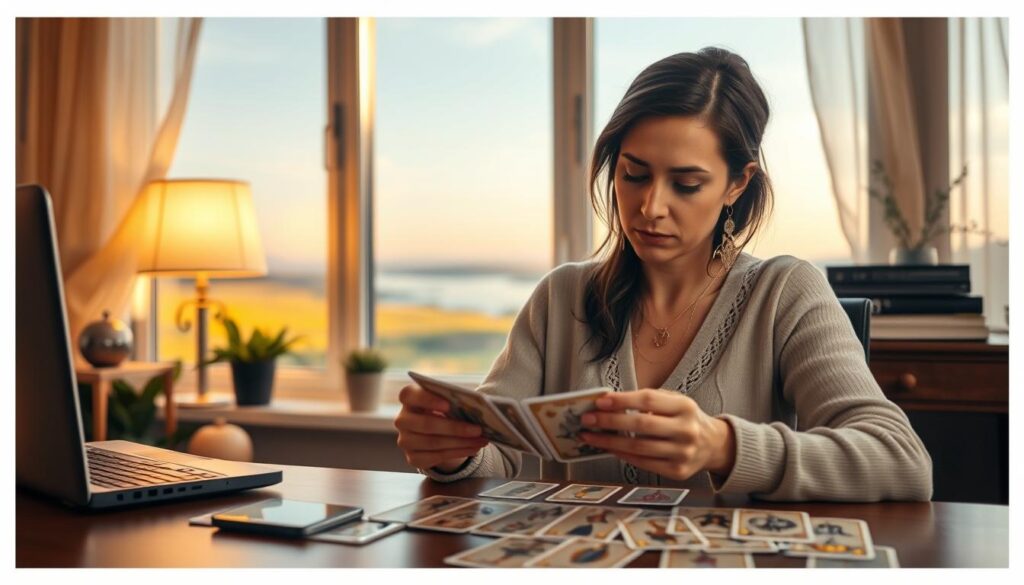
What helps remote readings feel specific and useful
Clear questions, focused time, and a calm space matter most. Use chat, voice, or video depending on your comfort and the reader’s style.
- Ask a concise question to narrow the view.
- Set a time budget and state goals at the start.
- Request clarifying examples or a short recap if something feels vague.
Platform considerations and choosing a quality reader
Choose platforms with transparent profiles, verified reviews, and clear rates. Services like Purple Garden, Keen, Kasamba, Everclear, and Mysticsense show mixed feedback—some clients praise grounded guidance, others report vague predictions or long sessions.
“Match your topic—love or career—to a reader’s specialty to improve fit.”
After a session, ask for a transcript or short summary to revisit the view later. For more on expanding psychic skills and vision, see this guide on developing clairvoyant abilities.
Making the Most of a Reading: Practical Ways to Improve Outcomes
A focused intent before the shuffle turns a reading into a useful planning tool. Set a clear life area and a concise question so your mind is ready to engage.
Ask better questions. Start with “How can I…,” “What’s the best way to…,” or “What should I consider about….” These prompts invite options and consequences instead of yes/no answers.

Frame intent and share context
Briefly tell the reader the situation so their intuition can target relevant layers. Offer enough detail to focus the session, but leave space for fresh insights to emerge.
Treat guidance as possibilities, not fixed facts
Treat the messages as a map of possibilities. Act on one aligned step, watch what shifts, and return to the spread if new information appears. Use a journal to record immediate thoughts and revisit them a few weeks later to spot patterns.
- Pick a spread that fits your decision: more positions add nuance; fewer pulls keep focus.
- If something feels off, ask for clarification—good readers welcome refining the focus.
- Close by converting one insight into a specific experiment to try in the next week.
“Use readings to test choices, not to lock in a single future.”
For tips on developing clearer inner vision and practical practice, see this guide on how to get clairvoyance.
Conclusion
This closing note focuses on practical takeaways: reflection, action, and choice.
Good sessions work as mirrors. They spotlight present patterns and suggest steps that can improve your life. Use the messages to test options in love, career, or daily concerns rather than expecting fixed future predictions.
Pick a reader and format that match your goals. Judge quality by clarity, empathy, and how useful the meanings feel. Different platforms and practitioners give varied experiences, so set expectations first.
The real power comes when symbolic prompts turn into small, concrete experiments. Revisit notes later to see which connections held up over time.
Thanks for exploring this with an open mind. For a close look at a single image and its practical meaning, see the Five of Swords meaning.
FAQ
What does “accuracy” mean in readings?
Accuracy often means how well a session reflects your current situation and feelings, not a fixed forecast. Many readers focus on relevance and resonance — whether the messages help you see options, patterns, or blind spots in work, love, or life choices.
Can readings predict the future precisely?
No method guarantees precise predictions. Most experienced readers treat insights as probabilities and possibilities. Outcomes depend on choices, timing, and changing circumstances, so readings work better as guidance than as a strict map.
What makes some sessions feel more accurate than others?
Clarity in the question, an experienced reader’s skill, and open communication all help. When a reader connects symbols and stories in a way that resonates with the querent, the session feels specific and useful. Bias and vague language can undermine usefulness.
Do in-person sessions work better than online ones?
Both can be effective. In-person readings offer body language and energy cues, while online sessions can use video, clear audio, and digital spreads. The reader’s skill, not the platform, usually determines outcome quality.
What should I ask to get useful guidance?
Ask focused, actionable questions about choices, timing, or next steps — for example, “What can I do to improve my career path?” Avoid yes/no traps and open with context so the reader can provide concrete insight.
How do readers interpret symbols and spreads?
Readers combine deck meanings, spread positions, and intuition to craft a story that fits your life. Good readers balance traditional meanings with the querent’s situation to turn symbols into practical advice.
Are some decks or spreads more “accurate” than others?
No deck guarantees truth. Some styles (Rider-Waite, Thoth, modern oracle) offer different symbolism; certain spreads provide more depth. Accuracy depends on how well the deck and spread match the reader’s method and your question.
Can personal bias affect a session’s quality?
Yes. A reader’s assumptions or leading questions can skew outcomes. Look for readers who emphasize clarity, follow-up, and ethical communication to reduce bias and improve usefulness.
How should I use insights from a session?
Treat insights as options and prompts for action. Use them to reflect, test choices, and set intentions. Combine messages with practical planning rather than relying on them as definitive fate.
Is intuition more important than textbook meanings?
Both matter. Textbook meanings provide a foundation; intuition links those meanings to your life. Strong readers use both to create relevant, actionable interpretations that speak to your moment.
What expectations should I avoid before a session?
Avoid expecting absolute certainty, miracle answers, or fixed predictions. Readings are tools for perspective and decision support — they work best when you stay curious and engaged with the process.
How do timing and context influence results?
Timing, life stage, and emotional readiness shape how messages land. A reading about career when you’re actively job hunting will yield clearer next steps than one given during a distracted or closed-off moment.
Can readings help with relationships and love?
Yes. Good sessions can reveal communication patterns, attachment styles, and actionable steps to improve connections. They don’t control another person’s choices but can highlight dynamics to address.
How do I pick a quality reader online?
Check client reviews, sample readings, and how a reader communicates ethics and process. Look for clear pricing, stated experience with specific issues (career, relationships), and formats that fit your comfort level.
What if a reading doesn’t resonate with me?
Don’t force agreement. Ask follow-up questions, seek a second opinion, or reflect on whether the timing or question was unclear. Sometimes insights reveal themselves later after reflection or action.
Can readings change outcomes?
Indirectly. Readings can prompt new choices, awareness, and action, which change paths. They provide perspective, not magical control, so their power comes through the work you do afterward.
How often should I get a session?
Frequency depends on your needs. Use sessions for moments of decision, transition, or when you need clarity. Regular check-ins can support long-term goals, but avoid dependence by treating readings as one of several tools.