

Many signals in nature seem simple — a dog’s play bow, a cat’s meow — yet the science behind those cues is richer than it first appears.
Communication means transferring information that changes what a receiver does next. Signals persist when both sender and receiver gain benefits, and they can be intentional, such as courtship displays, or unintentional, like predator scents.
The animal kingdom uses many modalities: sounds, color, scent, electric pulses, touch, vibrations, even heat. Species often combine these ways to reach different audiences and solve survival problems.
Scholars debate how to define signals. Some focus on natural selection, others on reducing uncertainty, and some ask whether a sender acts with intent. Studying this helps us understand animals’ lives and offers clues about how humans use tone, rhythm, and body language.
Throughout this article we will show striking examples, explain meaning and context, and offer practical tips for better interactions at home and in the wild.
Key Takeaways
- Signals change receivers’ behavior and often benefit both parties.
- Many modes—sound, scent, touch, color—work together in nature.
- Definitions vary: selection, information theory, or intentional acts.
- Understanding cues improves care for pets and respect for wildlife.
- Comparing species reveals shared tools and unique solutions.
What Is Animal Communication? A Clear Definition for Today
Across species, signals move information that alters what a receiver does next. A modern definition: it is the transfer of information that affects behavior now or later, and it can reach one individual or an entire audience.
Some signals are shaped by natural selection to influence receivers. A courtship display that attracts mates is a clear designed signal. By contrast, an accidental scent trail is an incidental cue that others may detect but was not shaped to send a message.
Informational accounts treat signals as useful when they reduce uncertainty. An alarm call, for example, raises the likelihood that “predator present” is true for listeners.
The biological view stresses coevolution: senders evolved specific acts or structures and receivers evolved responses. Human-style definitions demand voluntary intent. Some behaviors meet that bar, but many are reflexive.
Think of a frog’s mating call or a bee’s waggle dance: both carry structured information and fit the species’ environment. Context gives simple acts richer meaning, and upcoming sections will unpack why this matters.

| Signal Type | Intent | Example | Primary Effect |
|---|---|---|---|
| Visual | Often intentional | Bird courtship display | Attracts mate |
| Chemical | Can be incidental | Scent trail | Leaves location cues |
| Acoustic | Intentional or reflexive | Alarm call | Reduces uncertainty about danger |
Why Animal Communication Matters in the Animal Kingdom Now
Signals shape daily choices, from when a group moves toward food to when it flees a threat. In the present day, these cues keep species in sync and help them face rapid environmental change.
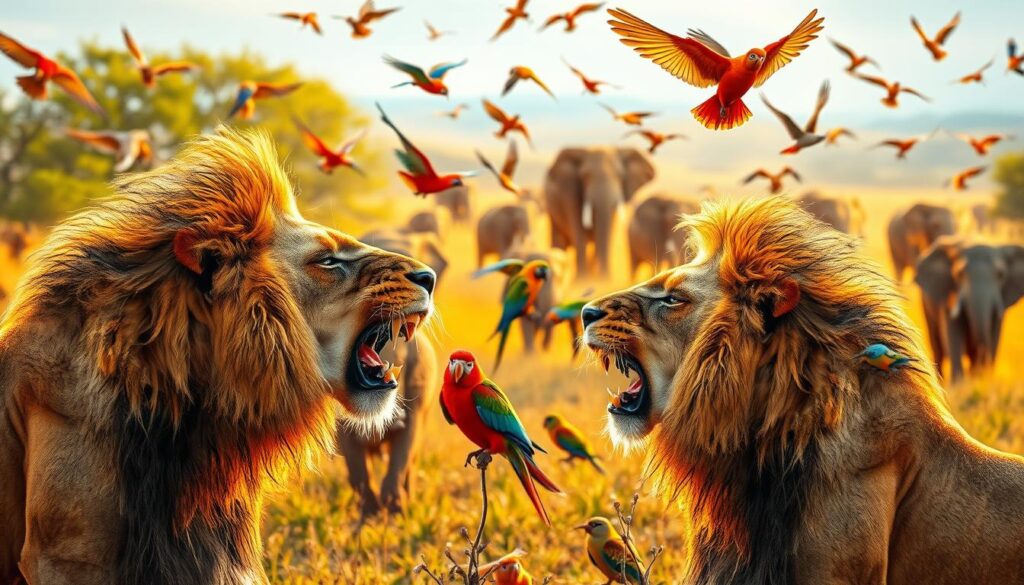
Helping animals find food, mates, and avoid predators
Foraging. Calls, scents, and visual cues let others locate and share resources. Groups coordinate to find food more efficiently and match search methods to local habitats.
Predator avoidance. Alarm calls and threat postures warn others to freeze, flee, or mob a danger. These signals reduce risk and save lives in risky encounters.
Mating. Courtship displays, songs, and scents often decide who pairs up and when. Even simple signals can shape reproductive success across species.
How understanding behavior benefits humans and conservation
Studying these ways improves welfare for pets and livestock and informs habitat protection. Conservationists use insights about specific cues to safeguard critical signals from noise or chemical pollution.
Animal communication reveals the strategies that guide daily life and shows practical paths for people to reduce conflict and support wild populations.
- Cross-species learning: Findings from one species can inform help for others.
- Urgency: Environmental change can disrupt messages, so timely action matters.
Signals, Information, and Intent: How Scientists Define Communication
Scientists sort signals by what they change: a receiver’s behavior, a receiver’s belief, or both. This section compares core definitions and shows why intent matters for mapping signals onto human language.
Biological definitions and evolutionary form
Maynard Smith & Harper define signals as acts or structures that alter another organism’s behavior and that evolved because of that effect.
- Senders produce acts shaped by selection.
- Receivers evolve matching responses.
- Signals persist when both parties typically gain a benefit.

Information as uncertainty reduction; voluntary vs. involuntary
Informational accounts treat a signal as carrying information when it correlates with a state and reduces uncertainty. For example, an alarm call can make “eagle present” much more likely for listeners.
Gricean ideas require voluntary intent. Many signals are involuntary cues, yet some animals do produce deliberate acts. Whether those acts share human-like communicative intentions remains debated.
“Signals are acts or structures that alter other organisms’ behavior, evolved because of that effect, and effective because receiver responses evolved.”
| Framework | Core idea | Focus |
|---|---|---|
| Biological | Signals shaped by selection | Production and receiver response |
| Informational | Correlation reduces uncertainty | Predictive value of signal |
| Gricean | Intentional production | Volition and meaning like human language |
Takeaway: think of signals, information, and intent as complementary lenses. Scientists study both production and perception across species to see how the same form can yield different responses in different contexts. The next section explores major sensory forms in detail.
Major Forms of Communication: The Main Ways Animals Communicate
Nature supplies multiple signaling tools, and species pick the best one for their environment. This quick map shows the main forms and why animals mix channels to reach receivers clearly.

Visual
Color, posture, and light displays send rapid signals. Bright coloration or a threat stance can warn rivals or attract mates. Bioluminescence works in dark habitats where displays must glow rather than call.
Auditory
Bird song, whale calls, and insect stridulation carry over distance. Sound suits open air or water and adapts to cluttered habitats by changing frequency and timing.
Chemical
Scent marks, pheromones, and kairomones convey status, territory, or danger. Olfactory cues persist longer than sounds and reach receivers even when sight is blocked.
Electric, Tactile, Seismic, and Thermal
Weakly electric fish encode identity and sex with waveforms. Touch—grooming or taps—coordinates groups and builds bonds. Substrate vibrations let underground or dense-forest species send messages without light. Some predators and bats sense heat to find warm-bodied prey.
Takeaway: displays are evolved solutions. Different species favor forms that travel best in water, air, soil, or night, and many signals blend to boost clarity for both senders and receivers.
Visual Displays and Body Language: Color, Light, and Dance
Visual signals—color flashes, dances, and polarized patterns—act like a private language in nature. They convey clear information at a glance and often guide decisions about mates, rivals, or food.
Waggle dances in bees: conveying distance and direction to food
The honey bee waggle is a brilliant visual code. Angle and tempo tell hive-mates both direction and distance to food so workers can navigate straight to the source without being led.
Cephalopod color change and cuttlefish dual displays
Cuttlefish and squid use rapid color shifts as expressive body language. One cuttlefish can show a male pattern toward a female and a different pattern toward rivals to deceive competitors while courting.
Mantis shrimp polarized light signaling
Mantis shrimp add polarized-light pulses that many other species cannot see. This creates a private channel that helps conspecifics send messages with less risk of eavesdropping.
Bird courtship displays: birds-of-paradise and grebes
Birds-of-paradise perform ornate dances and colors; Clark’s grebes even run together on water. Often males produce these displays and females judge compatibility during mating.

“Researchers keep decoding how posture, color, and motion become meaningful signals across species.”
Takeaway: visual displays excel where sight is reliable, but when visibility drops, species switch to other ways to help communicate.
learn more about reading body signals
Sounds, Songs, Whistles, and Growls: The Power of Vocal Communication
Sound lets many species send precise news, from danger alerts to long-range rendezvous. Vocal signals vary in pitch and power so that messages reach the right receivers while avoiding eavesdroppers.

Low and high: elephant infrasound vs. tarsier ultrasound
Elephants use infrasound below 20 Hz to broadcast over kilometers. These low tones travel far and are useful in open habitats.
Tarsiers emit ultrasound above 20 kHz to hide calls from nearby predators. High frequencies cut through clutter but fade quickly.
Prairie dog alarm systems
Research shows prairie dogs produce detailed calls that encode predator type, size, and even clothing color. This example reveals structure and learned elements in calls.
Whale dialects and cultural transfer
Whale vocal groups hold distinct dialects that pass across generations. Dialects act like a social language and shape group identity and behavior.
Dholes and coordinated hunts
Dholes whistle, cluck, and shriek to keep packs in sync during long-range hunts. Receivers respond with movement changes, confirming these sounds carry actionable information.
- Ecological note: low frequencies travel far; high frequencies avoid eavesdropping.
- Takeaway: structure and learning give some calls a language-like quality.
“Studying when and how animals call helps scientists map social ties and survival strategies.”
| Group | Frequency | Function | Range |
|---|---|---|---|
| Elephants | Infrasound <20 Hz | Long-distance coordination | Kilometers |
| Tarsiers | Ultrasound >20 kHz | Private alarms, predator avoidance | Hundreds of meters |
| Prairie dogs | Mid-range complex calls | Detailed predator alerts | Local colony |
| Whales / Dholes | Varied | Social identity / hunt coordination | Pod or pack ranges |
Chemical Cues and Scent: Olfactory Signals That Travel
Scent marks act like short messages pinned across the landscape, readable long after the sender has gone.

Olfactory channels persist in space and time, delivering clear information when sight or sound fail. Scents can linger for hours or days, so receivers react even if the sender is gone.
Rhino dung middens as community message boards
White rhinos build dung middens that function as public posts. Dominant males deposit centrally and kick to spread scent. These middens advertise status, health, and mating readiness to others in the area.
Scent marking, kairomones, and predator–prey cues
Pheromones target conspecifics, while kairomones unintentionally inform different species. Prey may detect predator scents and change behavior, showing how chemical notes cross ecological boundaries.
| Form | Primary Function | Example |
|---|---|---|
| Territory marking | Define range and dominance | Rhino dung middens |
| Mating cues | Signal readiness and quality | Male scent rubbing |
| Kairomones | Unintended information to others | Prey detecting predator odor |
Chemical channels often complement visual and acoustic signals, helping many species locate mates, find food, and avoid danger. Environmental factors, such as water acidity or wind, can change how faithfully scents travel.
Electric Talk: How Weakly Electric Fish Communicate
Where sight and sound blur in murky water, some freshwater species use tiny electric fields as a clean channel for social signals.

Waveforms, frequency, and social identity in murky waters
Each fish generates a characteristic waveform and frequency. Those patterns encode species, sex, individual identity, and social rank. Receivers read small changes in timing and pitch to interpret intent and proximity in real time.
Signals also shift with hormones and daily cycles, giving listeners clues about readiness or stress. Two nearby fish may perform a “jamming avoidance” dance, altering frequencies to reduce interference and keep messages clear.
- Electric fields work well where light and sound are unreliable.
- Waveform differences carry detailed identity and status cues.
- Receivers decode nuanced frequency changes instantly.
Electrocommunication is rare but highly refined where it occurs. Predators like sharks and rays can eavesdrop via passive electroreception, forcing signalers to balance clarity and stealth.
“Electric talk shows how form and function adapt to habitat challenges, enabling precise information transfer without light or sound.”
| Feature | Function | Example |
|---|---|---|
| Waveform | Species and individual ID | Distinct pulse shapes per species |
| Frequency | Sex and social rank cues | Higher or lower baseline rates |
| Plasticity | State signaling (hormones, circadian) | Day–night shifts in rate |
This electro-sensory form highlights coevolution of sender and receiver and the trade-offs of being conspicuous. For a practical dive into related ideas about perception and subtle signals, see how perception shapes interaction.
Communicating by Vibration: Seismic Thumps and Drums
Vibrations through soil and stems form a private, short-range language beneath and within habitats. Seismic signals travel via earth, plant stems, webs, or comb and work well when light or air are unreliable.

Mole rats’ head-thumping underground networks
African mole rats thump their heads on tunnel ceilings to send patterned beats. Pace and force change the meaning and trigger predictable responses from neighbors, such as approach, retreat, or alert digging.
Substrate-borne signals in frogs and bees
Frogs can vibrate branches or ground to court or coordinate when noisy environments mask calls. Inside dark hives, bees transmit pulses through comb to recruit workers or modulate tasks.
- Advantage: seismic cues fade fast, limiting eavesdropping and making them hard for predators to detect at a distance.
- Specialized organs like the sacculus detect low-frequency substrate motion.
- Many species combine seismic with visual or chemical forms for layered, reliable messaging.
“Vibration-based channels show how signaling adapts to habitat limits, offering precise, private ways to warn of a nearby threat.”
Heat as a Signal: Thermal Sensing and Responses
Heat provides a direct, often overlooked channel that some species use to find and assess living targets in the dark.
Pit vipers, certain boas, and pythons have facial pits that detect infrared (5–30 μm). Those organs let them build a crude “thermal image” and strike precisely at warm regions even without light.
Vampire bats use specialized IR sensors too. They can localize warm-blooded prey within 10–15 cm and often pick spots with higher blood flow to feed efficiently.
Thermal sensing likely evolved more than once, showing parallel solutions to nocturnal hunting. The sensors rely on temperature-sensitive ion channels rather than photochemical receptors, and they reset fast for rapid response.
Heat is not a message in the human sense, but it carries useful information. Prey movements and warmth patterns can unintentionally reveal position, giving predators a reliable cue.

Thermal detection often pairs with scent or vibration to make robust detection systems. Broadening the idea of communication to include heat helps us see how nature solves low-light challenges.
Touch, Social Bonds, and Coordination
Touch serves as the quiet but powerful language of many social groups. Direct contact conveys status, intent, and reassurance in close-knit communities.
Social grooming removes parasites and cements bonds. It also helps members test scent cues and confirm rank. You see this across insects, birds, and mammals.
Some ants recruit by tapping and leading while keeping contact. That hands-on guidance is an efficient way to coordinate foraging and share locations.
Huddling does double duty: it conserves heat and lets individuals exchange tactile and chemical signals in tight quarters.
Mating often begins with touch signals that align partners and synchronize movement. In fights, specific holds or nudges can either escalate or defuse conflict.
At home, dogs use nudges, leaning, or pawing to request play, comfort, or space. These simple acts map directly onto social roles and needs.

“Touch is immediate and intimate, ideal for precise, short-range messages.”
| Way of Touch | Primary Role | Typical Species | Example |
|---|---|---|---|
| Grooming | Bonding & parasite removal | Mammals, birds, social insects | Primate grooming to reinforce rank |
| Tactile recruitment | Coordination of foraging | Ants, bees | Ant tapping and leading to food |
| Huddling | Heat exchange & info sharing | Rodents, birds, bats | Colony huddle overnight |
For a deeper look at subtle signals and perception, see discover your telepathic abilities.
Autocommunication: Sending a Message to Oneself
Some creatures send signals out and then listen back to learn about their world.
Autocommunication is a loop where the sender and receiver are the same individual. The animal emits a signal that the environment modifies and then reads the return to guide its next move.

This setup boosts signal efficacy because the sender interprets its own output reliably, even in noisy conditions. Classic examples include echolocation and self-generated electric fields that map nearby obstacles, prey, or conspecifics.
Though aimed at the self, these probes can be intercepted. Predators or rivals may eavesdrop and mount a response, turning a private scan into public information.
Remarkable abilities are required: animals must send, receive, and process feedback in milliseconds. Environmental properties—echo delays, field distortions, or surface texture—shape the quality of the information returned.
“Autocommunication broadens our idea of signaling: it guides individual navigation while sometimes feeding social dynamics indirectly.”
- Benefit: precise self-guidance in cluttered or dark habitats.
- Trade-off: risk of eavesdropping by other species.
Semantics, Syntax, and Pragmatics in Animal Signals
Semantics asks whether a sound or scent truly stands for something in the world. In simple terms, it tests whether a signal carries specific meaning that reliably changes a receiver’s action.
Functional reference: from vervet alarm calls to meaning
Functional reference describes signals that seem to name real things. Vervet monkeys give distinct alarm notes for leopards, eagles, and snakes. Each call triggers the right escape move, which looks like a primitive form of reference.
Syntax-like order and combined signals
Scientists also probe whether callers sequence elements to alter meaning. Some birds and primates combine notes in ways that change the outcome for listeners. These combinations hint at simple syntax: structure that modulates what a receiver does.
Pragmatics: context shapes interpretation
Pragmatics studies how who, when, and where shape meaning. The same call can mean different things depending on the sender’s identity, the season, or recent events. Listeners often use context as much as the signal itself.
“Even without human-like intent, signals can guide reliable behavior across species.”
- Debate: critics note many calls are involuntary and context-bound, and primate vocal control is limited neurologically.
- Tests: researchers check both production and comprehension to see if receivers extract referential information or rely on cues.
- Time and learning: signal meanings can shift over development or seasons, showing flexibility.
| Topic | Key point | Example |
|---|---|---|
| Semantics | Specific referents possible | Vervet alarm calls for predators |
| Syntax | Order changes meaning | Call sequences altering response |
| Pragmatics | Context shapes interpretation | Same call means different things by time or sender |
Takeaway: Language also raises hard questions about intent. Even if animals do not use speech like humans, their signals pack rich information that reliably shapes behavior in the present time.
Cooperation and Honesty: Why Signals Evolve and Persist
When signals help both sides, they tend to stick around in a population. Signaling theory predicts that a signal persists when senders and receivers each gain an advantage from using it.
Production and perception coevolve. Senders change how they display a trait while others tune their response, shaping the dominant form of exchange in a given species. Over time this matching fits local ecology and social roles.

Honesty, deception, and costs
Some displays stay reliable because they carry real costs—time, energy, or risk. Those costs deter cheap fakery and keep signals informative.
When deception pays, it appears briefly, but receivers then adapt by ignoring or punishing liars. In many social groups, signaling becomes a kind of joint action where individuals align goals and timing.
- Audience effects matter: senders boost or hide cues when rivals or mates watch.
- Cooperation uses many forms: sharing food, coordinated defense, and alerting others.
- Models by scientists predict when honest signals or bluffing will win under different pressures.
“Reliable signaling and aligned responses underpin many stable social systems.”
For a short look at related signaling ideas, see costs and honesty.
From Prairie Dogs to Dogs at Home: Practical Examples and Takeaways
Field studies and home observations reveal practical lessons about signals and response. One vivid case is the work of Con Slobodchikoff: prairie dogs craft alarm calls that encode predator type, size, speed, and even human clothing color. That precision shows how much can ride on listening closely.

Reading body language and sounds to improve human–animal relationships
At home: dogs use posture, tail and ear positions, and vocal tone to say a lot. Learn to spot relaxed poses (soft eyes, loose body) versus tension (stiff stance, fixed gaze).
Listen for signal differences: an excited whine differs from stress whining, and a short bark can mean alert while repeated alarm barking asks for immediate attention.
Simple habits help lives at home: offer choices, set predictable routines, and reward calm responses with calm behavior from humans. Clear human movement—slow, steady, and quiet—helps pets interpret intentions more easily.
- Use prairie dog calls as a reminder: patterns carry detail—pay attention to timing and tone.
- Watch for play bows, soft eyes, and leaning vs. stiff stares to avoid misunderstandings.
- Respect wildlife: observe from distance and avoid interrupting courtship or feeding signals.
“Strong relationships grow when we treat signals as meaningful and respond with patience.”
animal communication
Signals take many physical forms, each tuned to a species’ habitat and senses.
Look broadly: visual, auditory, chemical, electric, tactile, seismic, and thermal channels all play roles. Species mix channels to boost clarity or keep messages private.
Why it matters: across species, signals evolve so senders and perceivers match one another. That matching reduces uncertainty and helps groups find food, avoid threats, and coordinate social life.
Some displays show syntax-like order or specific meanings, while others act as quick motivational cues to prompt action. Neither view alone captures the full picture.

“Study both what is sent and how it is perceived—perception is half the signaling story.”
- Practical point: understanding signals builds respect and improves human interactions with wildlife and pets.
- Curiosity prompt: explore how one species’ constraints led to clever signaling solutions.
- Research tip: use multiple frameworks—biological, informational, pragmatic—to get a fuller view.
| Focus | What it shows | Practical outcome |
|---|---|---|
| Modality mix | Combining channels for clarity | Better detection and fewer mistakes |
| Matched perception | Signals tuned to receivers’ senses | More reliable behavior changes |
| Structure vs. motive | Language-like meaning or immediate drives | Different methods for study and care |
To learn how these ideas link to individual traits and belief systems, see a related guide. The conclusion will tie these themes to conservation, welfare, and everyday practice.
Conclusion
To conclude, the many ways creatures send messages reveal practical rules that guide behavior and care.
Signals persist because production and perception coevolve: senders shape a display and receivers learn to act on it. Across species, this balance benefits both sides and keeps messages reliable over time.
Memorable examples—bee waggle dances, cephalopod color shows, whale dialects, electric fish pulses, seismic thumps, thermal sensing, and prairie dog alarm calls—illustrate the range of forms and the clever solutions nature invents.
For humans, studying animal communication helps conservation and everyday welfare. Notice posture, rhythm, and context, and respond with respect. Paying attention is a simple, practical way to protect lives and honor the shared language between people and the living world.
FAQ
What does "communication" mean for nonhuman species?
In nature, it means sending and receiving signals that change behavior or reduce uncertainty. Signals can be visual, vocal, chemical, electrical, tactile, seismic, or thermal. A message might warn of a predator, advertise a mate, or coordinate group hunting.
How do visual displays convey different messages?
Color, posture, movement, and light flashes all carry meaning. Birds use courtship dances and plumage. Cephalopods change color and texture for camouflage or threat displays. Even polarized patterns in mantis shrimp can signal identity or intent.
Can sounds carry specific information about threats or food?
Yes. Some species produce calls with detailed content. Prairie dog alarms can encode predator type and location. Elephants use infrasound that travels long distances. Whales and birds can pass vocal traditions across generations.
How do chemical cues work as long-range messages?
Scent marks and secretions can persist and inform others about territory, reproductive status, or recent presence. Rhinos use dung middens as communal notice boards. Predators and prey can pick up kairomones that reveal each other’s presence.
What is electrical signaling and which animals use it?
Weakly electric fish generate waveforms and frequencies that convey social identity and reproductive state, useful in murky water where sight fails. The pattern and timing of pulses carry information about the sender.
How do vibrations or seismic signals transmit messages?
Many animals tap, drum, or stomp to send substrate-borne signals. Mole rats head-thump underground to coordinate movement. Frogs and some insects use vibrations through leaves or soil to attract mates or warn rivals.
Is touch important for social bonding?
Absolutely. Grooming, nuzzling, and gentle contact reinforce bonds, reduce stress, and coordinate care. Primates, rodents, and domestic dogs rely on touch to maintain group cohesion and calm offspring.
What is autocommunication?
That’s when an individual uses its own signals to sense or orient itself, like some bats echolocating to map their surroundings or weakly electric fish sensing their own field to detect objects.
Do animals have semantics or syntax like human language?
Some signals have functional reference—specific calls tied to predators or food—suggesting semantic-like content. Sequence and context can alter meaning, but full syntax comparable to human language remains debated.
Why do honest and deceptive signals both exist?
Natural selection favors signals that benefit senders and receivers. Honest signals persist when they reliably convey payoffs. Deception can evolve when short-term gains outweigh the cost of being mistrusted, and receivers then adapt counters.
How can understanding these systems help conservation and people?
Recognizing how species communicate aids habitat protection, conflict reduction, and reintroduction success. For pet owners, reading body language and vocal cues improves welfare and safety. For wildlife managers, decoding signals can inform monitoring and protection.
Are there notable examples that show complexity in nonhuman signaling?
Yes. Bees perform waggle dances to map food. Prairie dogs make detailed alarm calls. Whales have regional dialects. Dholes use coordinated whistles during hunts. These examples reveal rich, context-dependent information exchange.