

Find gentle, useful guidance when life feels uncertain. Many clients say messages from angel-inspired decks feel softer and kinder than older, darker systems.
These decks are designed to deliver beautiful notes from the Divine. They map suits to life areas—material needs, logic, emotions, and purpose—so symbolism helps you see practical next steps.
To get clear insight, set a calm intention and keep an open heart. Breathe, focus your question, and treat the session as a conversation: notice the image, the name, and your first impression in the moment.
Whether online or by phone, create a small sacred space, call in your guides, and journal impressions right away. This approach helps guidance feel directly divine and grounded in your everyday path.
Key Takeaways
- Set an intention to receive supportive, accurate guidance.
- Angel-inspired systems can feel more compassionate than traditional decks.
- Center, breathe, and keep an open heart before a card reading.
- Frame a clear question about path, timing, or truth to help messages land.
- Record first impressions and actions in a journal immediately after the reading.
- Learn more about repeating number signs and synchronicity at seeing angel numbers.
What are angel card readings and why they’re so gentle and accurate
This style of practice emphasizes kindness, using uplifting imagery to deliver practical insight.
Angel-inspired decks swap ominous scenes for warm symbols. That shift helps clients stay open and calm. When the mind relaxes, guidance lands more clearly.

Angel and spirit guide messages vs. fear-based interpretations
Messages from spirit guides tend to support healing, not shame. If fear rises, pause and breathe. Ask for clarity from a place of love rather than anxiety.
Why oracle-style angel decks feel supportive and kind
Oracle cards use archetypes and simple symbols to speak to the psyche. Pay attention to the image, the name, and your first impression—those cues often hold the core message.
- Gentle language invites practical steps without removing free will.
- Specific guidance can appear even in soft, encouraging decks.
- Revisit a message later; meanings deepen over the next moment and beyond.
| Feature | Oracle-Style Decks | Fear-Based Systems |
|---|---|---|
| Tone | Uplifting and kind | Ominous or severe |
| Imagery | Encouraging symbols | Dark, warning visuals |
| Best for | Beginners and tender moments | Intense psychological work |
| How to get accuracy | Calm mind + open heart | Risk of fixation or victim lens |
For more on repeating signs and how synchronicity complements these sessions, see angel numbers decoded.
Angel card readings vs. Tarot and Oracle: what’s the difference
Choosing a deck often comes down to whether you want a set framework or a looser, intuitive tool.

Tarot structure and its strengths
Tarot is a fixed 78-card system with 22 Major Arcana that point to larger life themes. The 56 Minor Arcana are split across four suits and show daily dynamics.
Elemental suits in angel-inspired decks
Many angel-inspired decks reinterpret suits as elements. Earth covers money, health, and home. Air handles logic, choices, and fears.
Water speaks to relationships and intuition. Fire highlights creativity, career, and passion.
Oracle cards and flexible formats
Oracle cards are not bound to 78 units. They vary in size, tone, and focus. Many use affirmative language and clear guidance that can feel easier to apply.
- Use Tarot for structure and study.
- Choose oracle cards for a conversational, supportive way to get information.
- Mix systems when you want different perspectives on the same message and path.
Prepare your space and energy for a clear reading
A simple ritual to center your body and mind sets the stage for accurate guidance. Take a breath, sit comfortably, and state your intention to receive support for your highest good.
Call in your guides and spirit guides with intention
Invite your highest, most loving guides and angels to assist. Speak a short invocation aloud or in your head and ask only those of the highest light to be present at this time.

Clear and shield your energy with white light
Visualize an orb of white light around you. See it clear dense energy, cut cords, and form a love light buffer that protects and uplifts your vibration.
Relaxation and breath to open heart and mind
Soften your shoulders and jaw as you breathe. Gentle breathing opens the heart and calms the mind so subtle impressions can be noticed in the moment.
- Sit comfortably and state your intention to receive loving, accurate insight.
- Call in spirit guides by name or role and ask for help interpreting symbols.
- Step outside or pause for a minute of stillness if you feel scattered.
- Silence distractions and keep a simple altar or scent that grounds you.
End with gratitude—thank your helpers and your own inner wisdom before you shuffle or draw a single card. This short preparation improves accuracy and trust in the process.
Choose your cards: decks, creators, and what to look for
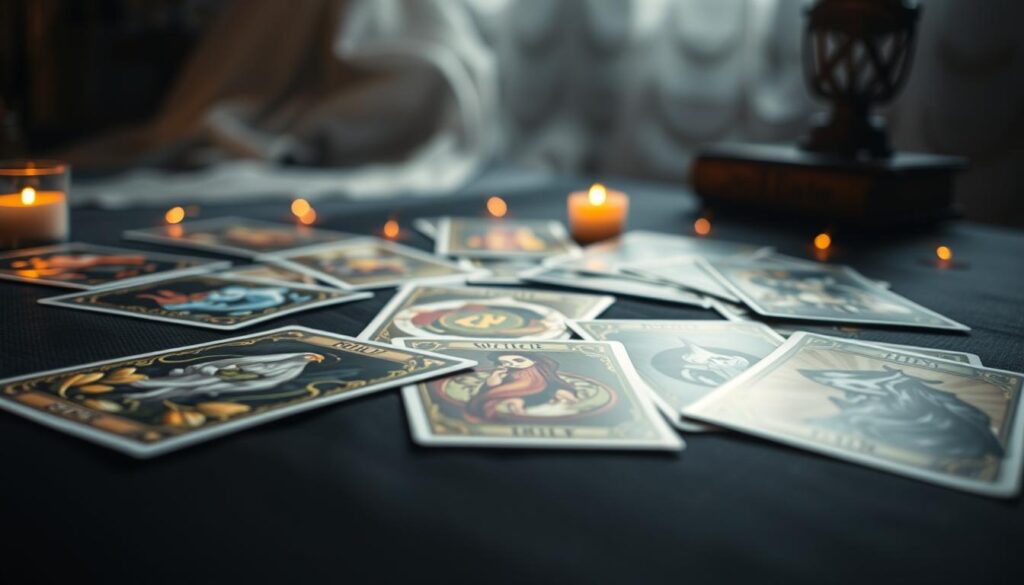
Picking the right deck begins with what draws your eye and soothes your mind. A deck that feels welcoming will help you stay open and notice subtle prompts during a session.
Trusted creators and design cues
Look for recognized names like Doreen Virtue, Kris Carr, Rebecca Campbell, and Kyle Gray when you want a reliable starting point. Many independent creators also make lovely, unique decks.
Check sample images and the guidebook tone. Uplifting language usually supports compassionate interpretations and clearer information.
When certification or experience matters
Certifications such as the Certified Angel Card Reader designation indicate formal study, but hands-on experience and ethical presence weigh heavily too.
“Choose the person you feel safest with; connection deepens the quality of a session.”
- Browse oracle cards whose imagery resonates with you.
- Skim sample cards to test tone and practicality.
- Ask how a practitioner prepares: meditation, invocation, or intention-setting are good signs.
- Decide if elemental suits or freeform oracle formats fit your practice.
Practical tip: If you plan to read on the go or online, pick a size and stock that suit travel and digital sessions like phone or Zoom. Start with one deck and add more as your practice grows.
Set your intention and tune into the present moment
Take a breath and come to the here and now before you touch the deck. A brief pause helps your mind quiet and your heart soften, so guidance arrives with less clutter.

Align mind and heart before you draw
Place one hand on your heart and one on your belly. Breathe slowly three times. Name your intention out loud—simple, clear, and kind.
If the mind races, lengthen your exhale to calm the nervous system. This small practice creates space for honest signals to surface in the moment.
- Invite help that is clear, compassionate, and actionable.
- Keep the intention focused: one theme or question at a time.
- Shuffle gently while holding your purpose; treat the deck with respect.
- Notice first impressions or nudges before you pull a card; they often guide choice.
When reading for someone else, set the time to be of service and reflect only uplifting guidance. Give yourself a minute to settle—this small investment saves confusion later and strengthens accuracy.
Ask better questions to get questions answered
Framing your inquiry with empowerment invites clearer guidance and practical steps.
A confused question draws a confused answer. Victim-based prompts like “Why is this happening to me?” focus attention on blame and shrink the space for useful insight.

Avoid victim-based prompts; shift to empowering wording
Move from blame to action. Ask what you can do, where to focus, or how to align with your values. This helps your guides and your mind deliver a clear message.
Examples that invite clarity, timing, and next steps
- Ask: “What is the next best step I can take?” instead of “Why me?”
- Ask: “What should I focus on this week to move forward?” to get timing and options.
- Invite practical help: “Please show me how to apply this insight today.”
| Problem Question | Empowering Alternative | Why it helps |
|---|---|---|
| “Why is this happening to me?” | “What can I learn and do next?” | Shifts attention to action and growth. |
| “Will I get this job?” | “Where is my effort best invested now?” | Keeps your mind open to options. |
| “Why won’t they change?” | “How can I show up with compassion and boundaries?” | Focuses on personal agency and clarity. |
Journal your exact question and resist reshuffling to chase a preferred outcome. If you want to learn more about repeating signs that guide timing, see get questions answered.
Popular card reading spreads for beginners and beyond
Start small with one- or three-position layouts to build confidence and clarity.
Single-card pull is perfect for daily guidance. It gives a focused prompt you can act on in real time. Use it when you have little time or need a clear nudge.

Three-card spread commonly maps to past, present, and future, or to situation, challenge, and advice. This format shows simple story beats and helps spot how past patterns affect current time choices.
Ten-card layouts (Celtic Cross variants) dig deeper. They surface underlying influences, long-range dynamics, and hidden blocks. Reserve them for complex questions or when you want a full map.
- State your intention before dealing and pay attention to jumpers or stuck cards.
- Note the exact name card titles; repeats often flag themes to pay attention to.
- Use clarifier cards for tricky positions rather than reshuffling the whole spread.
- Keep spreads consistent while learning and track outcomes in a journal to refine your skill.
For a guide to repeating signs and how they pair with spreads, see what repeating numbers mean.
Draw, observe, and reflect upon your message
Hold the card up and breathe; give yourself a quiet moment to notice what jumps out first. Let color, symbol, and the name of the card register before you seek explanation.

Notice the image, name, and first impressions
As soon as you pull, pause and record your first thoughts. Write the feelings, words, and images that arise in that exact moment. These impressions often carry the core message.
Read the extended description without losing intuition
Next, read the extended description slowly. Let phrases land and highlight lines that resonate. Use the guidebook as a companion, not a script.
- Write what you sensed in the moment before consulting text.
- Underline any phrase in the extended description that feels alive for you.
- Pay attention to synchronicities—a song lyric or memory can amplify the point.
- If you lose focus, breathe, visualize white light, and return to the page to reflect upon why a line struck you.
- Note clear actions suggested and give yourself time to time reflect across different life areas.
Close with gratitude: summarize the next step in one sentence and, when useful, consult a beginner’s guide to angel numbers for timing and repeating-sign context.
Interpret like a pro: symbols, synchronicities, and timing
Learn to read symbols as a language—each color, number, and figure carries a clue to your path. Pay attention to imagery before words; an archetype or repeating motif often points to a core truth.

Symbols and archetypes that speak to the psyche
Start with the symbol language—colors, elements, numbers, and figures show underlying meaning. A single card name can unlock a theme, while repeated suits often reveal priorities.
Everything counts: sounds, sensations, and “nudges”
Assume nothing is accidental. A sound in the room, a physical twinge, or a sudden image in your mind can be part of the message.
Patterns across a spread—repeated numbers or elemental emphasis—often suggest timing. Fire implies quick action; Earth suggests steady build; Water asks for emotional integration; Air invites mental clarity.
Balancing guidebook meanings with inner guidance
Use the guidebook as a map, not a mandate. Ask, “What part of this meaning fits my life now?” Invite your spirit guides to simplify complex guidance into one clear, practical step for this week.
When unsure, summarize the core truth in one sentence and test whether it aligns with your values and path. Note timing cues and a realistic next step so insight becomes grounded change.
Troubleshoot confusing readings without reshuffling
When a spread feels muddled, a small troubleshooting routine can restore clarity fast. Use gentle checks rather than scrambling the deck; reshuffling usually scrambles the information and creates noise.

Three common blocks
Victim lens: A blame-based question narrows what appears. If your question leans toward “why me,” the mind will echo that loop.
Fixation: Wanting one outcome biases interpretation. Ask your guides to clear that bias and open the field.
Not ready to hear: Sometimes the timing isn’t right. That creates confusion, not error.
Reframing unexpected themes
When business or education cards show up in a romance spread, view this as a redirect. The message often points to where energy needs stabilizing.
Why this matters: Stabilizing your work or learning path can clear space for relationship changes later. See the detour as practical help, not a punishment.
What to do if you don’t like the message
- Check your question first—reframe it to invite action, not blame.
- Notice fixation and ask for one neutral clarifier: “What is the next best step?”
- If emotions run high, pause, breathe, and return later with fresh perspective.
- Summarize the guidance in one neutral sentence to reduce reactivity.
- Set a time to revisit after taking one small action; progress often makes the information clearer.
“Confusion can be a sign you’re being protected or prepared for what comes next.”
Track confusing-now, clear-later moments in a log. Patterns build trust in the process and in how a true angel card reading maps to your path.
Ethics, boundaries, and reading for others
A respectful session always opens by confirming permission and honoring the person’s autonomy. Start with a clear yes from the querent and name the purpose of service before you proceed.

Invite compassionate help and keep ego aside. Ethical readers call in angels to support the client’s highest good and maintain nonjudgment throughout the process.
Consent, compassion, and nonjudgment
Get explicit consent before you work with anyone. Boundaries create safety and trust for the person and the practitioner.
- Anchor in compassion; offer guidance, not ultimatums.
- Respect privacy—avoid third-party snooping without permission.
- Hold an open heart while staying grounded; relay honest insights with love light and clarity.
- Be transparent about limits: a reading is not medical, legal, or financial advice.
- Refer out when topics are beyond your scope and close with gratitude for the support received.
Close each session by affirming the client’s agency and next steps on their path. Thank the angel presence and remind the seeker they hold choice and wisdom going forward.
Online angel readings: how to keep them accurate
Distance does not reduce clarity when intention, presence, and simple tech rules are in place.

Create a sacred container for your remote session. Silence notifications, close doors, and pick a quiet spot so both people feel private and present.
Begin with a spoken invitation. Ask for the highest, most loving spirit guides to join and protect the work. Breathe together three slow counts and visualize a white light that clears the space.
- Treat the call like an appointment—be on time and undistracted.
- Say a brief invocation calling in spirit guides and asking for accurate, compassionate help.
- Use a short grounding breath to arrive in the same moment before you begin the card reading.
- Name a plan for tech hiccups (rejoin, switch to phone, or pause) to keep the container steady.
- Share visuals by camera or screenshots so the seeker sees symbols in real time.
Pause for silence when needed; quiet can let messages settle. Recap next steps aloud and, if helpful, send a short written summary afterward. Trust that clear intention bridges distance and invites directly divine guidance across time and space.
For related timing and number signs, see this shortcut to spiritual numbers.
Integrate guidance into your path with love and light
Turn a fleeting message into progress by choosing one tiny action you can complete today. Small steps build momentum and create real changes over time.

Act on small nudges; reflect, journal, and revisit spreads
Translate insight into one doable step. Write it down and set a timer or calendar reminder. Then time reflect upon what shows up as you act.
Journal the result and reflect upon how it shifts your choices. Revisit a spread in a week or two to note progress and timing.
Self-care, forgiveness, and energetic hygiene between readings
Practice white light clearing and brief chakra resets to stay receptive. Nature walks, breathwork, and gentle movement help the heart integrate change.
- Invite an angel messenger like Raphael for healing or Zadkiel for forgiveness when a theme needs support.
- Offer yourself forgiveness and self-love; this raises vibration and opens the heart to new possibilities in love life and work.
- Keep your deck nearby for a quick check-in card reading when you need a course correction.
“Celebrate tiny wins—momentum proves a new way is safe and real.”
Conclusion
Anchor what you learned by journaling the first impressions and the single action you will take next.
Pause for a quiet moment, note the name on the card and write what rose in you first. Then read the extended description slowly and reflect upon message threads without losing your intuition.
Set a small intention, invite your spirit guides, and let love light steady an open heart. If timing or confusion appears, reframe the question and ask for one clear next step so you can get questions answered in practice.
Return later to time reflect and track results. To deepen timing and signs, learn how to find your angel numbers and keep moving along your path with gentle, practical guidance.
FAQ
What are angel card readings and why do they feel gentle and accurate?
These sessions use oracle-style decks that deliver calm, compassionate messages meant to support your highest good. Instead of fear-based predictions, readers and spirit guides focus on encouragement, next steps, and insight. The softness comes from uplifting imagery and language designed to open the heart while still offering clear, practical guidance.
How do messages from spirit guides differ from fear-driven interpretations?
Guide-led insights prioritize empowerment and clarity, avoiding panic or doom. They point to choices, underlying patterns, and resources rather than issuing ultimatums. If a reading triggers fear, it often reflects personal worry, not the guide’s intent—so a gentle reframe helps reveal constructive next moves.
How do these decks compare to traditional Tarot?
Unlike Tarot’s fixed Major/Minor Arcana structure, oracle decks are flexible and theme-driven. Tarot leans on archetypes and a codified system; oracle-style decks vary by creator and emphasize direct messages, intuitive imagery, and simpler, heart-centered prompts.
What should I do to prepare my space and energy for a clear session?
Create a quiet, comfortable area. Light a candle or use a diffuser, call in your guides with a brief intention, and take a few deep breaths. A simple white-light visualization can help clear and shield your energy, fostering peaceful focus before you draw cards.
How do I call in spirit guides or protect my energy?
Speak or think a short invitation—ask your guides to join and offer honest guidance. Then imagine a protective white light surrounding you. Keep the request simple and open; clarity and calm intention invite clearer, kinder messages.
How should I relax and open myself to receive guidance?
Use slow, even breathing and place a hand over your heart to center yourself. Let go of rigid outcomes, and allow curiosity. A five-minute breathing or grounding practice often suffices to shift from busy thinking to receptive listening.
How do I choose a deck or a reader I can trust?
Look for decks by reputable creators and clear, respectful imagery that resonates. Read reviews and sample guidance. For readers, consider training, ethical practice, and transparent policies. Professional experience matters when you want nuanced, accountable feedback.
Should certification or experience influence my choice of reader?
Yes. Certification can indicate studied methods and ethical standards, while experience builds intuitive skill and client care. Prioritize readers who communicate boundaries, confidentiality, and respectful guidance.
How do I set an intention before drawing cards?
State a focused question or theme—brief and open-ended works best. Align your heart and mind: name what you want clarity about, then relax and draw. Clear intentions help reveal timely, actionable messages in the moment.
How can I ask better questions to get helpful answers?
Avoid victim-focused wording. Ask empowering, specific prompts like “What step will help me heal?” or “What’s the next practical action?” Include timing or desired outcome if you want more precise guidance.
Can you give examples of good questions to ask?
Try questions that invite clarity and action: “What should I focus on this month?” “What’s one next step for my career?” or “How can I open more in my relationships?” These encourage constructive, usable insight.
What spreads work well for beginners?
Start simple. A single-card pull gives daily guidance. A three-card spread covers past, present, and future. Use larger layouts when you’re ready to explore patterns or deeper life themes.
How do I observe and reflect on a pulled card?
Notice the image, title, and your first impression. Read the extended description, then pause to sense what resonates. Let intuition and the guidebook inform each other—trust the feelings and details that stand out.
How do I balance guidebook meanings with my own intuition?
Use the guidebook as a helpful map, not a rulebook. Combine symbolic meanings with your immediate impressions and life context. If something in your body or mind lights up, give that priority—your inner voice helps translate messages into real steps.
What if a reading feels confusing or off-topic?
Three common blocks are a victim lens, fixation on a specific outcome, or not being ready to receive. Reframe the question, relax your need for a certain answer, and try again. Often a different spread or timeframe reveals the intended message.
Why might a reading about romance highlight work or education instead?
Cards often point to root issues or resources that affect multiple areas. A career-oriented message during a love question can reveal what needs attention to create healthier relationships—financial stability, self-worth, or time management, for example.
What should I do when I don’t like the message?
Treat it as useful feedback. Ask follow-up questions about next steps, reframe the advice into practical actions, and remember that tough guidance often points to growth. Compassion and self-care help you process it constructively.
What ethical considerations matter when reading for others?
Always get consent, respect privacy, and avoid judgment. Keep boundaries clear about health, legal, or medical issues—encourage professional help when needed. Compassion and honesty build trust and accuracy.
How can online sessions stay accurate over phone or video?
Create a sacred container: minimize distractions, set shared intentions, and use high-quality audio/video. Both client and reader should prepare their space, call in guides, and keep time and confidentiality clear for focused, reliable guidance.
How do I integrate guidance into daily life after a reading?
Start small. Act on one clear nudge, journal about progress, and revisit spreads to track shifts. Regular self-care, forgiveness practices, and energetic hygiene between sessions keep messages grounded and actionable.