

Michel de Nostredame rose in the Renaissance as an apothecary, physician, astrologer, and teller of poetic quatrains. Born in Saint-Rémy-de-Provence in 1503, he published Les Prophéties in 1555, a volume of 942 short poems that fueled centuries of fascination with predictions and alleged prophecies.
His almanacs and quatrains won attention from patrons like Catherine de’ Medici and spread fast thanks to new print culture. Readers praised apparent foresight, while scholars point out that many verses read as vague and fit many events after the fact. This introduction sets up a biography-driven deep dive into his roots, plague work, the making of Les Prophéties, and the debates over whether his lines truly mapped the future or reflected clever ambiguity in a turbulent 16th-century world.
Key Takeaways
- Michel de Nostredame wrote 942 quatrains in Les Prophéties (1555).
- He worked as an apothecary and physician during plague years.
- Printing spread his works; Catherine de’ Medici helped his fame.
- Scholars warn his verses are vague and often retrofitted.
- The debate: true foresight or flexible lines read into later events?
Who is Nostradamus: French astrologer, physician, and apothecary
Part physician, part astrologer, he built a public life that merged hands-on care with celestial guidance. As an apothecary and healer, he treated plague victims, mixed remedies, and gave hygienic advice to townspeople.
He took a Latinized name in print around 1550, and that label became his public brand. Over time he moved from making rose pills and poultices to producing annual almanacs and charts for wealthy patrons.
Daily work meant advising clients on health, writing forecasts, and casting horoscopes. This combination made him a sought-after physician and trusted astrologer for court and city elites.
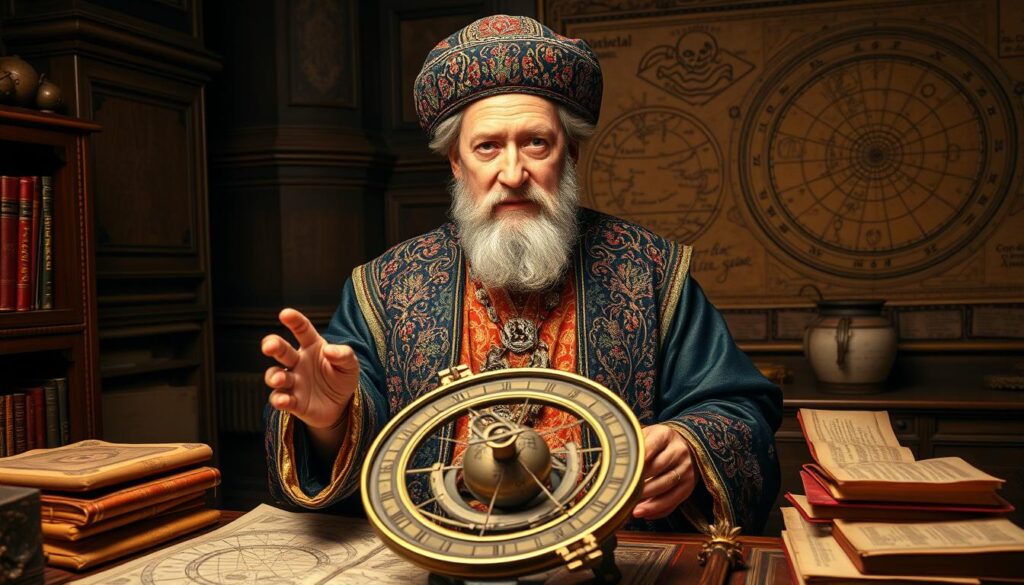
Seen as a Renaissance man, his blended career shaped the tone of his quatrains. His practical life and public roles fed the style and subjects of the prophecies that followed.
Origins and early life in Provence
Early life in Saint-Rémy-de-Provence tied his family to local healers and changing religious norms. He was born in December 1503, a date that places his childhood in a period of shifting political and social history.
Family roots and conversion
His paternal line had Jewish roots. Around 1459–60, his grandfather Cresquas converted catholicism and took the Christian name Pierre.
The surname taken then, Nostredame (Our Lady), later appeared in Latinized form as a printed name. This change mattered in a region where faith and identity shaped opportunity.
Birth, household, and local influence
He was one of at least nine children. His mother, Reynière, came from a medical line: her grandfather was a physician in Saint-Rémy.
Provençal language, regional customs, and church life were part of daily upbringing. Those elements became part of his interests in medicine and study, and set the stage for later work that mixed practical care with broader learning about Europe.
- Provençal roots: local culture and faith were part of early training.
- Large family: connection to medical practice through the maternal line.
- Recorded years: birth in December 1503 and the mid-15th-century conversion mark key family events.
Education and formative years
He began higher study in Avignon as a young teen, but that first chapter lasted barely a year. The University of Avignon closed when plague struck, cutting formal coursework short and sending him back into the region.
Early studies and practical learning
After the closure, he spent several years traveling and learning herbal remedies. These journeys let him collect practical knowledge that later informed his remedies and public advice.
Montpellier, expulsion, and professional boundaries
In 1529 he sought a medical doctorate at Montpellier but was expelled for having worked as an apothecary—a manual trade barred by university rules. The expulsion record (Register S 2 folio 87) survives as a clear fact of that split between craft and academic medicine.
Universities then often mixed medical teaching with astrology in their curricula. Cast charts and planetary tables appeared in period medical books, since physicians used celestial timing to guide treatments.
Despite the academic setback, years of travel, translations, and published medical paraphrases kept his public standing strong. The combination of hands-on remedies and printed work gave him a credible, if controversial, reputation among patients and patrons.
Plague years: medicine, remedies, and reputation
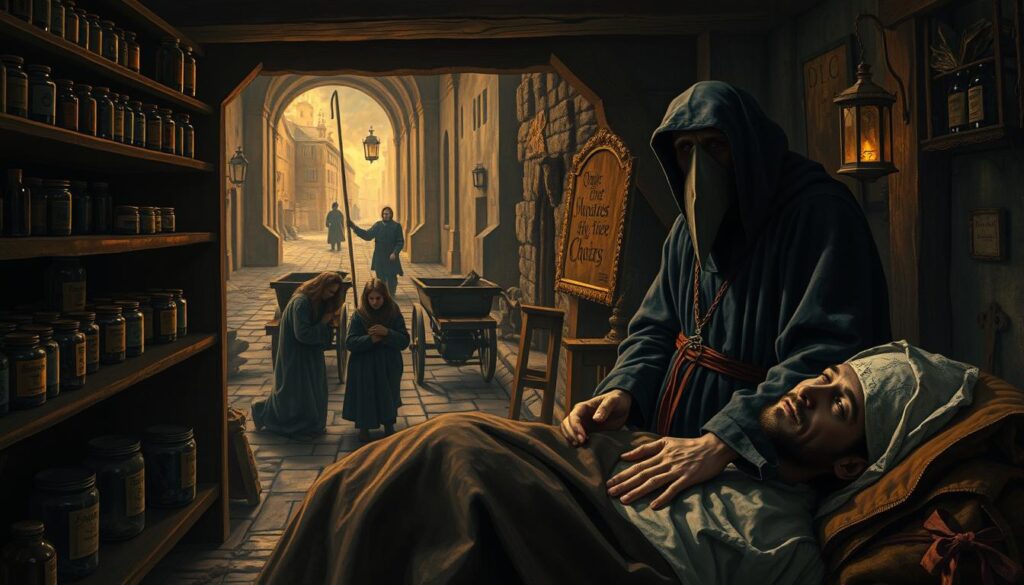
Plague years made itinerant medicine the day-to-day reality for a hands-on healer across southern France. Multiple waves of plague forced travel from Marseille to Aix and Salon-de-Provence. These crises shaped a public career built on rapid response and visible care.
Traveling practitioner: herbalism, rose pills, and hygiene
He promoted simple remedies such as rose-based preparations while urging cleanliness and safe water. Those rose pills had mixed results, but hygiene advice helped limit exposure in some places.
Work in Marseille, Aix-en-Provence, and Salon-de-Provence
In 1545 he collaborated with Louis Serre during the major Marseille outbreak. Later visits to Aix and a permanent move to Salon in 1547 gave him steady contact with ordinary people seeking help.
“Repeated public health crises forged trust as towns looked for practical cures.”
- Multiple plague waves kept him on the move and defined his public practice.
- Hands-on remedies and hygiene guidance fit the era’s limited disease knowledge.
- Visible work in key cities built a patient base that later supported consulting and printed texts.
For a timeline of related events and later publications, see this predictions by year resource.
Marriage, family, and personal loss
Records show he married in Agen around 1531 and began a household that would face sudden tragedy. In 1534 his first wife and two children likely died during a plague outbreak, a loss that reshaped his life and work.
Grief drove him back onto the roads. For several years he traveled, treating the sick and refining remedies. Those hard years added urgency to his public efforts and deepened his sense of vulnerability.

Later he remarried Anne Ponsarde after settling in Salon-de-Provence. That second union produced six children and a larger domestic circle. Family responsibilities influenced his choices and his finances.
- First marriage: married circa 1531; first wife and two children died in 1534.
- Renewal: married Anne Ponsarde and had six children in Salon.
- Provision: his will left property and 3,444 crowns in trust for wife and children.
“Personal loss and household duties gave a human face to his public life.”
These events reveal a man shaped by loss as much as by fame. The blend of sorrow, duty, and careful planning recurs in his writings and in the record of his final years.
From medicine to the stars: astrology, almanacs, and clients
A growing appetite for practical predictions led him to release an annual almanac in 1550. That first release contained thousands of short prognostications and quickly found an eager audience.

Almanacs then served as popular little books, mixing weather, calendars, and forecasts people used every day. They read them for planting advice, fair dates, and hints about the coming year.
Annual almanacs and the rise of an astrological consultant
Regular publication turned a healer into a public adviser. Repeat almanac editions built trust and spread his name beyond Salon.
Wealthy patrons and the path to court favor
Rising sales led nobles to request horoscopes and counsel. He often relied on client-supplied birth data for accuracy.
- Pivot: from hands-on medicine to a published almanac.
- Reach: these small books made forecasts available to many people.
- Consulting: success with printed forecasts opened doors to elite clients.
- Limit: critics later noted calculation errors when charts were computed without client data.
- Patronage: Catherine de’ Medici became a leading supporter, easing access to court.
“Publication and practice together turned public trust into court patronage.”
Astrology then functioned as a shared, public tool for planning, not merely occult practice. In the sixteenth century, celestial charts guided decisions in health, farming, and politics.
Les Prophéties: quatrains, sources, and style
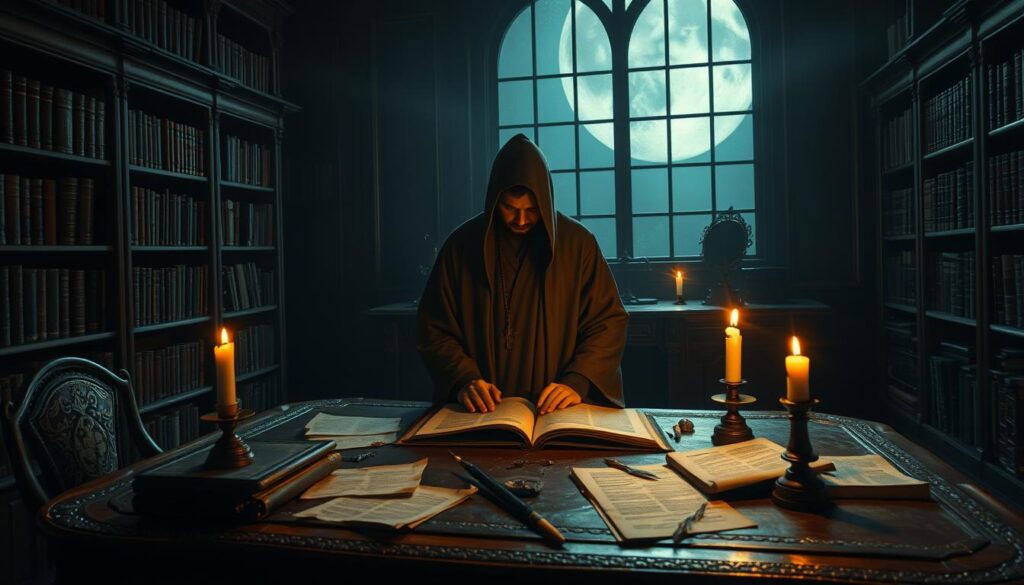
Les Prophéties collects nearly a thousand short, four-line poems that resist single, neat meanings. The volume groups these quatrains into labeled sets called “Centuries,” a structural choice that names collections, not future centuries in time.
What the book contains
The core content is hundreds of compact quatrains written in mixed languages and poetic turns. Each quatrain reads like a riddle: dense, image-rich, and open to multiple readings.
Classical, biblical, and popular sources
Sources range from biblical apocalypse traditions to classical historians and omen anthologies. He often paraphrased older texts rather than claiming lone revelation, a common Renaissance practice that tied new lines to established authority.
Style, language, and deliberate obscurity
Multilingual phrasing—French blended with Latin, Greek, Italian, and Provençal—adds layers of meaning. Virgilianized syntax and wordplay intentionally veil sense and reduce the chance of direct offense.
Printing and edition variation
Early printing led to variant spellings and punctuation. These differences mean exact words and line breaks shift between editions, so literal decoding of a single edition can mislead. The work therefore reads as a product of its history: learned, popular, and shaped by the lively print marketplace.
- Structure: quatrains grouped as “Centuries,” not literal future centuries.
- Influences: biblical, classical, and folk omen sources inform many passages.
- Practical note: editions vary—punctuation and spelling are unreliable for rigid interpretation.
For close readings of individual quatrains, see this quatrain guide.
Predictions and the record: between prophecies and history
Linking short poetic lines to famous calamities created lasting fame and fierce debate. Supporters point to verses tied to the fatal joust wound of King Henry II (1559) and the Great Fire of London (1666). Later readings pushed matches to revolutions, emperors, and wars.

Claims and translation problems
Popular accounts present specific-sounding lines as proof. Scholars reply that small translation choices shift meaning. A single word swap can turn a vague image into a named target.
Why retrospective interpretation matters
Retrospective interpretation maps a verse onto a known event after it happened. That method makes matches likely, not inevitable.
| Attributed Event | Common Verse Appeal | Main Scholarly Objection | Practical Tip |
|---|---|---|---|
| Henry II’s joust | Bloodied helmet, fatal blow | Vague imagery and late linking | Check original wording and date |
| Great Fire, 1666 | City aflame, burning streets | Multiple similar fire metaphors exist | Compare translations and editions |
| Revolutions and wars | Leaders, crowns, and upheaval | Sources often echo older histories | Look for source borrowing |
Compare popular books that celebrate hits with academic studies that stress textual variance and source borrowing. For critical reading, verify the original language, edition, and historical sources behind a claimed match. The stories stay compelling because human minds seek patterns, even when evidence stays thin.
Patronage, controversy, and the Church
Court favor changed his public profile, turning local curiosity into royal appointment.
Catherine de’ Medici read his almanacs and summoned him to court. Her support led to a formal title as Counselor and Physician-in-Ordinary to Charles IX. That position gave him protection and access to elite people.
Court backing and its effects
Patronage raised his social standing and helped shield him from some critics. Court interest made printers and patrons treat his words as part of public life.
Accusations and church tensions
He faced accusations of heresy in Agen in 1538. Religious tensions in sixteenth-century France made any unapproved teaching risky.
Astrology and prophecy were not automatically illegal. The real problems came from publishing without permission or from claims seen to challenge doctrine.
“Publishing without a bishop’s approval invited state and church discipline.”
In late 1561 he was briefly imprisoned at Marignane for issuing an almanac that lacked ecclesiastical clearance under a royal decree. That episode shows how press controls worked then and why patronage mattered.
| Issue | Action Taken | Impact |
|---|---|---|
| Royal appointment | Named Counselor and Physician-in-Ordinary | Increased protection and public rise |
| Heresy accusations | Inquiry in Agen (1538) | Heightened scrutiny by church authorities |
| Unauthorized publication | Imprisonment at Marignane (1561) | Illustrated limits on print and need for patron protection |
Why this mattered: Patronage was a crucial part of Renaissance intellectual life. Support from the queen let him publish and travel with less fear, even as controversy kept his name in the headlines of history.
For a fuller Nostradamus profile, consult a detailed biography and works guide.
Final years, illness, and death
By the mid-1560s a painful gout left him increasingly housebound. The condition worsened, and swelling progressed into edema, which limited movement and raised the risk of complications.
Even as mobility fell, he kept writing and advising patrons when possible. Those final years show continued activity in almanacs and private counsel despite physical limits.
Shortly before his death he drew up a will, setting aside property and 3,444 crowns for his family’s care. Documents record those legal and financial preparations in the closing weeks of his life.

He died on 1 or 2 July 1566 in Salon-de-Provence and was later reinterred in the Collégiale Saint-Laurent after the Revolution. This passing at a plausible age for the sixteenth century counters later myths of mysterious ends.
“He sorted his affairs, leaving a clear provision for kin.”
The record shows a practical end: illness and care, not intrigue. His writing outlived him, and readers kept returning to the quatrains. For practical estate details and resources about his final arrangements, see the estate arrangements page.
Legacy today: Nostradamus in culture, media, and skepticism
From printed pamphlets to viral posts, these quatrains keep finding new audiences around the world.
Why his lines adapt to new media
Flexible wording makes quick reuse easy. Editors and creators can match short images to modern crises and call them predictions.
More than 200 editions and 2,000 commentaries mean fresh takes keep appearing. Supporters tie verses to the French Revolution, Napoleon, Hitler, and other major events.
Critique, misuse, and modern trends
Academic critics point to ambiguity, translation drift, and selective memory as reasons many claimed hits fall apart under scrutiny.
During global crises, modern “nostradamus predictions” spike online, driving clicks and headlines. Propaganda has also exploited verses; historical actors used them to push agendas.
“Check the edition, translation, and source before treating a verse as a forecast.”
- Why lines keep rising in media: brevity and ambiguity.
- Frequent attributions to the French Revolution show lasting cultural fascination.
- Practical tip: verify context and edition; don’t accept claims at face value.
For a look at current claims and predictions for 2025, see predictions for 2025.
Conclusion
His life stitched practical medicine and public astrology into a single public identity. A french astrologer and apothecary by trade, he treated plague sufferers, wrote almanacs, and published the quatrains that still spark debate.
The prophecies drew on older texts and deliberate obscurity, which helps explain why readers map verses to later events. Patronage and occasional censorship shaped his career, while court favor gave his work reach.
Claims that specific predictions foretold modern shocks often depend on translation, edition, and hindsight. For careful context and a fuller profile, see this profile and works.
His legacy lives in the book and in how people worldwide return to those lines during uncertain years — a mix of hope, curiosity, and scholarly caution.
FAQ
Who was the French astrologer, physician, and apothecary often called Nostradamus?
He was a 16th-century Provençal figure known for mixing medical practice with astrology. Trained as an apothecary and briefly at the University of Avignon and Montpellier, he gained fame for plague remedies, annual almanacs, and later for publishing Les Prophéties, a collection of quatrains that cemented his reputation as a prophetic voice.
What were his family roots and religious background?
Born into a family with Jewish ancestry, his relatives converted to Catholicism generations before his birth. Family ties and regional culture in Provence influenced his early life and identity, which blended local traditions and emerging Renaissance thought.
Where and when was he born, and what does his adopted name mean?
He was born in Saint-Rémy-de-Provence in the early 1500s. The Latinized name he used suggests a crafted public persona: it evoked both a classical air and a prophetic role, helping him stand out in a crowded world of medical practitioners and astrologers.
What happened during his studies at Avignon and Montpellier?
He attended the University of Avignon, but studies were disrupted by recurrent plague outbreaks. Later, his time at Montpellier aimed at formal medical training, yet conflicts with guild regulations and tensions over his apothecary background led to expulsion before he completed a degree.
How did he treat plague victims and build a medical reputation?
He traveled through Provence offering herbal remedies, hygiene advice, and famous “rose pills” based on rose hips and other botanicals. His methods emphasized cleanliness and simple remedies, which contrasted with some contemporary harmful practices and helped build his local reputation.
In which towns did he practice medicine?
He worked in multiple Provençal towns, including Marseille, Aix-en-Provence, and Salon-de-Provence, where patients sought his treatments during outbreaks and where his mix of remedies and observational practices gained attention.
What do we know about his marriage and children?
He married and fathered children, though his life also included significant personal loss from plague and illness. Surviving records show family roles shaped by the era’s high mortality and his frequent travels as a practitioner and consultant.
How did he shift from medicine to astrology and publishing almanacs?
Building on his local fame, he wrote annual almanacs combining weather, medical advice, and astrological forecasts. These publications increased his audience, attracted wealthy patrons, and led to more formal astrological consultation work at court.
What are Les Prophéties and how are they structured?
Les Prophéties is a poetic collection organized into “centuries” of four-line quatrains. The verses use dense imagery, classical and biblical references, and multiple languages. The text’s obscurity helped protect him from censors and invited many later interpretations.
What sources and styles influenced his quatrains?
He drew on classical authors, biblical prophecy, folklore, and contemporary events. He often mixed Latin, French, and regional terms, and used ambiguous phrasing intentionally so meanings could be reinterpreted over time.
How did printing and edition differences affect interpretations of his work?
Early printing practices introduced variant readings and typographical changes. Later editors sometimes rearranged quatrains, altered wording, or added commentary, which complicated efforts to pin down original intent and fueled divergent readings.
Which famous events do people claim he predicted?
Popular claims link his verses to events such as wars, political upheavals, and disasters. Examples often cited include readings associated with the French Wars of Religion, the English Civil War, or later events retroactively matched to quatrains. Many such links rely on loose translation and retrospective fitting.
Why do critics argue his prophecies are vague?
Critics note that the quatrains are intentionally ambiguous, lacking precise dates or clear names. This vagueness, combined with flexible translation, makes many predictions appear accurate only after events occur and are forced to match verses.
What role did royal patronage play in his career?
Support from influential figures, notably Catherine de’ Medici, helped him secure status and court appointments. Such patronage expanded his client base and gave his writings wider circulation, though it also attracted scrutiny from rivals and the Church.
Did he face accusations of heresy or legal trouble?
Yes. His blending of astrology with public influence and unconventional practices drew suspicion. He faced accusations that led to short imprisonments and censorship threats, but he largely navigated those challenges, partly through patronage and careful ambiguity in print.
How did his life end?
He suffered declining health in his later years and died in the mid-16th century. Accounts record illness and the customary practices of the time; his burial and legacy were shaped by both admirers and detractors.
Why does his work still matter in culture and media?
His writings endure because they mix poetry, prophecy, and history, offering fertile ground for interpretation. Almanacs to modern internet speculation keep his name alive, while films, books, and articles keep reexamining quatrains against new events.
How do scholars view his predictions today?
Academic critics emphasize methodological problems: retrospective matching, mistranslation, and confirmation bias. Scholars study his medical texts, almanacs, and historical context to separate genuine contributions from myth-making around prophetic claims.
Where can one find reliable editions of his works?
Look for critical editions published by academic presses that include original-language texts, variant readings, and scholarly commentary. University libraries and reputable historical journals also offer vetted translations and contextual analysis.