
Welcome. This friendly guide helps you start working with a deck without overwhelm. You will learn the deck’s structure, core meaning patterns, and simple spreads you can use right away.
Begin with the basics: a standard deck includes the Major Arcana, the big life lessons, and the Minor Arcana, which covers day-to-day themes. The Fool’s Journey shows a story arc from innocence to completion that makes meanings easier to map to your life.
Understand the suits as quick shorthand: Wands = Fire (action), Cups = Water (emotion), Swords = Air (thought), Pentacles = Earth (material life). This lets you decode a card’s energy before you study imagery or keywords.
Practical steps: pick one deck you love, learn a few spreads, keep a journal, and practice a little each day. You can also source a quality deck from a local metaphysical store or a reputable online shop for readable imagery and sturdy cardstock.
Key Takeaways
- Start by separating Major Arcana and Minor Arcana to see how each fits in readings.
- Use the Fool’s Journey to learn card meaning as a life-story map.
- Elemental suits (Fire, Water, Air, Earth) give fast insight into card energy.
- Practice simple spreads, journal results, and build confidence with daily work.
- Reversals offer nuance, not just “bad” outcomes; they show blocks or inner work.
- Buy a deck you connect with from a local store or trusted online seller.
Start Here: What Beginners Should Know About Tarot
Think of readings as a conversation that surfaces patterns, not final answers. This guide helps you use a deck to reflect on choices and find practical meaning. Approach the work with curiosity, not fear.
Major Arcana cards highlight big life lessons; the Minor Arcana handles everyday things. Learn this split early so you can read patterns faster and feel less lost when different types appear.

Understand suits by element: Wands = fire and action; Cups = water and feelings; Swords = air and thought; Pentacles = earth and material life. These cues give quick tone when you pull a tarot card.
Keep expectations realistic. Readings amplify intuition and offer interpretations, but they do not replace medical, legal, or financial help. Use insights as a way to plan next steps.
- Start with beginner keywords and then personalize meanings as you grow.
- Choose a readable deck for clearer imagery and faster learning.
- Pull one card a day and jot what you notice to build confidence.
| Aspect | What it shows | How to use it | Beginner tip |
|---|---|---|---|
| Major Arcana | Big arcs and life themes | Look for major turning points | Study one card per week |
| Minor Arcana | Daily events and moods | Note patterns across readings | Track repeats in your journal |
| Suits/Elements | Wands, Cups, Swords, Pentacles | Use element to set tone | Learn keywords for each suit |
| Reversals & feelings | Nuance, delays, inner work | Ask constructive questions | Pause if a reading feels strong |
Tarot Cards at a Glance: The Deck, Suits, and Arcana
Think of the deck as two linked stories: one shows big life chapters and the other shows everyday scenes. This split makes study practical and memorable.
Major Arcana vs. Minor Arcana
The full set contains four suits of 14 each (Ace–10 plus Page, Knight, Queen, King) and a separate run of 22 major cards. The majors include the Fool and 21 trumps.
Major arcana cards highlight archetypal milestones. The Minor Arcana reflect daily choices, habits, and practical steps through suit themes.
“The majors show life chapters; the minors show the scenes between those chapters.”
The Fool and the 21 Trumps
The Fool often wears the number 0 and marks the journey’s beginning. Each trump advances a narrative toward completion and integration in The World.
- Suit elements: Wands = Fire, Cups = Water, Swords = Air, Pentacles = Earth.
- Court ranks (Page, Knight, Queen, King) can mean people, roles, or attitudes in a reading.
- Study tip: sort Majors from each suit and then review similar numbers across suits to see shared meaning patterns.
| Part | Shows | How to use | Study tip |
|---|---|---|---|
| Major Arcana | Archetypal milestones | Look for turning points | Study one trump per week |
| Minor Arcana | Daily scenes and choices | Track repeat numbers | Learn suits by element |
| Court Cards | People, roles, attitudes | Ask who or what energy appears | Practice interpreting courts as actions |
One-line takeaway: learn the set structure first, then the suit element, then each card’s story—this order softens the learning curve and builds confidence.
A Quick History of Tarot: From Italian Games to Modern Readings
The story starts in 15th-century northern Italy, when players added a row of trumps and a wandering Fool to a familiar four-suit pack.
That simple change created the structural set we still use. Surviving decks like the Visconti-Sforza give historians clear details about early iconography and courtly play.
The printing press and the Italian Wars helped the deck travel to France and Switzerland. There the Tarot de Marseille emerged as a dominant visual style.

Tarocchi, Trionfi, and Regional Orders
Different regions used different trump orders in gameplay. For example, some areas ranked the Angel or the World at the top.
“For centuries the pack was primarily a game; divination arrived later.”
Cartomancy grew in the mid-1700s. Around 1789, Etteilla produced the first occult-oriented deck, linking the practice to invented ancient origins.
- 15th century: northern Italy — games and the new trump set.
- 16th–17th century: spread across Europe, printmaking scales production.
- Late 18th century: occult uses appear; scholarly caution about origin myths.
| Era | What changed | Why it matters |
|---|---|---|
| 15th century | Trumps added to a four-suit pack | Forms the basic deck structure readers use today |
| 18th century | Occult reinterpretation | Raised interest in symbolic meanings beyond play |
| 20th century | Esoteric decks proliferate | Visual styles like RWS reshape modern study |
Why this history helps you. Learning Marseille and RWS lineages adds context to imagery and naming. It won’t change a reading, but it enriches your understanding of the deck’s visual language.
For a practical next step, explore a focused study like the Eight of Pentacles study to see how history and imagery pair in practice.
The Major Arcana Essentials: The Fool’s Journey and Big Life Lessons
Think of the Major Arcana as a roadmap of inner growth and outer milestones. The set follows the Fool’s Journey from hopeful beginning to full completion in The World.
Milestones: The Magician through The World
The sequence highlights milestones like The Magician (willpower and creation), Strength (inner courage), The Chariot (direction and control), The Lovers (choices and values), The Tower (sudden change), and The World (wholeness).
Upright and Reversed Themes in the Majors
Upright meanings show active lessons: The Magician = manifestation, Strength = compassion, Chariot = focused drive. Reversed positions flip the tone: trickery, self-doubt, or a lack of control.
The Lovers often points to partnership but also to aligned values and life-path choices. The Tower and Death act as necessary catalysts, clearing old ground so new growth can begin.
When a Reading Uses Only the Major Arcana
Use a majors-only spread when you want big-picture clarity about purpose or a major transition. Keep spreads short and ask broad questions about identity, direction, or healing.
“Majors give a compass; minors supply the steps.”
Practice tip: pull one major per week, journal how its lesson plays out in your life, and revisit those notes to deepen your card meanings over time. For a focused study, try the Seven of Pentacles study to pair imagery with practical reflection.
Understanding the Minor Arcana: Your Day-to-Day Story
The Minor Arcana narrates the everyday plot—where chores, conversations, and small victories live.
Think of the minors as the practical layer of a deck. They show routine choices and steps you can act on. Use them when you need timing, who to contact, or which task to prioritize this week.
Number flow matters. Aces spark a seed. Twos force a choice. Threes grow the idea. Fours steady things. Fives bring conflict. Sixes restore balance. Sevens test resolve. Eights demand focus. Nines call for perseverance. Tens complete the cycle.
Link suits to elements for fast anchors: wands = action and enterprise, Cups = feeling and bonds, swords = thought and debate, Pentacles = work, money, and health.

Court cards show roles or approaches: Pages learn, Knights pursue, Queens nurture or master, Kings lead. Compare the same number across a set to see one theme in different life areas.
“Reversals in the minors often point to lack of momentum, internal blocks, or delays—not guaranteed doom.”
| Use | What it reveals | Quick tip |
|---|---|---|
| Timing & tasks | Practical steps and who to talk to | Pull a daily card from one suit for a week |
| People & roles | Court cards as people or attitudes | Note 3–5 personal keywords per card |
| Patterns | Compare same numbers across suits | Journal examples and situations |
Example: a reversed Eight of Swords can reframe self-imposed limits. A Page of Wands might nudge you to pitch a small, energizing idea at work. Write short, personal keywords for each card to build living interpretations that fit your life.
Suit of Wands: Fire, Work, Creativity, and Action
The Wands suit channels raw spark into projects, plans, and public action. This element carries passion, willpower, and the push to begin. Think of it as the part of a deck that asks, “What will you start?”
Core energy: Fire brings heat for passion, light for vision, and a flame that transforms when you commit effort. Healthy expressions include courage, creative leadership, and steady ambition.

From Ace to Ten: Momentum and Ambition
The Ace ignites a new project. Two plans a course. Three expands horizons. Four marks a stable foundation.
Five brings tests. Six celebrates small wins. Seven defends gains. Eight speeds progress. Nine asks for perseverance. Ten shows the load you may carry and when to delegate.
Pages, Knights, Queens, Kings in This Suit
The Page experiments and sparks curiosity. The Knight charges with bold action. The Queen magnetizes creativity and leads teams. The King organizes vision into scalable work.
“When Wands dominate, pick one next move you can finish in 24 hours.”
| Focus | Healthy | Shadow | Quick tip |
|---|---|---|---|
| Element | Passion, will | Recklessness | Plan one step |
| Ace→Ten | Ignite→Complete | Burnout | Track momentum |
| Court | Curiosity→Leadership | Lack of control | Test ideas small |
| Mixes | Strategy, grounding | Impatience | Combine with Pentacles |
Suit of Cups: Water, Feelings, Relationships, and Intuition
The water suit opens a window onto moods, bonds, and the quiet voice of intuition. This area of the deck points to empathy, vulnerability, and what the inner life asks you to notice.

Emotions, Love, and Inner World
Cups rule feelings, imagination, and close relationships. When a spread leans heavy here, prioritize emotional tone over logistics. Check your breath and body first; somatic cues often give the clearest guidance.
Water signals flow, receptivity, and healing. Upright placements show openness; reversed positions can point to a lack of boundaries or emotional fog that needs tending.
Aces to Tens: Heart-Centered Growth
Think of the sequence as a heart arc: the ace opens the heart, the two forms a bond, and the three celebrates community. The four reassesses, the five grieves, and the six recalls warmth.
The seven invites dreams. The eight often marks departure. The nine brings fulfillment and the ten harmonizes relationships and home.
- Pairings: Cups + Swords = compassionate conversation.
- Cups + Pentacles = practical care and shared resources.
- Relationship spread tip: ask what needs nurturing, what needs naming, and what needs releasing.
“The Ace of Cups often asks for self-compassion rituals—journal, meditate, or create.”
Emotional wisdom grows with practice. Revisit past readings to track how your meanings deepen. Daily check-in: What would my heart like to focus on today?
Suit of Swords: Air, Thoughts, Communication, and Clarity
Swords speak to the mind’s toolkit: how we analyze, debate, and name truth.

Air energy gives perspective and movement. It asks you to zoom out, test assumptions, and reorganize thinking patterns. In practice, this suit highlights honesty, logic, ambition, and the risks of harshness.
Double-Edged Logic and Conflict
Define Swords as the suit of thought—decisions and words that can cut through confusion or wound when misused.
Healthy expression means clear communication, ethical debate, and brave truth-telling that respects boundaries. Use this energy to make plans, set protocols, and regain calm control without turning rigid.
Shadow sides include spiraling thoughts, sharp criticism, or a lack of empathy. Watch for when “being right” eclipses being kind.
“Clarity often follows discomfort—use the mind to cut away what’s untrue so better ideas can breathe.”
- Clarity technique: pair a Swords pull with the question, “What fact am I missing?”
- Cross-suit cues: Swords + Cups = compassionate truth; Swords + Wands = decisive action; Swords + Pentacles = written agreements.
- Reframe stuck thinking: name the fear, list options, take one small step to move forward.
| Focus | Healthy Outcome | Shadow Sign |
|---|---|---|
| Analysis & Decisions | Clear priorities and protocols | Overthinking and paralysis |
| Communication | Precise, ethical speech | Harsh words or abuse |
| Conflict | Constructive conversations | Defensiveness and lack of empathy |
Suit of Pentacles: Earth, Money, Security, and the Material World
Pentacles ground the deck in practical life: earnings, health, and the systems that keep you steady.
Position this suit as the house of stability and stewardship. It shows how you earn, save, invest, and sustain material life over time.

Career, Health, and Long-Term Stability
Readings here point to money choices, business operations, career progression, and the systems that secure home and health.
The number line has a long-term lens: an ace seeds new opportunity, fours build foundations, sixes show fair exchange, and tens create legacy.
Think in seasons: slow, steady effort compounds. Treat work like soil—regular care produces growth.
Shadow Themes: Greed, Jealousy, Overcontrol
Watch for a scarcity mindset, lack of generosity, or rigid control that sacrifices joy for security.
Reset tools: gratitude practices, fair-exchange agreements, budgets that protect priorities without becoming joyless.
- Business prompt: “What provides the greatest value?”
- Efficiency check: “Which process needs simplifying to improve margins and morale?”
- Ace action: open a savings goal, update your resume, or plant a literal seed.
“Material growth is seasonal—patience plus consistent effort yields real security.”
Court Cards Decoded: Pages, Knights, Queens, and Kings
Read court figures as energetic profiles that map how people act or a role you might adopt in a spread.
Pages are students and messengers. They bring new ideas and shows of curiosity. A Page of wands experiments; a Page of swords asks questions and researches.
Knights move things forward. They act and create momentum. Expect faster timing when Knights appear near an ace or a project card.
Queens integrate and nurture. They hold relational influence and steady skill. Kings direct with vision and long-term stewardship.
“Courts point to energy, not rank—use posture, gaze, and symbols for rich detail.”
- Use the Page→Knight→Queen→King order as a lifecycle tool to spot stalled progress.
- Courts can be you, someone else, or a role to try on in a reading.
- Near Aces they signal new people or openings; near Tens they often mean stakeholders or final decision makers.
- Mixing courts across suits shows team dynamics: a Wands leader with a Swords advisor, a Cups facilitator, and a Pentacles operator.
| Court | Role | Timing |
|---|---|---|
| Page | Learner, messenger | New ideas, short-term |
| Knight | Doer, mover | Speeds action |
| Queen | Integrator, nurturer | Mid-term stewardship |
| King | Director, decision-maker | Long-term control |
Practice prompt: journal “Which court energy helps me today?” and note posture or elements for richer meaning in your deck and daily work.
Card Meanings 101: Upright vs. Reversed Interpretations
A card’s position changes its voice: upright pulls show a direct, outward expression while reversed pulls often point inward—blocked energy, delay, or a need to recalibrate.
Upright usually means the card’s core meaning is available to act on: The Fool = new beginnings, The Magician = creation, Strength = steady inner power, The Chariot = clear control, The Tower = sudden change, The World = completion.
Reversed alters that flow. A reversed Chariot may signal control issues. Reversed Strength often shows self-doubt. Reversed World can mean no closure yet. These flips ask, “What is missing?” not “Is this all bad?”

Finding Balance When Reversals Appear
Use a simple balancing method: name the upright goal, then ask what belief, habit, or resource is lacking to unlock it.
- Read reversals as advice—adjust pace, ask for help, clarify scope.
- If reversals overwhelm, try upright-only pulls and ask, “Where is the energy stuck?”
- Note suit shadows: reckless Wands, foggy Cups, cutting Swords, grasping Pentacles to refine tone without catastrophizing.
Track patterns: keep a reversal log to spot repeats—frequent reversed Fours often mean stability work; reversed Knights point to pacing issues.
“Reversals are invitations to refine alignment, not verdicts.”
When confused, ask a clarity question—“What supports balance here?”—and pull a clarifier. Treat each reversed pull as a practical course-correction you can work with.
How to Read Tarot: Simple Spreads for Beginners
Begin each session with one calm breath and a single, clear question. This keeps your focus steady and reduces projection.
Use one deck consistently at first. Familiarity speeds learning and helps you spot repeating meanings in imagery and suits.
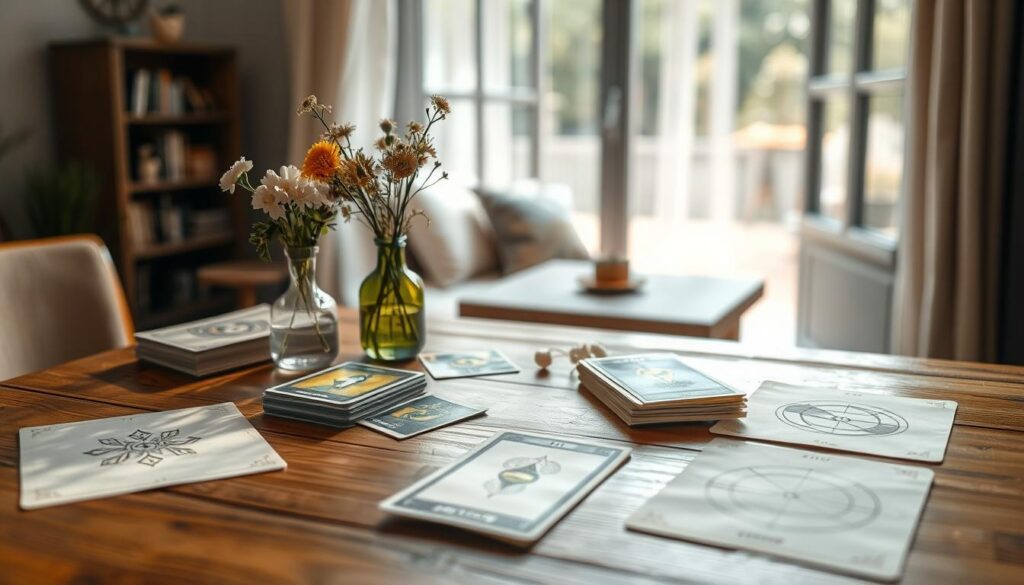
Single-Card Draw for Daily Guidance
Shuffle mindfully and ask a focused question, then draw one card. Jot a short note about first impressions.
During the day, watch where that meaning shows up. End with a quick action: one small step you can take based on the pull.
Three-Card Spread: Past, Present, Future
The classic layout reads left→right: Past, Present, Future. Use it for quick clarity on a situation.
Alternate order: Situation — Challenge — Advice. This version fits problem-solving or decision work.
“Three cards give a clear story arc without overwhelming detail.”
Five-Card Spread for Deeper Clarity
Try a simple five: Situation, Root Cause, Advice, Likely Outcome, What to Embrace/Release.
Keep positions plain and actionable so the reading leads to steps you can test in real life.
Step-by-step flow:
- Ask a clear question.
- Shuffle and breathe.
- Lay cards in order and scan suits/elements.
- Note any majors; they shift tone toward life themes.
- Synthesize a short story and choose one practical next action.
| Spread | Use | Best for | Quick tip |
|---|---|---|---|
| Single-card | Daily guidance | Quick clarity | Journal one sentence |
| Three-card | Context & timing | Past/Present/Future or S/P/A | Use majors-only for big pivots |
| Five-card | Deeper clarity | Root causes and action | Keep positions simple |
Timing tip: avoid fixed dates. Look for momentum indicators (wands, eights) or delays (reversed sevens/fours) instead.
Ethical note: frame questions around influence and choices, not other people’s secrets.
Practice plan: read for yourself three times a week, then for a friend. For focused study try the Five of Cups study to see how pattern work builds meaning and confidence.
Reading Tarot for Love, Money, and Self-Growth
Ask a clear question and let pulls point to practical steps for heart, work, or personal change. A reading should guide action, not create worry.
Relationships and The Lovers
The Lovers often signals values alignment and mutual choice, not just romance. Use it to surface honest dialogue, shared goals, and where trust needs repair.
Try a quick check-in spread: You, Them, The Bridge, The Challenge, The Choice. If lovers appears, use it as the bridge theme.
Money, Business, and Pentacles Energy
Pentacles pulls translate into steps: budget tweaks, salary conversations, or a small experiment to test a new revenue stream.
For business questions, watch Pentacles + Wands combos and turn meaning into metrics or process changes. See an example study in the Ace of Pentacles study.
Creativity, Passion, and Wands Themes
Wands points to where passion wants expression. If stuck, pull a wand and ask, “What small, brave step can I take this week?”
Include Swords when communication matters—clear, kind language often resolves conflict and restores momentum.
“Frame self-growth as integration across feeling, thought, action, and resources.”

Choosing Your First Deck: Ordering, Style, and What to Expect
Picking your first deck is like choosing a study partner—look for a voice that invites you to practice.
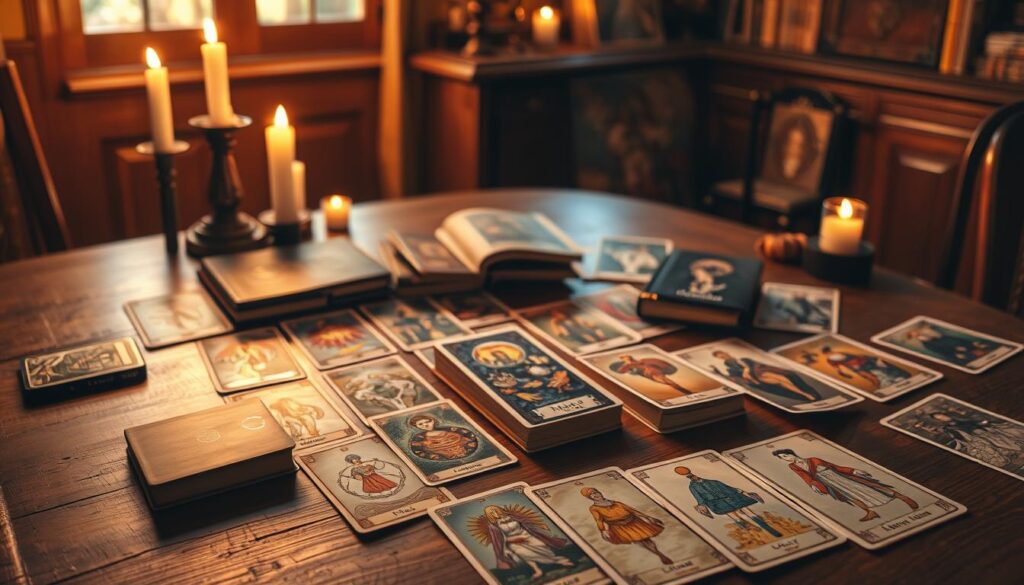
Two lineages stand out: Rider‑Waite‑Smith offers fully illustrated minors that help beginners tell stories. Tarot de Marseille uses pip-style minors that highlight numbers and suit structure for pattern study.
Rider‑Waite‑Smith, Marseille, and Modern Takes
Some historical decks shift trump names or the order of certain cards. That won’t break learning—stick with one system at first to build confidence.
Practical buying tips: check cardstock, size, and how clear the imagery is. Handle decks in a local store if you can, or ask for close-up photos when ordering online.
- Match the deck to your learning style: visual/story-driven or numeric/structural.
- Pair a deck with a good companion book or a clear page guide to deepen context.
- Support ethical producers when possible and store your deck in a pouch for security.
“Try a simple deck interview: Strengths, Challenges, How it wants to work with me.”
Learn Tarot Faster: Books, Journaling, and Community
Make study practical and repeatable. Start with one clear habit: a short, daily page that pairs a single card with a prompt, affirmation, and one small action you can do that day.

Card-by-Card Study, Prompts, and Affirmations
Build a card-by-card plan: one new card per day or week. Write a concise prompt, a one-line affirmation, and a tiny task that embodies the meaning.
Use a dedicated notebook or a digital page template to record upright and reversed notes, personal symbols, and short examples from real life.
Curate a short reading list that matches your deck lineage—visual guides for illustrated decks, structural workbooks for pip-style decks. A focused Four of Cups study is an example of targeted practice.
Practice Readings and Ethical Expectations
Practice live with friends using clear boundaries: set the question, limit time, and ask consent. Offer short, scoped readings and note what landed and why.
Set ethical expectations: protect privacy, avoid giving medical, legal, or financial directives, and encourage the seeker’s agency. Treat interpretations as guidance, not orders.
“Small, steady practice plus community feedback accelerates learning and deepens meaning.”
- Review monthly to spot recurring themes and plan targeted study sessions.
- Join a supportive community to swap readings, ask questions, and refine phrasing.
- Celebrate small wins—clearer interpretations and kinder boundaries are progress.
Tarot Do’s and Don’ts for Clear, Compassionate Readings
Compassion and clarity are the two habits that make interpretations useful. Start every session by naming consent, scope, and time. This keeps the seeker safe and the spread focused.
Do ask empowering questions and present meaning as choices, not fate. Offer one practical next step so the reading leads to action.
Do set the container: confirm consent, limits, and what you will not read. Respect privacy and avoid third-party probing.

- Ground yourself and the seeker; slow the pace if nerves rise.
- Acknowledge limits—refer legal or medical matters to professionals.
- Watch for control dynamics and repeated lack signals (reversals, suit shadows).
“Readings work best when they increase agency, not fear.”
| Do | Don’t | Why | Quick fix |
|---|---|---|---|
| Ask empowering questions | Make absolute predictions | Preserves seeker agency | Reframe as options |
| Set consent and scope | Probe third parties | Respects privacy and ethics | Use a short consent script |
| Translate meaning into one next step | Overwhelm with details | Action beats confusion | Offer a single, testable task |
| Note suit shadows (Wands, Cups, Swords, Pentacles) | Use fear or mystique to control | Builds trust and clarity | Call out patterns gently |
End each reading by summarizing insights and confirming one follow-up step. Invite a short self-check later so the seeker can reflect and report back. That final integration turns insight into change.
Conclusion
This guide closes with a simple idea: practice turns meaning into momentum.
From the Fool’s first step to The World’s sense of integration, you now have a clear way to approach structure, suits, and spreads with confidence. Use the simple loop: pull, observe, reflect, act, so meaning grows into habit.
Choose one deck and work it steadily. Pair short daily pulls with a journal check each month to track patterns and celebrate progress.
Keep elemental anchors—Fire, Water, Air, Earth—visible as you read. Stay values-first: align relationships, money, creativity, and material wellbeing with what matters most.
Top next step: do a single-card draw for two weeks, then add a three-card spread to plan your week. Practice with kindness: respect privacy, avoid absolutes, and keep agency at the center.
FAQ
What should a beginner focus on first when learning card reading?
Start with the deck structure: learn the major and minor arcana, the four suits, and court roles. Practice simple spreads like a single-card draw and the three-card past-present-future. Keep a journal to record meanings and patterns so your intuition builds alongside knowledge.
How do the Major Arcana differ from the Minor Arcana?
The Major Arcana reflect big life lessons and milestones, while the Minor Arcana describe daily events, choices, and personality dynamics. Majors often point to long-term themes; minors show the practical steps and smaller energies shaping a situation.
What is the Fool’s role in the 22 trumps?
The Fool represents beginnings, risk, and potential. Appearing at zero or as the unnumbered card, it marks the start of a journey through the other trumps — an invitation to grow, learn, and embrace change.
Do I need to use reversals when interpreting cards?
Reversals are optional. They can add nuance, signaling internalized energy, delays, or blocked expression. If reversals confuse you, skip them and focus on positional meaning and card relationships until you feel comfortable adding that layer.
How should I choose my first deck and where can I buy one?
Pick a deck whose imagery resonates with you. Rider-Waite-Smith variations suit beginners because of clear symbolism. You can buy decks from independent bookstores, metaphysical shops, or reputable online sellers like Barnes & Noble and Etsy for artisan decks.
What are easy spreads for learning and daily practice?
Use single-card draws for daily guidance, a three-card spread for past-present-future or situation-advice-outcome, and a five-card spread for deeper clarity. Start simple and repeat the same spreads to build pattern recognition.
How do suits like Wands, Cups, Swords, and Pentacles translate to real-life topics?
Wands link to creativity, work, and action; Cups to feelings, relationships, and intuition; Swords to thought, communication, and conflict; Pentacles to money, health, and material security. Think of them as lenses for different life areas.
What are court cards and how do I read them?
Court cards represent people, roles, or personality energies. Pages often signal messages or beginnings, Knights action or pursuit, Queens emotional mastery, and Kings leadership or control. Combine costume, posture, and surrounding cards to refine meaning.
Can readings help with love, money, and career decisions?
Yes. A focused spread clarifies feelings, resources, and next steps. For relationships, look at Cups and relevant court cards; for finances and career, watch Pentacles and Wands. Use readings as guidance, not absolute answers.
How do I improve interpretation skills faster?
Study card-by-card, use prompts and affirmations, and join a community for feedback. Read works by trusted authors like Rachel Pollack or Mary K. Greer, and practice daily with journaling and mock readings to build confidence.
Are there ethical rules for giving readings to others?
Yes. Get consent, be clear about your role, avoid medical or legal predictions, respect privacy, and offer compassionate guidance. If a client needs professional help, suggest appropriate resources instead of definitive answers.
What if I don’t feel intuitive — can I still learn?
Absolutely. Intuition grows with practice. Start with learned meanings and structure, then add personal impressions. Regular study, journaling, and repetition build the intuitive layer over time.
Should I cleanse or charge my deck, and how?
Many readers prefer simple rituals like moonlight, a brief smudging with sage, or keeping the deck in a special cloth or box. Choose a method that feels respectful; the main goal is to set clear intention before readings.
Where can I find quality learning materials and community?
Look for books by Mary K. Greer, Rachel Pollack, and Juliet Sharman-Burke. Online forums, local meetup groups, and workshops at bookstores or spiritual centers provide practice and feedback. Journals and study groups accelerate progress.